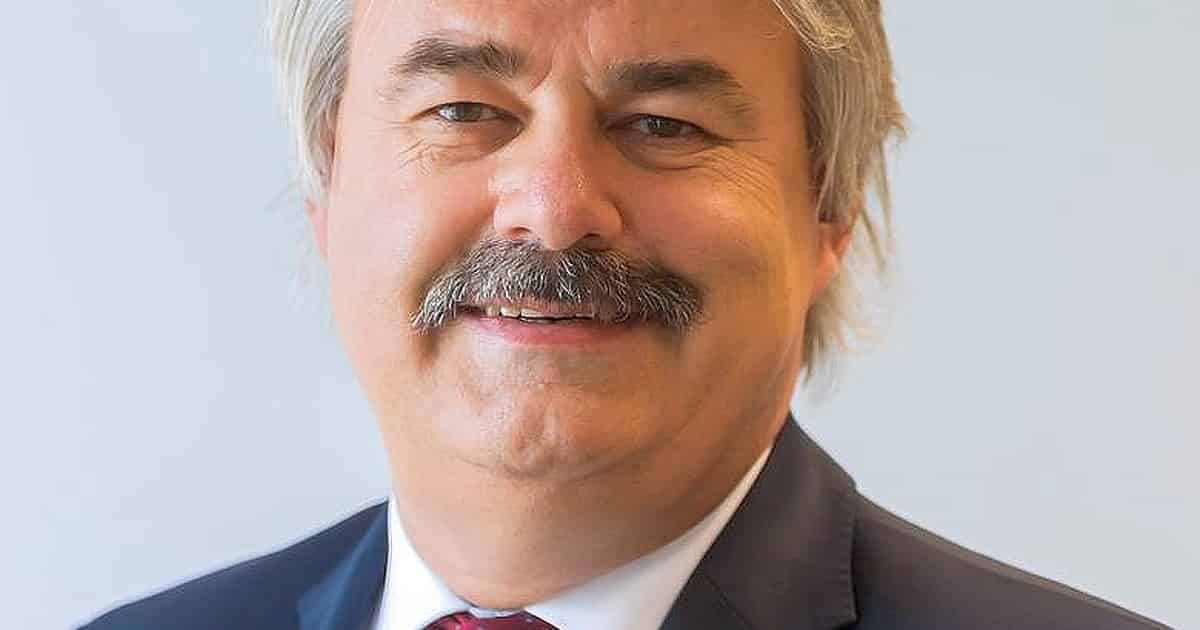
With a post on the X platform, the Leipzig law professor Tim Drygala sparked debates. “What do gay people and Kurds have in common? They have a flag, but no land to explain it,” he wrote on March 12.
The post drew mixed reactions on social networks. While some users categorized the statement as demeaning toward gay people, others saw it as a provocative sharpened point or irony.
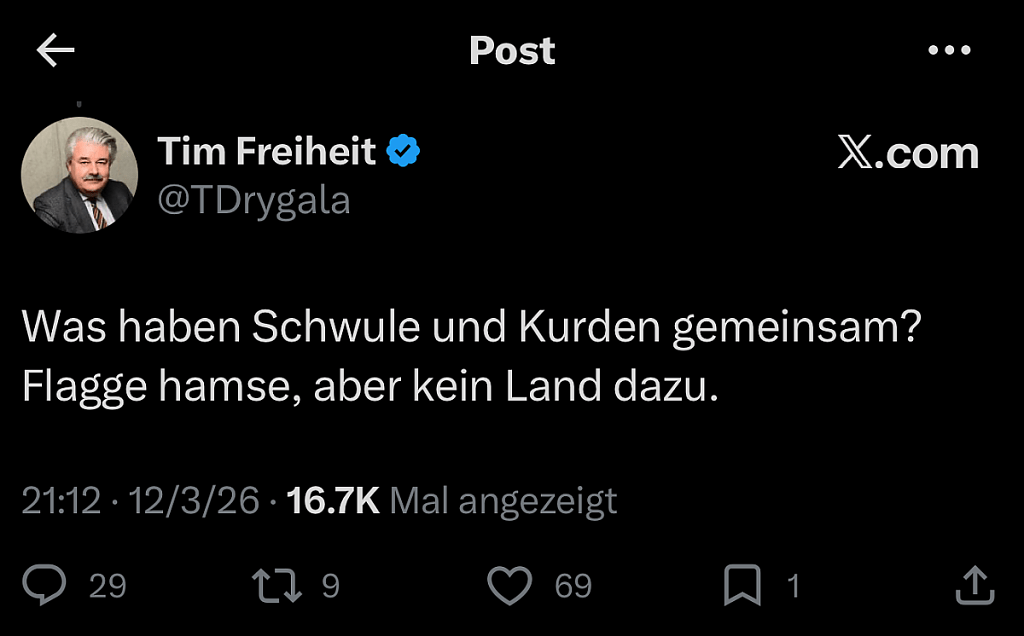
Upon request, Drygala confirmed to TheColu.mn that he authored the post. “I wrote that.” At the same time, he defended his statement and rejected the criticism.
“On the surface correct, but not underneath”
According to the university professor, the remark was intended as irony. The starting point was the different function of flags, which can express identity as well as political or national claims.
“If I say both groups have a flag, but no country, that is superficially correct, but not underneath,” Drygala said. Gay people do not seek their own territorial state. With Kurdish movements, this is sometimes different.
From this contrast, he says, the irony of the remark arises. At the same time, the professor concedes that this irony “is not visible at first glance.”
According to him, the post emerged during an online debate. Another user had accused him that his posts were “boring.” In response, he chose a topic that — as he explains — typically garners more attention. He had “written something about minorities.”
“I’m not sure why that should be considered demeaning”
The accusation that his statement could devalue gay men, Drygala rejects. “I’m not sure why the statement […] could be perceived as demeaning,” he explained. He characterizes the criticism as an “overwhelming misinterpretation.”
A distancing from the statement, he says, did not occur. “I always consider my posts to be very appropriate.”
Drygala also references freedom of expression under Article 5 of the Basic Law. It is limited only by general laws. “What is not prohibited is allowed.”
He describes his account as privately run. He does not connect it to his work at the University of Leipzig, according to his own statements.
University of Leipzig stays silent
The University of Leipzig does not publicly evaluate the specific post. A spokesperson told TheColu.mn that statements on private social-media accounts are “not to be prevented” and would generally not be judged.
At the same time, the university concedes that such statements “reflect on the university and can harm its reputation.” Internally, discussions were held to raise awareness of “moderation, appropriate conduct in office, and non-discrimination.” “Discrimination, exclusion, or even hate speech have no place with us,” it says.
The queer community needs a strong journalistic voice — especially now. Do your part to support TheColu.mn’s work.
Ministry emphasizes responsibility in public service
The Saxon State Ministry for Science, Culture and Tourism said in response to inquiries that private remarks are generally not publicly evaluated. In this specific case, however, the ministry “clearly distanced itself from the published content.”
It also notes a special responsibility for public-sector employees. Where the boundary between private opinion and official duties lies must be assessed on a case-by-case basis.
Controversy over X post about Heidi Reichinnek
Last year Drygala had already sparked an uproar with an X post. In reference to a photo of his refrigerator with a pinned portrait of Left Party politician Heidi Reichinnek, he wrote that the photo served as a reminder to close the door with a punch. Reichinnek filed a police report. In January 2026, the Leipzig public prosecutor’s office dropped the investigation for lack of sufficient evidence.
Tim Drygala himself is a founding member and an executive board member of the association and the party of the same name, Team Freiheit (Team Freedom), founded by former AfD chair Frauke Petry.