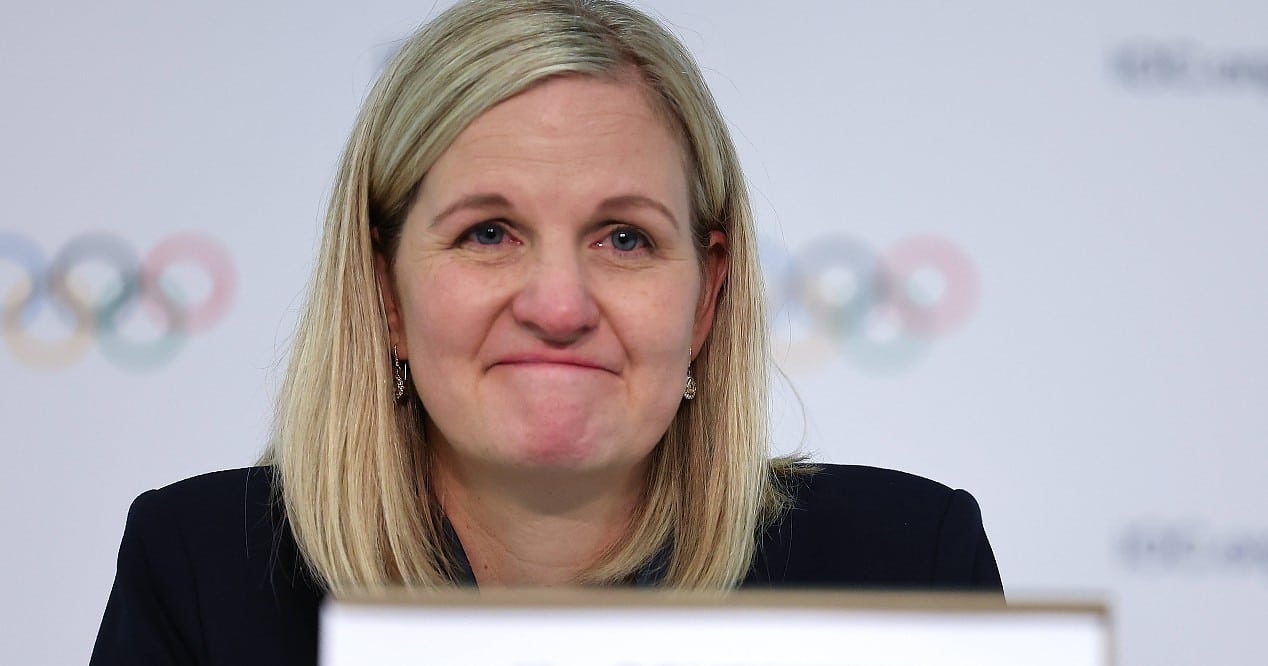
All athletes should, in the IOC’s view, undergo gender tests in order to participate in international women’s competitions. Trans women will be categorically barred from starting in the women’s category in the future, the IOC announced. The new guideline is the result of a working group on the “Protection of the Women’s Category” that IOC President Kirsty Coventry convened.
The push for a tougher policy by the Olympic umbrella organization was sparked by the uproar surrounding women’s boxing at the Paris 2024 Olympics. At the heart of the gender debate were Olympic champions Imane Khelif and Lin Yu-ting. Both had previously been excluded from the World Boxing Championships by the Russian-controlled world federation IBA, reportedly because they did not meet participation criteria based on a gender test that was not explained in detail — but no evidence was ever produced. At the Olympics, however, they were allowed to compete. The then-IOC president Thomas Bach said, referring to the rules at the time: “There was never any doubt that they were women.” Khelif has since emphasized: “I am not transgender, I am a girl.”
Test must be done only once
Khelif had already announced before the IOC’s new regulation that she would undergo a gender test ahead of the 2028 Los Angeles Games (TheColu.mn reported). According to the new IOC guideline, athletes must only take the test once, provided there are no doubts about the result. After that, they are permanently eligible to compete, it said.
Most recently in Italy, the Swedish freestyle moguls skier Elis Lundholm—openly living as a transgender man—took part in the Winter Games in the women’s division, the first openly transgender man to do so. At birth he was assigned female; for many years he has identified as a man. He had not changed his legal gender marker, nor undergone gender-affirming medical treatment. As a result, he was nominated by the Swedish federation for the women’s team, and the IOC allowed his participation.
Case of Caster Semenya sparked controversy
In track and field, the Semenya case has recently caused a stir. The three-time world champion resisted hormone treatment to lower her natural testosterone levels before competitions, insisting time and again that she is a woman. According to her autobiography, she has no uterus and no fallopian tube.
In response to the debates, at last year’s world championships in boxing in Liverpool and in athletics in Tokyo, only athletes in the women’s category who underwent a so-called SRY test to determine biological sex and who produced a “female” result were allowed to compete. The test looks for a gene on the Y chromosome that is decisive for the development of male sexual characteristics. The test can be performed with a cheek swab or a blood sample, but it is preceded by a lengthy counseling session. Among the athletes, opinions about the process are divided, and many German athletes have spoken out critically. A large coalition of human rights organizations had previously urged the IOC not to put the rule into effect.
The critics argue that the tests violate privacy. Focusing solely on biological characteristics fails to reflect the complexity of gender identity. “Gender-specific checks and exclusion harm all women and girls and undermine the very dignity and fairness that the IOC claims to stand for,” said Andrea Flores, director of Sport & Rights Alliance.
Trump puts pressure on the IOC
There has long been a history of gender testing in Olympic sport. Before the 1968 Olympic Games, the IOC introduced chromosomal swab tests to determine sex. After problems and resistance, the IOC discontinued universal testing in 1999.
Coventry, the first woman to lead the IOC, had already signaled during her campaign that protecting the women’s category would be a central issue — effectively pushing transgender women out of sport. Additional pressure came from U.S. President Donald Trump, who, amid the debate over Khelif, pledged to “keep men out of women’s sports.” Earlier last year, Trump signed an executive order excluding transgender people from participation in women’s sports (TheColu.mn reported). The Republican is set to host the 2028 Summer Games in Los Angeles.
Scientific studies to date, however, generally indicate that transgender women do not have a blanket advantage over cisgender women (TheColu.mn reported). (dpa/cw)