In art, lesbians, gays, bisexuals, transgender and intersex people and their life worlds have throughout centuries been depicted with an exceedingly variable degree of visual presence and visibility. Depending on morals, on criminal prosecution and censorship, but also on the intended audience of art—i.e., for whom it was created—the clarity of what is depicted varied substantially. The pressure to remain hidden, to deny oneself, and to conceal meant that “proofs” of queerness, even in visual form, were either destroyed or wrapped in codes and deliberately constructed interpretive patterns. In earlier centuries’ art it is therefore necessary to decipher the visual artworks, to interpret their signs within the picture compositions.
Until October 26, 2025, the exhibition “Wish you were queer. Un-Sichtbarkeit von LSBTI* in Kunst und Geschichte” at the Museum im Prediger in Schwäbisch Gmünd places LGBTQI* self-image, perception, and life worlds in focus. This is the occasion to recount the development of LGBTQI* invisibility in art, incorporating major works from the show in a series of articles. Through an exemplary discussion of four to six artworks across historical epochs, a chronological sweep through the centuries emerges.
Christian Schad, “Citizen’s Casino” for the “Guide Through Debauched Berlin”
The drawing served as the template for one of ten illustrations that the renowned New Objectivity artist Christian Schad created for the 1931 booklet “Führer durch das lasterhafte Berlin” by Curt Moreck. It shows a view into the “Citizen’s Casino,” a gay venue on Berlin’s Friedrichstraße that had been in operation since 1925.
In the foreground, a male couple embraces, while other patrons can be found in the compartments. The interior design features wooden lattice walls, artificial grapevines, and lanterns reminiscent of a wine tavern. In the background, a sailor stands in an open door, and there’s a boat visible behind him, perhaps part of the room’s decor.
All ten Schad illustrations offer a highly revealing visual glimpse into Berlin’s queer nightlife—during a period of relative liberalism in the Weimar Republic. Because the volume was available nationwide in bookstores, the capital’s self-assured queer scene could be perceived in the provinces and thus could serve as a form of identity-affirmation. It certainly benefited those who traveled from the regions to Berlin and carried the book with them as a kind of travel guide.
Jeanne Mammen, “Eifersucht” from the “Bilitis-Zyklus”
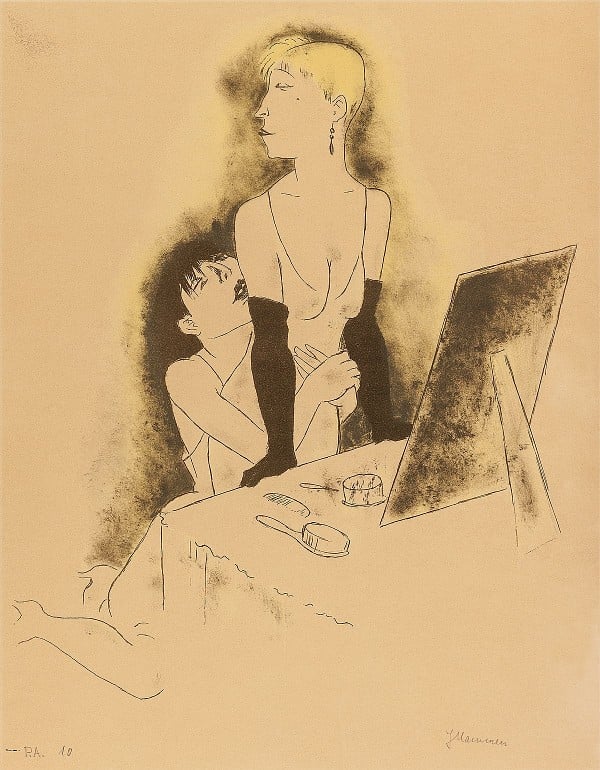
In 1930 Jeanne Mammen created, at the commission of Berlin gallery owner Wolfgang Gurlitt, the preparatory drawings for the color lithographs of a German-language edition of “Lieder der Bilitis” (Songs of Bilitis). Of the lithographs realized from Mammen’s drawings, only proofs survive; the planned edition never appeared, and Nazi rise to power in 1933 prevented the lavish new edition with Mammen’s scene compositions.
The Songs of Bilitis is a collection of largely lesbian poems by the French poet Pierre Louÿs (1870–1925), renowned for its delicate erotics, first published in Paris in 1894. Louÿs claimed to have purportedly translated newly discovered poems of an ancient poetess named Bilitis from ancient Greek into French, which makes this work a pseudotranslation. The unknown poet Bilitis, whom Louÿs places in the circle of Sappho, likely never existed. The poems are divided into three sections, each representing a phase of Bilitis’ life.
One of the scenes Mammen planned for the color lithographs is devoted to jealousy. In art, this remarkable composition stands as the first known dramatic interaction of jealousy between a conventional (non-divine or non-mythological) same-sex couple. A kneeling woman restrains the other from leaving, and in the gesture of grasping, Mammen conveys the insecurity and fear of loss that characterize this painful emotion.
Herbert Rolf Schlegel, Portrait of W. K.
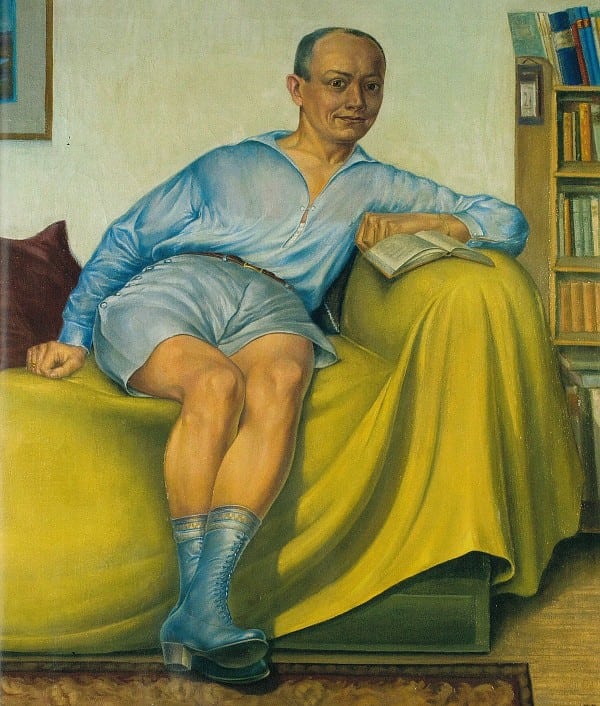
Herbert Rolf Schlegel hailed from Breslau. His artistic training included studies in Düsseldorf and Kassel. He was a proponent of the Romantic rendition of the New Objectivity. His portrait shows W. K. from Cologne, a writer and translator. W. K. enjoyed dressing in women’s clothing and, at least in private, wearing corresponding footwear. The artist depicts W. K. in this manner, likely around 1930. In expression and gesture, the subject appears exceptionally happy, radiating a self-confident sense of worth.
The painting, signed bottom-right, is one of the earliest examples in which Dress Crossing—the fetishization of wearing women’s clothing—appears inpainted; it is no accident that this occurred precisely in the liberal Weimar Republic, Germany’s first genuinely democratic era.
In the background, a bookshelf hints at the subject’s passion for literature. According to oral tradition, W. K. owned an extensive library of queer fiction. Some of the volumes are now in the collection of the Schwules Museum Berlin, which also houses another transvestite portrait by Schlegel of an unknown subject, signed by the artist.
Lotte Laserstein, Back Nude (Madeleine)
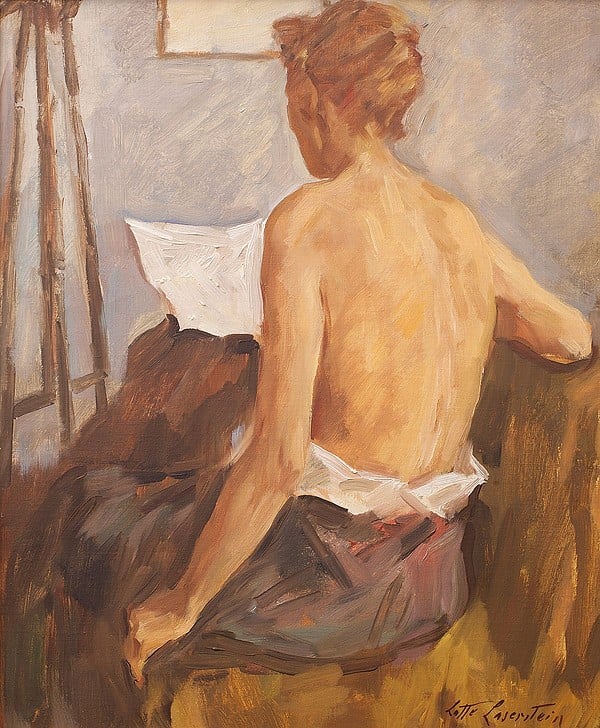
The oil painting titled “Back Nude (Madeleine)” is one of the preparatory studies Laserstein produced for the today-lost painting “Malerin und Modell” (Painter and Model) from 1956, known today only through photographs. As one of the first female graduates of the Berlin University of the Arts, she completed her painting studies in 1927 with honors. It wasn’t until 1919 that women in Germany were allowed to study at the academy. Double portraits of the artist and the model—as yet in preparation—are characteristic of Laserstein, as is the subject of female nude figures, which was then considered rare among her male peers.
Her favored model was her longtime friend Traute Rose, whom she had met in 1925, and it is generally believed that they shared a lesbian relationship. While concrete documents explicitly naming the artist’s orientation are lacking (as is often the case in times of homophobic climates), the works themselves clearly convey deep affection and same-sex desire.
The “Back Nude” of Madeleine was created in Sweden. As a Jewish artist persecuted in Nazi Germany, Laserstein left her homeland in the winter of 1937 and emigrated to Stockholm. There she met in the war’s first year the economist Margarete Jaraczewski, nicknamed Madeleine, who served as the model: reading a letter while seated with her upper body bare on a sofa, supporting herself with her right arm. Her red hair is pinned up, allowing a clear view of the woman’s back. With a delicate brushstroke and restrained tones, Laserstein renders the model’s presence with particular sensuality.
Jürgen Wittdorf, Group with Bicycles
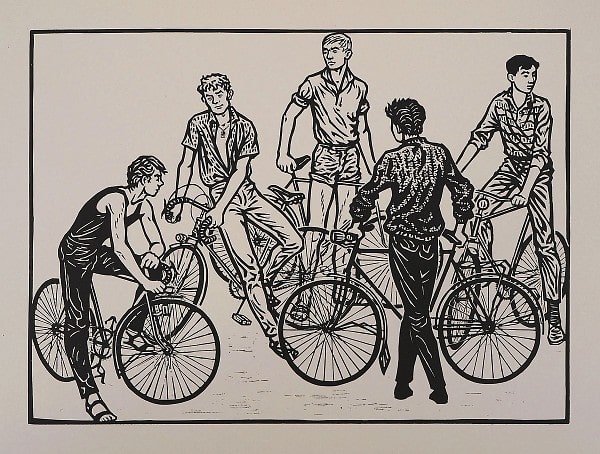
With his woodcut cycle “Für die Jugend” (For the Youth) created between 1960 and 1962, the artist Jürgen Wittdorf produced a homoerotic work that stands out as unique in East German art. It embodies the private passion of the printmaker. Composed in a painful phase of coming to terms with his own homosexuality and before his actual coming out, the intensity of the images and preliminary drawings rests on Wittdorf’s erotic fascination with the male body, which found its outlet solely in art.
One of the cycle sheets, Group with Bicycles from 1961, shows five young men standing in a circle, leaning on or against their bicycles. The male poses and clothing styles are subtly differentiated. There are glances that touch another rider, but none are returned.
This seemingly incidental arrangement was deliberately constructed by Wittdorf. Although the group is tightly clustered, there is intentionally no contact. The need for group belonging and the simultaneous loneliness of the individuals are conveyed in a subtle yet obvious way.
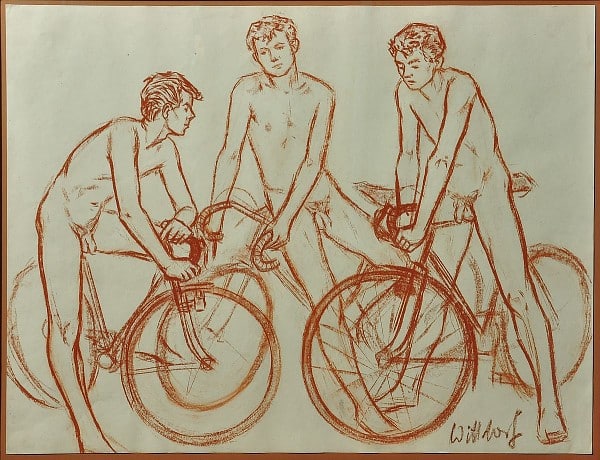
In his preparatory drawings, Wittdorf had the models depicted completely nude on and around their bicycles. This underscores the homoerotic dimension of his work. The study shows three young men with road bikes in various poses and angles. It is an unusual sight to encounter fully naked people on their bikes in everyday life or vacation by the Baltic Sea. All body parts, including genitals with pubic hair, are drawn in meticulous detail. Nothing is left uncertain; the drawing reveals, in its compression, some of the feelings Wittdorf kept hidden before his coming out. Of course, public works by an artist in the former East Germany could not display explicit nudity, so in the later woodcuts he omitted the erotic nudity by dressing the two left figures in clothes.
Nevertheless, the drawing remains a vivid example of the artist’s repressed yet sublimated longing. In winter 1962/63, the woodcut was presented together with other sheets from the cycle “An die Jugend” at the German Art Exhibition in Dresden’s Albertinum. The Free German Youth (FDJ) awarded Wittdorf their Art Prize in January 1963, and the cycle appeared the same year as a portfolio in a run of 10,000 copies, with an official foreword by the FDJ.
On August 21 Dr. Martin Weinzettl will give a lecture at 6:30 p.m. at the Museum im Prediger in Schwäbisch Gmünd on the topic “Lifeblood of Water. The Bath as a Theme in Homoerotic Imagery from Albrecht Dürer to Today.”
And on September 12 there will be at 7:00 p.m. at the museum a panel on “Visibility of LGBTQI* in Contemporary Art” with Berlin painter Norbert Bisky, with Hannah Römer, artist and student at the State Academy of Fine Arts Stuttgart, and with Andreas Pucher from the Stuttgart gallery Thomas Fuchs.