An almost eight-meter-tall human figure rises above the Arsenale’s harbor basin in Venice. Where a face would normally appear, a tree takes root. Branches push out from the shoulders, flowers and leaves drape the skin, and birds perch in the crown: one of several poetic sculptures by American artist Nick Cave that are on view this year at the Venice Biennale. Human form, flora, and fauna blur into each other.
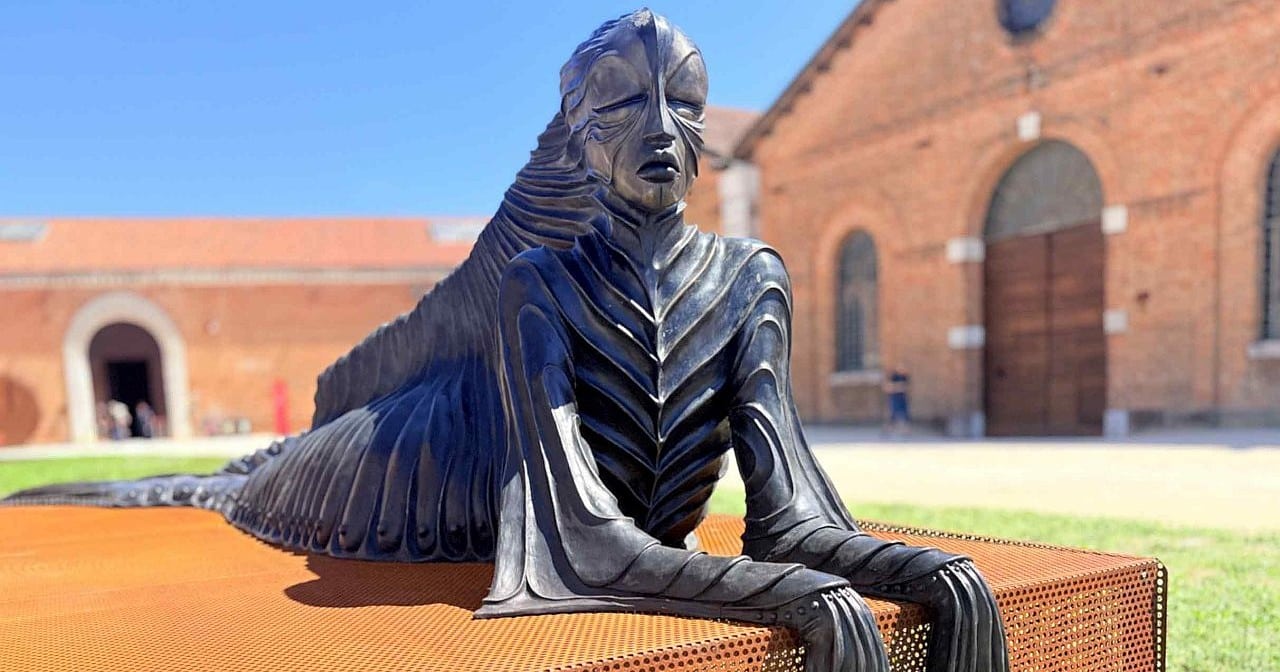
Cave is not alone with this artistic approach at the World Art Fair. Not even fifty meters away, Kenyan-American artist Wangechi Mutu presents in her bronze sculpture “SimbiSiren” a fish-like being with a human face, its scales wrapping the body like armor.
The Fluidity of Species
And Belgian artist Koen Vanmechelen, in a show staged parallel to the Biennale in an old Venetian palazzo titled “We Thought We Were Alone,” merges human beings with elements of reptiles, fish, and birds. Behind these fantastical bodies lies social critique: they question the idea of humans as a species superior to nature and instead sketch a world of interdependent relationships.
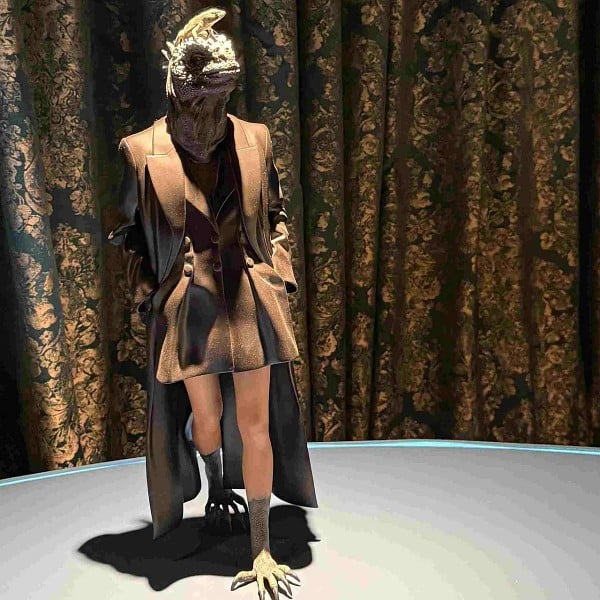
It seems as though the fluidity of genders now accompanies the fluidity of species. Since queer feminism and queer theory have challenged the notion of clearly separable genders since the 1990s, contemporary art is beginning to push the boundaries of species as well. While not identical in principle, both movements share a skepticism toward categories long considered natural and immutable. Humans, plants, and animals cease to exclude one another and can coexist in the same form at the same time.
Even Gods Change Their Form
That may sound esoteric, but it is also radical. Such beings, however, are not new at first glance. Merfolk, sirens, centaurs, or sphinxes have populated myths for thousands of years. In Greek mythology, the play with fixed bodily boundaries does not stop at such hybrids. There, even the gods change their shapes. For Zeus, this fluid transformation is tied to desire—and to violence.
Two of these myths associated with the king of the gods would centuries later prove significant for lesbian and gay cultural history: to win Callisto, Zeus assumes the form of the goddess Diana. The handsome Ganymede, he desires as a man, and according to tradition he abducts him in the form of an eagle.
Christianity also helped a hybrid creature gain popularity, which was later appropriated by queer culture: the unicorn. In the Middle Ages it became a symbol of purity and chastity and was meant to point toward Christ. Today it often glows in rainbow colors and is regarded as a queer pop symbol. This unique creature outside the natural order embodies a difference that is no longer a blemish but a special gift.
Comeback of the Mermaid
One of the most familiar figures from myth archives has been making a noticeable comeback in contemporary art in recent years: the mermaid. Its queer readability is not merely a modern invention. Hans Christian Andersen’s 1837 fairy tale “The Little Mermaid,” seen against the backdrop of his unfulfilled love for Edvard Collin, can also be read as a story of desire that has no room in its own world. The mermaid must forsake origin and body in order to come close to the beloved.
Almost seventy years later, Antonín Dvořák’s opera “Rusalka” tells a related story: here too a nixie desires a human and assumes a different physical form for this love. There, too, one can discern a queer experience: the wish to deny one’s own nature and to adapt to a foreign world in order to love and be loved.
Today the mermaid does not have to become human by necessity. The old deficit narrative has, in fact, flipped. What in Andersen and Dvořák appeared as a tragic deficiency—a body that must transform for the desired love—can become a distinctive quality in contemporary art. Precisely because the mermaid embodies both human and animal traits, she serves as a counterfigure to a world that seeks to clearly separate bodies, genders, and species.
The queer community needs a strong journalistic voice — especially now! Lend your support to secure TheColu.mn’s work.
The Body in Between
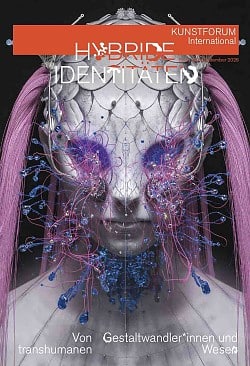
Art historian Jessica Ullrich dedicates an essay to this remarkable career in the current theme volume “Hybrid Identities” of “Kunstforum International,” titled “Queer Mermaid Figures.” She writes that the mermaid resists both binary subject positions and fixed species classifications. In contemporary art, one increasingly encounters her in forms that bear little resemblance to the traditional image of the beautiful, young, white woman with a fish tail and long hair.
A particularly dazzling variant, Ullrich notes, is the US trans artist Juliana Huxtable. In her self-portrayals, she appears as a mermaid or fantastical creature in which human and animal bodies blend. Not only do the boundaries between species blur, but those of gender and sexual identity do as well.
Ullrich sees these figures as queer counter-models to conventional ideas of what a human body should look like. For Huxtable, the mermaid no longer has to overcome her otherness. What in Andersen was an obstacle on the path to the coveted human world is here confidently displayed: the body in between.
The Price of Adaptation
How far the old tale of the necessary transformation still resonates is shown by another example Ullrich presents in her essay. In his video “Cambrian Explosion,” the Japanese artist Fuyuhiko Takata makes a mermaid dream of becoming a human. He violently splits her fish tail into two legs.
Direct link | “Cambrian Explosion” by Fuyuhiko Takata
|
Ullrich emphasizes the ambivalence of this transformation: it can be read as a self-determined intervention into one’s own body, but equally as self-mutilation. From the fairy-tale metamorphosis, a drastic physical process emerges—and from the desire to belong to the human world, a question about the price adaptation demands.
The Little Mermaid Man
A further shift can be seen in the mermaid’s gender. In Helsingør, the harbor north of Copenhagen, stands “Han” by Elmgreen & Dragset. The gay artist duo transferred the pose of the famous Little Mermaid onto an androgynous young man.
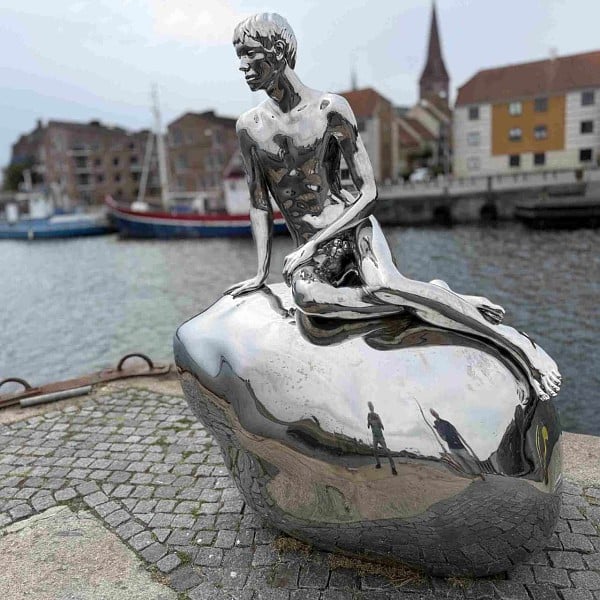
The title simply means “He” in Danish. The figure, crafted from polished stainless steel, sits like its female counterpart on a rock and gazes out over the water.
Elmgreen & Dragset thus transform a female national icon into her male counterpart—and in doing so, continue their queer cultural history.