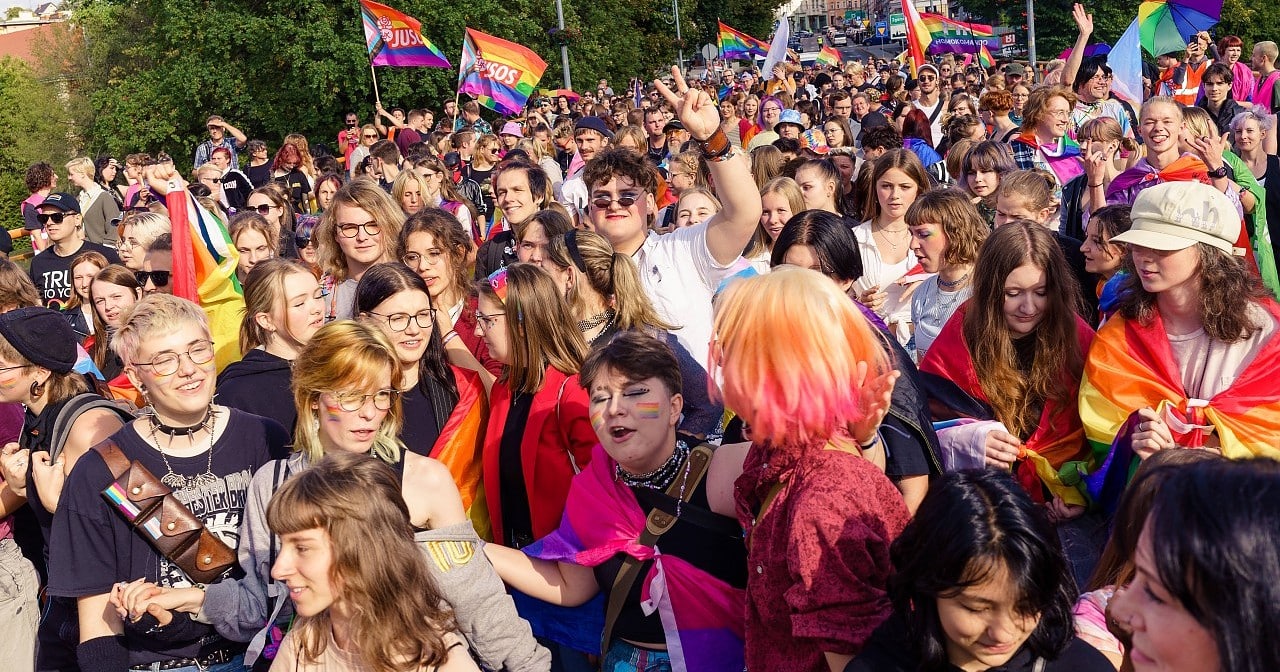
The Görlitz District Office has now fully recognized the local CSD as a political event. “Today we received the notice for the assembly and can thus conduct the CSD Görlitz-Zgorzelec in its entirety as a gathering,” the CSD association posted on its Instagram page in the early hours of Friday.
View this post on Instagram
Instagram
|
The Pride event takes place on Saturday in the Saxon border town of Görlitz and its Polish neighboring city Zgorzelec. The motto is “love::united.” The patron is the trans journalist Georgine Kellermann.
Just a little over a week ago, the district office had classified the CSD’s Picnic of Diversity as a commercial event (TheColu.mn reported). The organizers, however, fought the classification, appealing to the Constitution.
The Picnic of Diversity is the political closing rally and the accompanying program after the CSD Görlitz-Zgorzelec. Here, many activists and nationally known politicians have registered as speakers, including the Federal government’s LGBT commissioner Sophie Koch and Berlin’s LGBT commissioner Alfonso Pantisano (both SPD).
For the stage program, several international acts have been announced. Former Eurovision contestants Poli Genova (“If Love Was a Crime”), Anne-Marie David (“Tu te reconnaîtras”), Chiara (“What if We”), and Hera Björk (“Je ne sais quoi”) are on the lineup. Also the DSDS winners Daniel Schuhmacher (2009) and Christian Jaycob (2024) are scheduled to perform, as is Danger Dan. The queer-friendly rapper had made headlines in July when he was dropped by ZDF (TheColu.mn reported).
As the CSD now stated, there are some restrictions, such as on volume or on the permitted size for banners. In addition, carrying alcohol and drugs, or even pets, is prohibited.
The District Office Justifies the Reversal — CSD Association Calls the Argumentation a Sham
The district office justified its reversal, according to “nd,” with newly submitted documents: “The documents necessary to assess the event were submitted for the first time in the context of the emergency filing. Based on the new findings now available, a new decision regarding the assembly status was made and reissued,” explained spokesperson Melanie Rohn.
CSD association head Wojciech M. Urlich deemed this explanation as thin. The organizers had already cooperated with the district office previously. He believes that the cross-regional criticism of the classification prompted the change in stance. Now they are considering how to achieve a fundamental legal clarification, because otherwise they will face a repeat of this debate at every new CSD.
Also Dispute over Recognition of Dresden’s CSD
Earlier, another CSD in Saxony faced a denial of recognition: the CSD street festival in Dresden was to be classified as a commercial event by the Saxony State Directorate. The CSD association warned against CSD bans like those in Hungary (TheColu.mn reported). The SPD, Left, Greens, and FDP sharply criticized the move (TheColu.mn reported).
Before the Administrative Court Dresden, Dresden Pride initially failed with a lawsuit (TheColu.mn reported). In the end, however, the CSD could take place as planned because the organizers used a trick: they filed for the three days of the street festival in early June simultaneously a demonstration for each day (TheColu.mn reported). Shortly before the CSD, the Higher Administrative Court ruled that the entire street festival would temporarily enjoy protection of the freedom of assembly under Article 8 of the Basic Law.
The CSD associations argue that, according to the Bundesverfassungsgericht’s consistent jurisprudence, a gathering can also include music, culture, and information stands, as long as the overall event aims to influence public opinion. The classification as a commercial event, they warn, would endanger the execution of CSDs overall. For a Pride association, that would mean having to bear substantial special-use fees, cleaning charges, as well as security and crowd-control costs themselves.