To reinvent oneself and publicly stage one’s own life is regarded as a phenomenon of our time. The home is no longer merely a dwelling but a stage, furnished with the right furniture and inhabited with the corresponding attitude. Likewise, clothing, travel, and photographs have become parts of a carefully composed self-presentation. All of this comes together to form an image that aims less to depict daily life than to forge a personality.
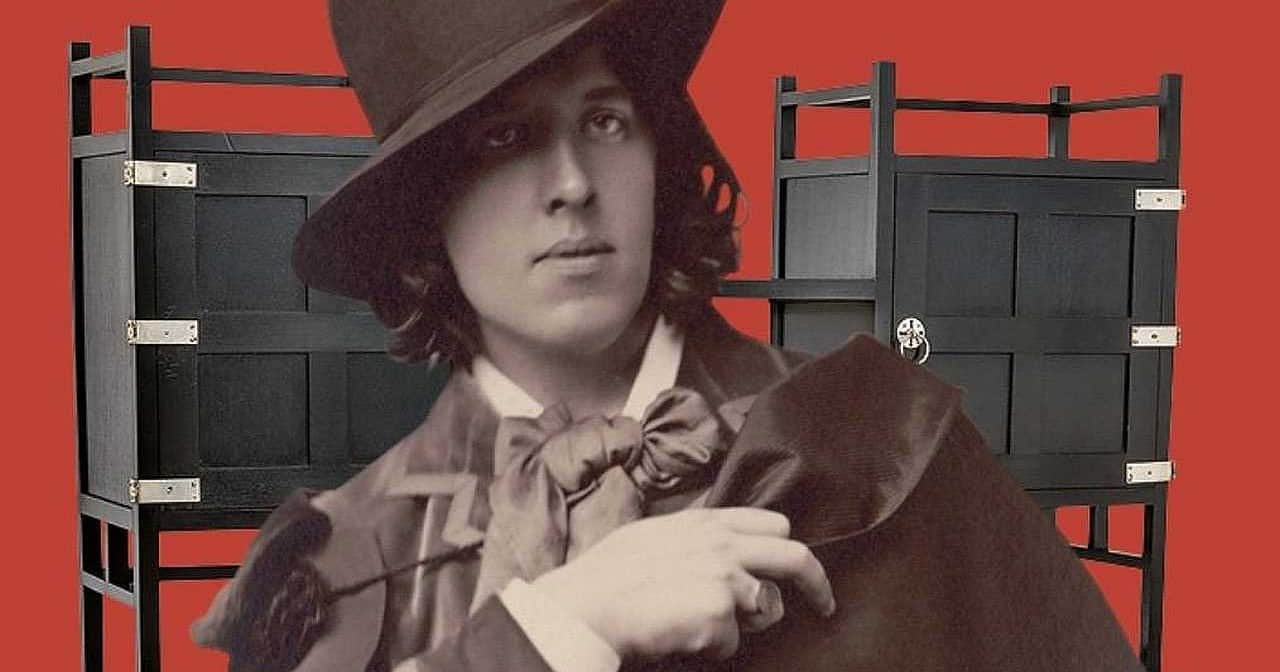
What today reads as the logic of social media was already foreshadowed at the end of the 19th century by Oscar Wilde. One of his most famous quotes reads: “One should either be a work of art or at least wear one.” Wilde not only made a name for himself with his literary work, but also for portraits in which he posed in extravagant capes. Few have embodied the ideal of stylizing one’s own life as consistently as he.
Vorreiter der “Ästhetischen Bewegung”
With this, Wilde became worldwide the archetypal figure of eccentric self-presentation—and a projection surface for anxieties and fantasies about what place a homosexual man could and should occupy in society. For in Victorian England, the cult of beauty for Oscar Wilde was not merely a question of “lifestyle” or vanity, but an existential form of self-assertion—a response to a society that not only disapproved of but criminalized his same-sex desire.
Wilde became the leading representative of the “Aesthetic Movement,” and aesthetics, in this sense, was a language of indirectness. In it, many gay men saw a way to hint at their same-sex desires—and perhaps even to develop a form of collective identity: something that publicly could neither be spoken nor negotiated. The green carnation on the lapel, the wearing of a particular tie, or idiosyncratic views on everyday life and art became signs of belonging that could not be openly named. “It grows harder to live up to my blue china every day,” Wilde once remarked.
Art as a Space of Freedom
For many gay men, the Aesthetic movement was far more than a matter of taste. It became a cultural technique through which they could express themselves and communicate with one another in a hostile environment. In Victorian times, references to the natural were used as a moral pressure tool to legitimate only the marriage between a man and a woman. Yet when the supposedly unnatural was set against homosexuality, art presents itself as a space of freedom. Against this backdrop, one of Oscar Wilde’s most eccentric aphorisms takes on a new meaning: “The first duty in life is to be as artificial as possible.”
How this claim manifested in daily life can be seen in the current exhibition “Edward W. Godwin and Oscar Wilde. Dandys Decadence Modern” at the Bröhan Museum in Berlin, on view until August 30, 2026. At the start of the exhibition route, Oscar Wilde greets visitors from large-format poster walls, adorned with aphorisms from his literary works.
“All art is at once surface and symbol,” is quoted, for example, from the preface to The Picture of Dorian Gray. “Those who venture beneath the surface do so at their own peril. Those who interpret the symbol do so at their own peril.” Hardly a sentence captures the essence of the Aesthetic Movement better—the surfaces were never merely decorative, but intended to be read as signs.
Wilde’s collaboration with Edward William Godwin
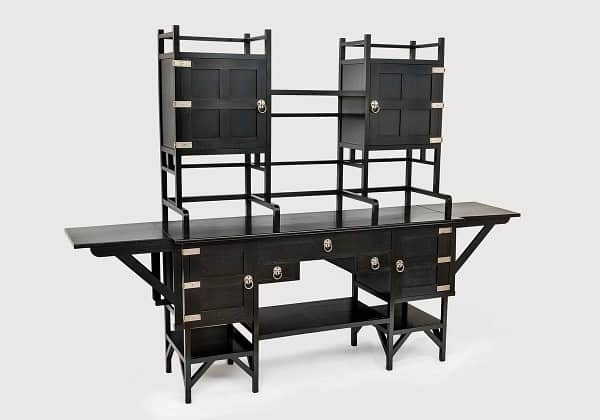
Yet the exhibition largely avoids interpretation and readings. It focuses primarily on the collaboration between Wilde and his designer and interior architect Edward William Godwin, the designer of Wilde’s house furnishings on Tite Street, which Wilde and his family inhabited. While Wilde worked on himself as a work of art, Godwin designed the stage on which his client could present himself—or in other words: while Wilde embodied the Aesthetic Movement, Godwin created the space for him.
Not by coincidence did Godwin establish a name for himself as a creator of stage sets and costumes in the theater world. Yet he became especially known for his designs influenced by Japanese models. They rejected decorative overload and relied on clean lines, simplicity, and minimalism: the beauty freed from all superfluous elements should permeate everyday life. In doing so, Godwin anticipated principles of design that would shape modernity in the decades to come.
A highlight in Oscar Wilde’s house was the dining room designed by Godwin. The walls, the floor, and the few pieces of furniture were almost entirely rendered in white tones. The guests found themselves both puzzled and fascinated. Such a break from Victorian design—with its dark woods, heavy textiles, and ornate abundance—appeared to them as an aesthetic shock. Rightly, this design is regarded as a precursor to modern interior design. The dining room marked the apex of their collaboration.
Direct link | Video tour of the exhibition
|
Homosexuals as the New Custodians of Taste
Wilde and Godwin were close friends. Their influence extended far beyond Victorian England—but in different directions. While Godwin’s designs pushed into architectural modernism, Wilde left his most significant legacy in another realm. Especially for later generations of homosexual men, he became a symbolic figure of an aesthetics that did not see posing, exaggeration, and artificiality as flaws but as a counter-movement to the supposedly natural.
When Susan Sontag published her Notes on Camp in 1964, she opened her essay with the dedication “To Oscar Wilde.” In it she recognized a central figure in whom that aesthetic stance she described as “Camp” had long since crystallized. For Sontag, gay men were not merely adherents of a particular style. She attributed to them a historical role: after the aristocracy as a cultural elite had vanished, she named homosexuals the new custodians of taste—a proposition that, viewed against Wilde’s biography and late-19th-century aesthetics, proves all the more persuasive.