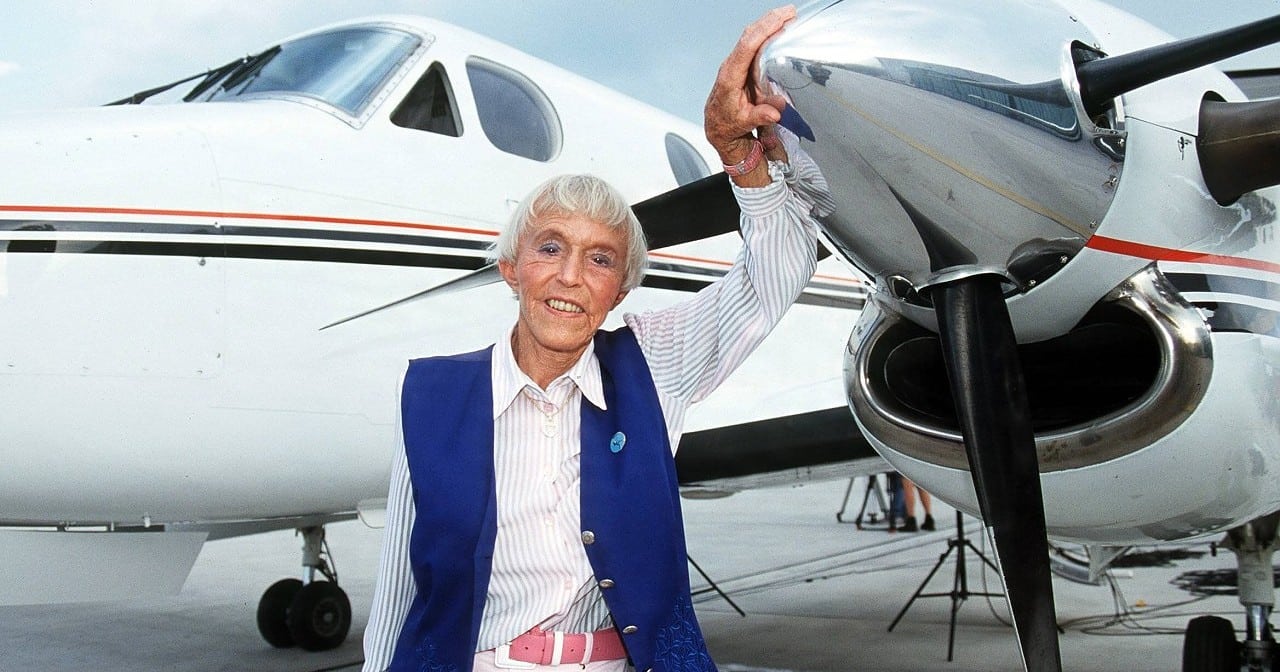
When people think of Beate Uhse (1919-2001), they often picture the shrewd businesswoman who built an erotic empire. Yet long before her name became a byword for sexual education, she stirred up attention in a very different arena: as a pilot.
Uhse was taught to be open-minded by her mother, one of Germany’s first female doctors. Her cosmopolitan upbringing was matched by equally progressive dreams: flying. After completing a domestic science apprenticeship, Beate Köstlin became the sole woman among about sixty flight students to earn her pilot’s license on her 18th birthday.
In the 1930s she worked as an aerobatic performer and stunt pilot for UFA. In 1939, the then-19-year-old married her former flight instructor, Hans-Jürgen Uhse, an aviation officer. Four years later their son Klaus was born. Soon after, her husband died in the war. By the end of the conflict, Beate Uhse had ferried fighter aircraft for the Luftwaffe from Berlin-Tempelhof to various theatres of operation. She would later speak very little about her role during the Nazi era, a reticence that drew repeated criticism over the years.
Mut aus der Not: die “Schrift X”
In 1945, the young widow fled with her small son and a plane to Schleswig-Holstein. After the war, she spent six weeks in British captivity. With flying now banned for Germans, she earned a living first as a teacher and then as a salesperson. It was during this period that she encountered many women who longed for more sexual freedom but feared an unwanted pregnancy.
Contraception was largely frowned upon, and comprehensive sexual education was taboo. In 1947, Uhse published the so-called “Schrift X,” a pamphlet in which she explained a contraception method based on the cycle calendar. More than 30,000 copies were sold. Also in 1947, she met Flensburg merchant Ernst-Walter “Ewe” Rotermund, whom she married two years later. They lived in Flensburg with his two children, Dirk and Bärbel, along with their shared son Ulrich.
Das “Fachgeschäft für Ehehygiene”
With the pamphlet, Uhse had spotted a market gap. She initially built a mail-order business for condoms and educational books. In 1962, she opened the world’s first sex shop in Flensburg. Because the word “Sex” was considered provocative in the era of postwar economic miracle Germany—where homosexuality was still persecuted under the Nazi-era Paragraph 175—she named the store the “Fachgeschäft für Ehehygiene” (Specialty Shop for Marital Hygiene). She also chose the opening date with care: a few days before Christmas. “People are all Christmas-peaceful then,” she explained later.
Yet success carried its own resistance. For decades she faced more than 2,000 advertisements and numerous lawsuits over alleged “indecency.” She repeatedly went to court, and through her litigation helped push forward Germany’s gradual liberalization of attitudes toward sexuality.
Keine Feministin oder Queer-Aktivistin, aber eine Wegbereiterin
Toward the end of her life, the initial rejection gradually gave way to recognition. Although she made contraception and sexual self-determination more accessible for many women—and even supplied gay men with dildos—her role within the women’s movement remains controversial. Her company’s entry into the pornography business drew sharp criticism. The feminist magazine Emma, now infamous for its stance on transgender issues, wrote in a profile: “Side by side she fights with the comrades. In the Nazi war as in the sex war. Yesterday with bombs. Today with porn.”
Nevertheless, in a time when women were often pushed into traditional roles, she forged her own path as a pilot, an entrepreneur, and the sole breadwinner. She acted as if there were no barriers based on gender—and by doing so, became a pioneer of a self-determined life for many women.
Her pioneering work also indirectly propelled the queer community forward. Her trailblazing efforts acted as a catalyst, tearing down social walls whose collapse ultimately benefited sexual minorities across the board. In postwar Germany, sexuality was legally and morally framed primarily as a means of procreation within marriage. Sex for pleasure was taboo. Uhse changed that. By dismantling the medieval dogma, she laid the groundwork for accepting sexuality that isn’t strictly reproductive. She also helped normalize sex toys.
For queer people in the countryside who could not easily reach urban sex shops, Uhse’s discreet mail-order service often offered the only safe, anonymous way to obtain lubricants, condoms, or sex toys. Packages arrived in a now-legendary brown cardboard box with no sender.
When Beate Uhse died on July 16, 2001, at the age of 81, she left behind a society that was far more open toward sexuality than at the start of her career—and a culture that felt safer and more welcoming, especially for queer individuals.
Ein Fest zum Abschied
Even in death, she shaped how she would be remembered. In her will she requested no traditional funeral, but “a joyful celebration with my favorite pieces of country and western music.” Beate Uhse AG fulfilled this wish: on August 3, 2001, a public farewell took place at the Deutsches Haus in Flensburg—the cradle of her enterprise—an event that felt more like a community festival than a quiet obituary.