Queer visibility in art is cruising at full speed right now—that’s my impression. Hardly has one exhibition been visited and checked off before an invitation to the next lands in the mail. I can’t comment on it any other way than with that famous postscript: and that’s a good thing. And even better—the fact that there is this queer boom in the art world, in galleries and museums, is matched by what they offer us in those spaces. The diversity we’re living is, in a sense, being translated aesthetically into its potential in these venues.
What’s equally fascinating is that we repeatedly dive into literal new worlds. Just recently it was Gabriele Stötzer with her queer-feminist art of boundary-crossing and subversive aesthetics under dictatorial conditions; now it’s the photographic works of Walter Schels at the C/O Berlin exhibition house, right beside Berlin’s Zoo Station.
Pride and Self-Confidence of Trans Youth
To be precise, I must correct myself: Schels isn’t really a queer photographer, except that he has always enjoyed roaming in aesthetic frontiers and experimenting in general, in order to craft auratic visual worlds with a favored black-and-white photography that often comes across as radical and provocative in content.
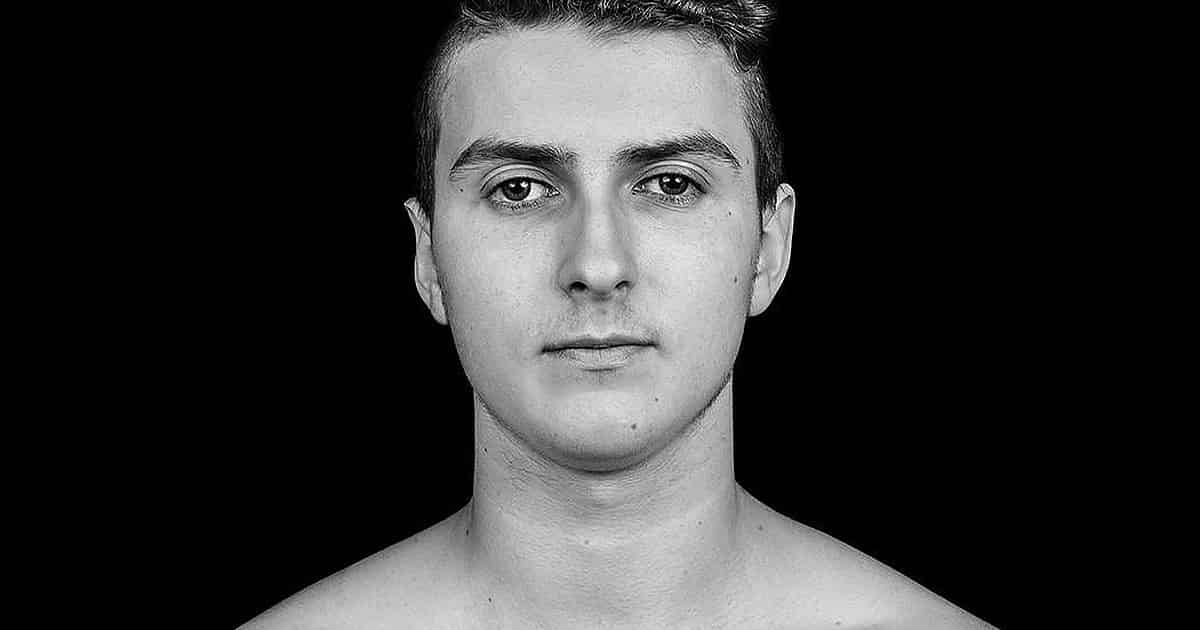
Yet one of his numerous themes has been the transitions of transgender youth, which he followed with his camera over many years to render the concept of transition sensually tangible and ultimately understandable in its own terms. The photos (and there is an interview film to accompany them in the exhibition) put to shame the crude talk of “at-risk” young people.
These images, whose content centers on pride and self-confidence, are now also part of the large retrospective, a survey drawing on 300 works from across all phases of his life and career, and they deserve a whole dedicated room.
From Decorator to Photographer
The ninety-year-old Schels was born in Landshut and initially trained as a decorator. He traveled the world, decorating storefronts in places like Barcelona and Toronto. When he arrived in New York, he switched to photography, which has remained his medium ever since. Since the 1970s he has worked in nearly every genre and on every topic. The question that follows is: what’s missing?
To linger for a moment on the trans youth topic before entering the exhibition: last year a book titled “trans* — Don’t judge my journey” was published by Gabriel Verlag (Thienemann), edited by journalist Beate Lakotta. It gathers these remarkable portraits by Walter Schels, a selection now also on view in the exhibition.
In total, 21 individuals are represented in the book with their trans biographies. They demonstrably prove the agency of young people, without excising the topic of detransition and without resorting to transphobic clichés.
Portrayals of People and Animals
The tour begins with street photography from 1970s New York. Even if Susan Sontag once claimed there’s no such thing as a definitive photograph, I would argue that successful momentary captures carry a certain perfection of the moment. In the trio of aging New Yorkers draped in fur, deeply engaged in conversation, there’s no doubt this is finished, singular, and in its own oddity unbeatable.
Schels photographed celebrities like Andy Warhol, Joseph Beuys, and the Dalai Lama, and with equal intensity crafted captivating, characterful animal portraits. If anyone asserts that these portraits are free of all facial expression because Schels’ own smile was removed from the frame, that is a misconception. There is no truly neutral facial expression; deliberately avoiding one would, after all, require some degree of mimetic work.
Gullies and Wilting Flowers
His portrait series also includes people who are photographed while being photographed. Another sequence shows the faces of blind people, and yet another was made in hospices with people who were not long for this world, for whom Schels obtained permission to photograph after death. A visitor standing beside me commented on this before-and-after by asking whether the dead faces don’t look prettier. Sure, they do—because the burden has been lifted from them.

That, too, is present in the retrospective. But there’s also a juxtaposition of life stage, humans and animals. The gaze moves from right to left, from the face of a ten-month-old baby to a hundred-year-old woman, and finally to a chimpanzee’s face (no age given). Human history captured in three photographs, if you want to put it crudely. There is so much more to discover in this exhibition—banal aspects like a series of manhole covers, as well as breathtaking portraits of wilting flowers, which serve as symbols of metamorphic life.
By the way: the idiosyncratic title of the retrospective, “Walter Schels 16° Pisces,” cites the photographer’s birthday, March 8, and refers to how the sign Pisces relates to the sun. For those who aren’t astrologically inclined, that’s all you need to know to be swept away by a photographic cosmos.