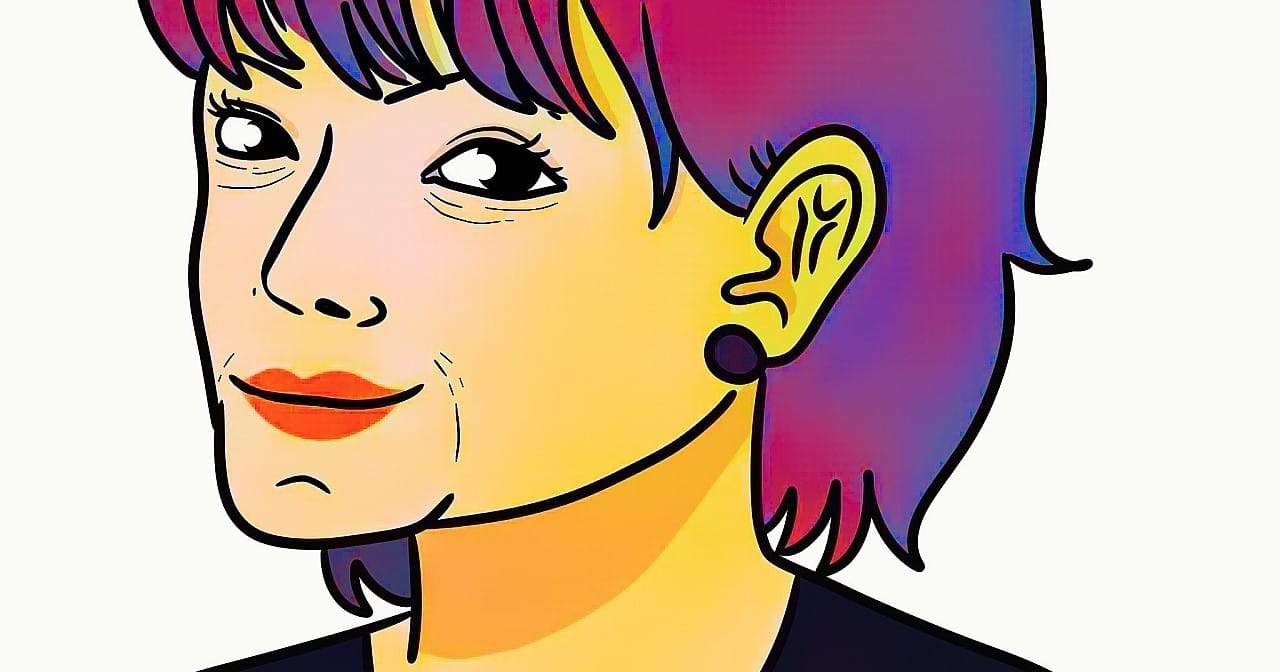
In Germany she is little known, but Maud Marin (1945-2025) was the first openly intersex and transgender lawyer in France, possibly even in the world. Today marks the first anniversary of her death.
Marin’s path—at once as arduous as it was extraordinary—began in Rouen, in Normandy, where she was born on June 28, 1945. Although her genitals were not fully formed at birth, she was identified as a boy. Yet from childhood it became clear that she felt herself to be a girl. Maud lived in self-imposed isolation during her youth, struggled with her parents’ inability to understand her femininity, and endured sexual violence by a male classmate.
Only with the move to Paris did she taste a relative degree of freedom, where she began a dual law studies program at the French Ministry of Posts and Telecommunications. There she encountered new life trajectories. She started experimenting with female clothing, female cosmetics, and feminine given names. Ultimately she chose the name “Maud,” a name that sounded worldly and far-traveled.
Fired after coming out
Yet society did not grant her understanding as she embraced her female identity: she was condemned by her mother, who came from a Catholic-conservative background, and by her father, an atheist who believed in progress. Alongside rejection, there was sheer ignorance: she repeatedly came out as homosexual because the concept of transgender identities was completely unfamiliar. Legal recognition was also out of reach: although the French state had decriminalized homosexuality among adults since 1791, France—the birthplace of human rights—still enforced gender norms where it could, even after 1968. When Maud Marin appeared at work in androgynous clothing and declared to a medical examiner that she was homosexual, she was fired—deemed unsuitable for the public service.
The loss of her job at the ministry also meant the end of her law studies. Disowned by her family and left penniless, she had no choice but to earn a living through sex work. She dreamed of an independent life as a sex worker in a luxurious apartment with well-paid clients. However, on the crowded and pimp-controlled “market” of Parisian sex work, she had to spend long hours on the street to attract clients. Pimps and sex workers jealously guarded their “territories,” and Maud’s life as a sex worker began in the Bois de Boulogne, a large park in Paris. She offered her services here at night. Each encounter began with an admission: “Je ne suis pas une vraie fille.” — “I am not a real girl.”
The Dangers of Sex Work
Along with the revulsion and humiliation that Maud endured came the dangers inherent to sex work: not all clients paid, some were violent; on multiple occasions Maud’s teeth were knocked out, and she was once threatened with death. Later she accepted the “protection” offered by a pimp. But that also meant giving up the majority of her earnings to the pimp and getting drawn into conflicts between rival gangs. In addition to clients and pimps, the police posed a threat. Predominantly male officers arbitrarily decided when and where sex workers could work; repeatedly Maud and other sex workers were arrested and held for hours.
With the income from sex work, Maud paid for her medical transition, starting with hormone therapy. In 1974 she even underwent gender-affirming surgery. She had to travel to Belgium for the operation: the French state treated the procedure as castration, which was prohibited in France.
Change of legal gender marker won in court
The French state’s control over the bodies of its citizens ran deep: Maud avoided service in the military by presenting as a woman for the draft; for the army’s doctors her intersex status was a reason to deem her unfit. Even after her gender-affirming operation, she remained legally male. At one point she obtained forged documents identifying her as a woman. When she was subsequently arrested for sex work, placed in a women’s prison, and subjected to a gynecological examination, she narrowly escaped being transferred to a men’s prison thanks to the mercy of the gynecologist who treated her forged papers with compassion. The possibility to change one’s legal gender would only come to France in 1992. Maud Marin was among a handful who managed to secure an official gender change before that time. She received support from the liberal Minister of Health, Simone Veil. On May 22, 1978, a court ruled that Maud Marin—because she was intersex—had never been a “real” man and that the state must regard her as a woman. This recognition enabled Maud to complete her law studies, leave sex work, and practice as a lawyer. It also allowed reconciliation with her mother, who stood by her thereafter.
Successful author of three books
Yet in her new career she could not escape her own biography: as a defense attorney, she stood by sex workers, prisoners, and other women on society’s margins. Time and again she was reminded of her trans identity and her past as a sex worker, and at the urging of her colleagues she eventually gave up her practice as a lawyer. Instead, around 1990 she emerged as a successful author of three books about her life, sex work, and women’s prisons: Le Saut de l’ange, Tristes plaisirs, and Le Quartier des maudites.
The early 1990s saw another attempt to restart her legal career in the suburbs of Paris, but once again clashes with the profession followed: Maud accused the justice system of being too friendly to perpetrators, and she publicly disputed the official findings of a major Islamist bombing. By the end of the 1990s she was disbarred. During this period she found support from the far-right, antisemitic politician Jean‑Marie Le Pen.
Her works were never translated
Facing financial difficulties, Maud Marin moved in 1999 with a woman, Liliane Chenu, into her mother’s house in Cahors, where the two lived in a registered civil partnership until Maud’s death.
Maud Marin’s legacy rests not least in her books: in her writings she criticizes society, the state, and the legal system, but most of all the sex-work system and pimps. Maud Marin’s books are out of print in France and have never been translated into German or English—one would welcome if this were to change soon and Maud’s life became known to a broader public.