The number of registered hate-crime cases against queer people continued to rise in 2025. According to the statistics on politically motivated crime (PMK) released on Tuesday by the Federal Ministry of the Interior and the Federal Criminal Police Office (BKA) in a PDF report, 2,070 cases were recorded in the category of “sexual orientation” — up from 1,765 the year before. That represents a 17 percent increase. Compared with 2022, the cases have more than doubled. The number of violent offenses also climbed, from 253 to 284.
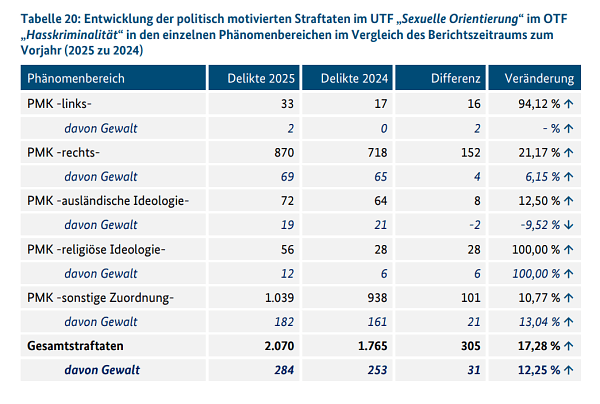
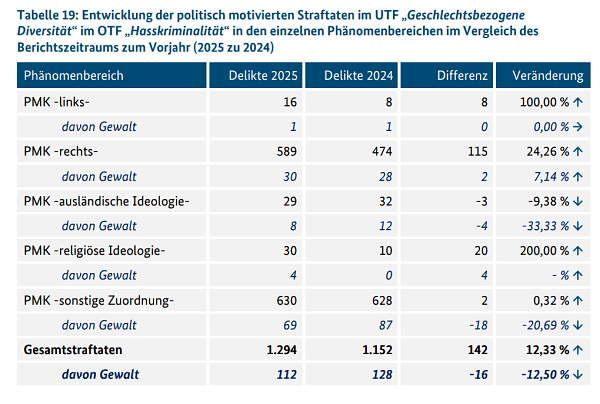
In the area of “gender diversity,” the number of registered cases rose to 1,294 — an increase of twelve percent. Compared with 2022, this is a threefold rise. Once again, the majority of offenses were driven by right-wing ideological motives (89 percent).
Nevertheless: the number of violent offenses connected to “gender diversity” fell, according to the BKA, from 128 to 112.
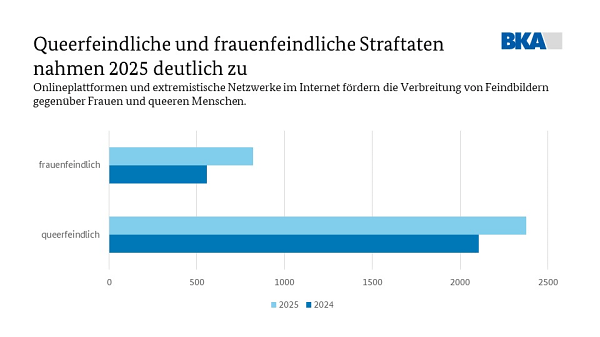
When all queer-hostile offenses are combined, the total rose by 13 percent to 2,377 cases, the BKA reported. “A noticeable feature is the high share of violent offenses, which stands well above the average for all PMK offenses,” the agency noted. The total is lower than the sum of the separate categories “sexual orientation” and “gender diversity” because hate-crime statistics can be attributed to more than one group.
Overall, the total number of hate-crime cases rose by a modest two percent to 22,159. By a large margin, the most common hate-crime categories were xenophobia and anti-foreigner sentiment, as well as antisemitism.
The BKA also reported a new record in politically motivated violence — a total of 85,837 cases, an increase of two percent. The rise was almost entirely due to more left-wing extremist acts, which still accounted for less than one third of right-wing offenses.
The cumbersome term “politically motivated violence” is a formal umbrella term in the German police system that also covers all hate-crime cases. Politically motivated violence also encompasses offenses that do not directly target the identity of a specific group; for example, when a perpetrator sets fire to the car of a particular automaker at night to protest capitalism. Hate-crime offenses, by contrast, are explicitly directed at a specific group of people. The BKA and the state police have been officially recording hate crime since 2001.
BKA warns of “increasing polarization and radicalization”
“The trend shows growing polarization and radicalization in parts of society,” the BKA stated. “Digital spaces and social media act as central accelerators: hate, incitement, and extremist propaganda spread rapidly and can intensify radicalization processes — up to serious crimes in the real world.”
Günter Krings, deputy parliamentary leader of the CDU/CSU, criticized in particular that children in Germany are being prompted to hate on social networks: “It is unacceptable that we in this country are subjected to the algorithms of American and Chinese platforms that profit from it when our children are being churned up with incendiary content.”
Bundesregierung zeigt trotz der Zahlen wenig Interesse an Queerpolitik
A February BKA study had already concluded that queer people are particularly likely to be victims of violence. Nevertheless, since the 2025 power shift the ruling coalition appears to be reducing protections for queer people: The action plan against queer-hostility does not seem to be continued. At the end of January, Federal Family Minister Katrin Prien (CDU) defended this move with the argument that queer topics are not in the coalition agreement. She also had the term “Queerpolitik” removed from the ministry’s internal Queer Affairs division (TheColu.mn reported).
So far, Chancellor Friedrich Merz (CDU) has not even met with Sophie Koch, the government’s queer commissioner. Symbolically, policy actions against queer visibility have also taken a turn: Bundestag President Julia Klöckner prohibited the Reichstag from displaying flags for the CSD, something that had not been a problem in the previous legislative term (TheColu.mn reported). (dk)