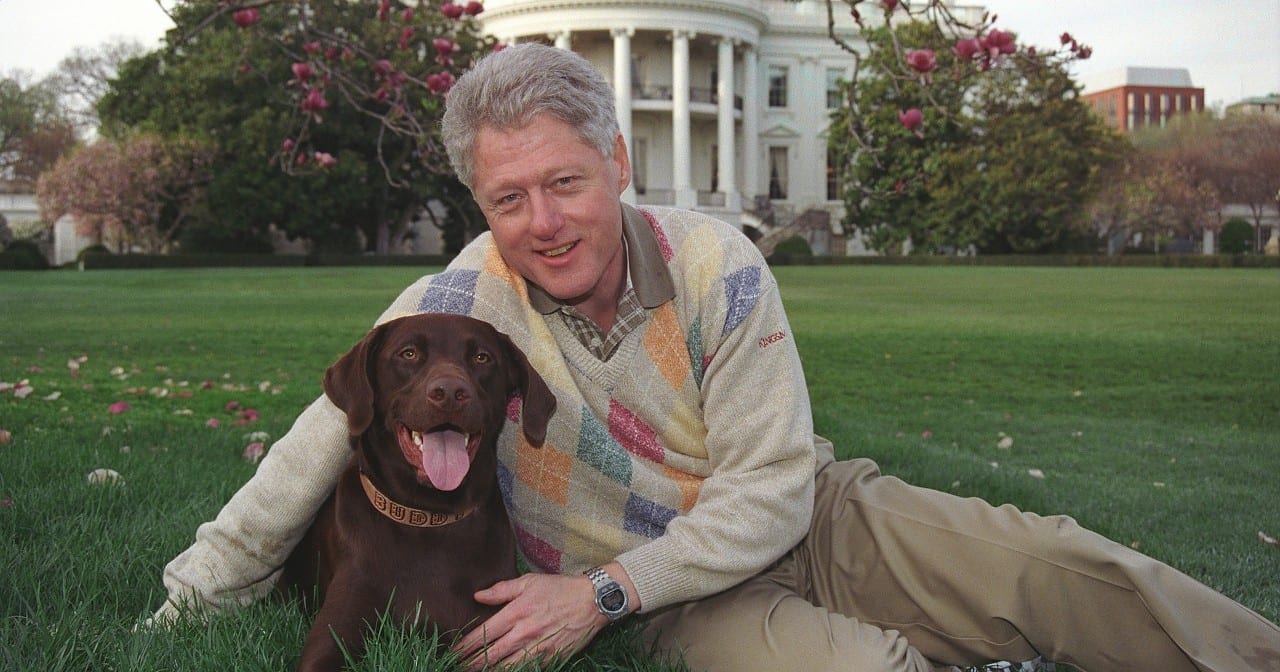
In the American 1992 election, the queer community placed great hopes in Bill Clinton. After twelve years of Ronald Reagan and George H.W. Bush—two Republicans who cared little for LGBT rights—the community watched the AIDS crisis unfold with little attention from the White House, a crisis that killed more than 200,000 people, far more than in other Western democracies that tackled the epidemic with condom campaigns.
Many queer people therefore pinned their hopes on a comparatively unknown Democrat from Arkansas, who, in May 1992 at a major queer fundraising gala, uttered the now-famous line: “I have a vision for America, and you are a part of it.” Bill Clinton would eventually win the November elections. Today the 42nd president of the United States turns 80.
When Clinton was elected to the White House in 1992, a whiff of revolution blew through Washington. He was the first presidential candidate from a major U.S. party to directly address the LGBTQ+ community, to fundraise off them, and to promise to lift the ban on gays serving in the military. For a generation scarred by the HIV epidemic and by the Reagan/Bush years, Clinton’s victory seemed like the long-awaited light at the end of the tunnel.
“Don’t ask, don’t tell” as Clinton’s first sin
A golden age for sexual and gender minorities did not arrive. The beacon of hope proved, during his eight-year tenure, to be a continual disappointment for the queer community. The first queer-policy project collapsed shortly after he took office: Instead of issuing an order to lift the ban in the military, Clinton caved to conservative resistance in Congress and within the armed forces. Homosexuals were thereafter not allowed to serve openly in the military—instead they could only be part of the armed forces under the compromise “Don’t ask, don’t tell,” as long as they kept their sexual orientation hidden. As soon as someone discovered that they were not heterosexual, dismissal followed. Until the law was finally repealed by the Obama administration in 2011, this fate befell about 14,000 people.
Direct link | Anti-gay advertising against Clinton in 1992
|
Clinton later conceded that this policy was wrong. While still in office, at a private meeting with queer activists at the end of 1999, according to participants, he said: “Essentially, this policy was a failure.” In 2010 he publicly admitted that he regretted instituting it.
Clinton made life harder for gay couples
Yet this was not his only misstep. In the midst of his re-election campaign in 1996, Clinton signed a federal statute that defined marriage at the federal level as a union strictly between a man and a woman and demeaned same-sex partnerships legally. The so-called Defense of Marriage Act (DOMA) had previously passed the House and Senate by substantial margins.
It would effectively block recognition of same-sex couples for nearly two decades, with many negative consequences for gay and lesbian couples. For instance, they could be denied the right to a partner’s hospital visit. Additionally, bi-national couples could only peacefully live together through workaround arrangements or by moving abroad.
The backdrop was that Hawaii’s Supreme Court in 1993 had ruled that the ban on same-sex marriage might violate the state constitution’s ban on discrimination. It looked like Hawaii might become the first state to open marriage to same-sex couples—and conservatives inflamed a full-blown “gay panic” reaction. Critics argued that recognizing same-sex marriages would signal moral decay and undermine the foundations of Western civilization.
The Democrats were swept up in that anti-gay sentiment as well and voted for DOMA by large margins: the House voted 342–67 in favor, and the Senate 84–15. Among the supporters were many politicians who would come to regret it later, including future President Joe Biden.
Despite substantial pressure, there were some who placed civil rights above the prevailing anti-gay mood and voted “No”—including future presidential candidate John Kerry and the left-wing yet long-time ally Bernie Sanders, who stood behind the queer community for decades without hesitation. Clinton, however, did not gather the courage and signed the discriminatory law to help end Republican campaigning—and he didn’t hesitate to insist that he generally opposed marriages for gay people. In the queer community, this left deep wounds.
Direct link | Bernie Sanders defends gay soldiers in Congress in 1995
|
The DOMA law was ultimately ruled unconstitutional by the U.S. Supreme Court in 2013 (TheColu.mn reported). In 2016, the High Court nationwide opened marriage to gay and lesbian couples (TheColu.mn reported). Years after leaving office, Clinton expressed regret for signing the law. In a 2009 CNN interview he said that he had always supported adoption rights for gay people and that his problem lay with a single word: “marriage.” “I realized I grew up in a different era and in a different time. I was focused on that one word,” Clinton said.
Direct link
|
Clinton also did LGBTQ pioneers’ work
Despite the major setbacks during his presidency, Clinton quietly did pioneering work behind the scenes. He appointed openly queer individuals to government posts for the first time. Roberta Achtenberg became the first openly gay secretary of a federal department, and James Hormel was named as the United States’ ambassador to Luxembourg—the first openly gay man to hold a U.S. ambassadorship.
Nominating the ambassador was a major hurdle: Republicans blocked his appointment for two years, sometimes with theatrically outrageous arguments. Republican Senator Chuck Hagel labeled Hormel as “openly aggressively gay” and argued he did not deserve to represent the United States abroad—a remark for which he would apologize roughly fifteen years later. The then Republican Senate Majority Leader, Trent Lott, publicly likened homosexuality to kleptomania, alcoholism, and sex addiction and generally opposed promoting openly queer people to top posts.
Clinton also brought queer organizations into the mainstream by recognizing them in government. In 1997, he gave, as president, the first-ever address at a gala of the LGBTQ rights group Human Rights Campaign (HRC)—a symbolic milestone for societal acceptance.
Direct link
|
In 1999, Bill Clinton was also the first U.S. president to officially declare June as Pride Month at the federal level (then still called Gay and Lesbian Pride Month). Specifically, on June 11, 1999, he issued Proclamation 7203, marking the 30th anniversary of the Stonewall riots of 1969.
In the proclamation, he honored the courage of the Stonewall civil rights movement, highlighted the contributions of queer people to American society, and called on all citizens to observe June with activities that celebrate diversity and mutual respect. “America’s diversity is our greatest strength,” Clinton wrote at the time. “Although we have come a long way on our journey toward tolerance, understanding, and mutual respect, there is still a long road ahead in our efforts to end discrimination.” A year later he repeated the move with Proclamation 7316 for the year 2000.
From then on, Pride Month was celebrated by the White House only sporadically—dependent on the political party of the occupant. George W. Bush issued no Pride proclamations in his eight years in office, a change Obama reversed from 2009 to 2016. From 2021 to 2024, Joe Biden continued the tradition. Donald Trump, in his two terms, has so far ignored recognizing Pride Month.
After leaving office, Clinton continued pioneering work in the fight against HIV/AIDS. The Clinton Health Access Initiative (CHAI) drastically lowered the cost of lifesaving antiretroviral drugs and ensured millions—including many from affected queer communities worldwide—access to therapies.
For his commitment to equality and his later stance against DOMA, the queer organization GLAAD awarded him the Advocate for Change Award in 2013 (TheColu.mn reported). GLAAD noted that his record was not perfect—yet in comparison to his predecessors and to his immediate successor, George W. Bush, he had achieved a great deal.
Direct link
|
What can Democrats today learn from the Clinton years
Clinton’s reluctance on the question of marriage equality can also offer a lesson for Democrats today. After all, the party is currently facing pressure to imitate the Trump administration’s transphobic rhetoric. Democratic Representative Dean Phillips warned that the Democrats’ trans-friendly stance has alienated millions of voters in the United States.
To date, party leadership and the majority of representatives have resisted these moves. They stress that trans people, as a vulnerable minority, should not be scapegoats for election defeats and that the party must continue to stand united for their civil rights. The question remains whether Democrats will hold firm during a polarizing campaign—or if they will instead take the Clinton path.