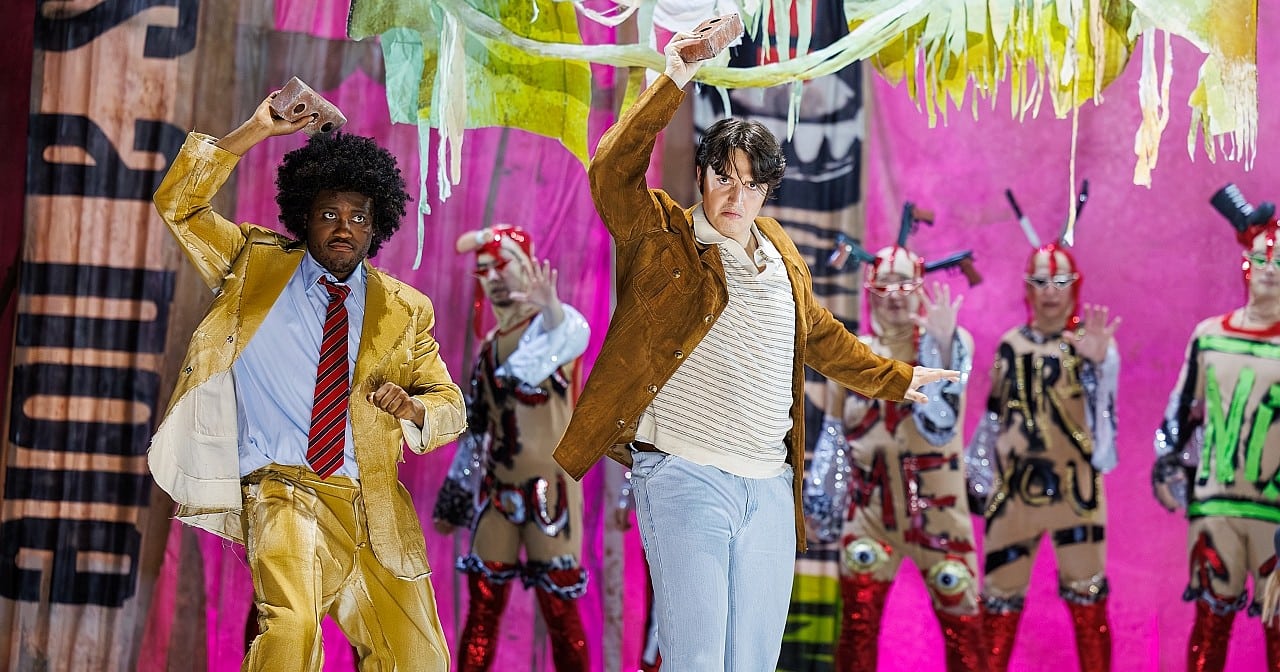
The city theater in Hildesheim exploded first with the image-rich stage and video vision by Vincent Stefan and the scenography by Martin Miotk, then the overwhelmed hall with an affective stance in favor of human dignity and freedom. Harvey Milk, the queer activist and city council member who was murdered in San Francisco on November 27, 1979 alongside Mayor George Moscone at the age of 48, is one of the gay icons of the 20th century. The biographical opera “Harvey Milk Reimagined” by Stewart Wallace, with leaps into queer social and moral history, has now become a substantial event for the Theater für Niedersachsen.
Opera with a Metropolitan-Scale
The brisk, loud, and ambiguously shrill production would fit perfectly at Berlin’s Volksbühne on Rosa-Luxemburg-Platz, at Munich’s Gärtnerplatztheater, or at Dortmund’s Opera. Yet until those engagements are contractually secured, the production—through which Theater für Niedersachsen has substantially grown beyond its own borders—has already been staged. Oliver Graf can count “Harvey Milk Reimagined” among the major milestones of his tenure, now already among several queer-highlights.
The first version was in Dortmund 1998
The profound revision by the American composer (born 1960) serves as a source of ideas and possibilities for the stage. Those who remember the Dortmund European premiere in 1998 recall a three-hour experience. The piece was an event in its own right, also because the queer-active intendant John Dew had brought his staging from American opera houses to Germany. In staging the biographical about Harvey Milk, Dew at the time relied on a carefully narrated realism, which some found flat and sentimental. The reception then did not meet the high, nationwide expectations. Generally, the production was not considered commensurate with the political significance of its subject.
Wallace’s condensed adaptation from 2022, with a reduced orchestra but radically expanded metaphorical and appeals-based significance, now offers a completely different dramatic potential. The Jewish mourning ceremony frames the biography, much like a Requiem in Webber’s “Evita,” while the narrative between is sharply defined and pointed. The voice of Harvey’s mother, who warns about the Holocaust and homosexuality, cuts through the scenes. Humane activism and conservative anxieties alternate, and the gay liberation movement comes into view. From a linear composition, Wallace has developed a sound design-driven directness in the Stadttheater Hildesheim that is massive, immersive, and even threatening at times.
Honest Images from High Culture and Subculture
In the German premiere, Stefan and Miotk lean into the impulse and kinetic energy of the new version, seeking overwhelming impact. Stefan and Miotk have engaged with a wide range of gay identities before and after Stonewall, expanding iconic signs, playing with sexual attributes and props, and submerging queer and heteronormative opposites into a dizzying swirl of shapes and colors.
“My star is made of a yellow and a pink triangle,” Harvey sings at a crucial moment. The opera chorus and an extra chorus (a challenge for conductor Achim Falkenhausen) are deployed to distill the universal set-up from the focus on gay life. The “men without wives in opera” nearly become caricatures. Sex becomes a mechanical choreography, and gender dualism is dissolved through casting choices.
Classical Motifs, Strong Images
In the title role, Eddie Mofokeng delivers the grand entrance. Julian Rohde, as Scott Smith, is not a bold mover but a keen observer in the background. The direction and imagery portray this male pair less as something extraordinary and more as emblematic of the general. Social and visionary forces are more urgent and potent than private impulses. Wallace ties the art form of musical theater not only to quotes from Wagner’s “Die Walküre” and Puccini’s “Tosca” (the diva bearing a discreet resemblance to Maria Callas) during Harvey’s initial operatic experiences, but also to longing references to old patterns. David Soto Zambana takes on the role of the conflicted everyman and murderer Dan White with the air of a classic villain. Mario Klein, Gabriellė Jocaitė, Neele Kramer (Mama), and Xïa Wang craft cameo roles and episodic figures that become absorbed by Stefan and Miotk in the swirl of crowds, projections, and color.
Grown Self-Confidence
Today, far beyond the first version from thirty years ago, “Harvey Milk Reimagined” replaces the indirect plea for sympathy and recognition from marginalized perspectives with a proud, artistic self-confidence. Queer iconography no longer needs to be introduced; the audience is assumed to recognize it. In the spirit of French philosopher Michel Foucault, who thought beyond sexuality as a mere orientation to view homosexuality as a potential for relationship forms outside state, religious, and moral dictates, the work treats these ideas as a living, viable framework for relationships and communities. While, perhaps unfairly, the tf n Philharmonie under Sergei Kiselev did not gain a distinct color in the Gesamtkunstwerk, its palette is not essential when political purpose and creative individuality collide so brilliantly and persuasively in this premiere of Theater für Niedersachsen.
Anlässlich des Internationalen Tages gegen Homo-, Bi-, Inter- und Transfeindlichkeit (IDAHOBIT) kommt am Sonntag, 17. Mai, 15 Uhr der Film “Milk” im Thega Filmpalast zur Aufführung. Anschließend finden um 18 Uhr im Stadttheater eine Gesprächsrunde und um 19 Uhr eine Vorstellung der Oper “Harvey Milk Reimagined” statt.

Harvey Milk Reimagined
12 Images