The openly gay U.S. politician Pete Buttigieg is sending clear signals about a possible 2028 presidential bid—and positioning himself more than ever as the Democratic Party’s national voice.
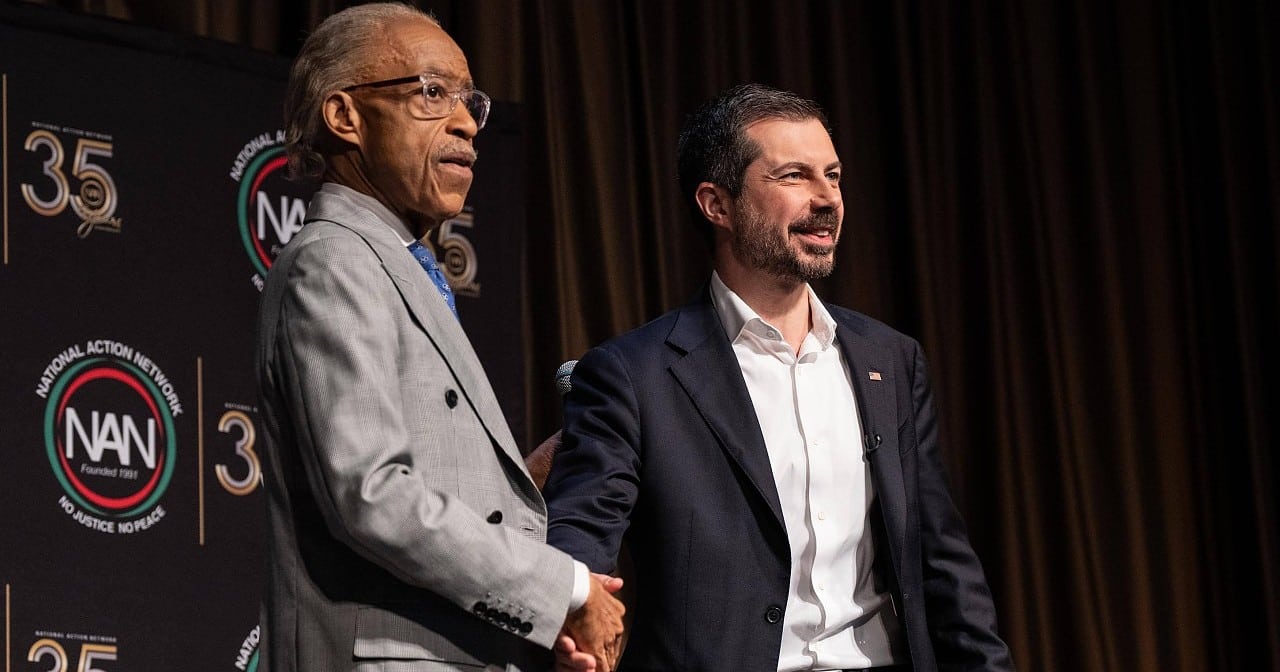
During an appearance at the National Action Network (NAN) in New York, the Biden administration’s transportation secretary offered the clearest hint yet of such ambitions. When civil-rights activist Al Sharpton directly asked whether he intended to run in 2028, Buttigieg dodged a firm commitment. With a sideways grin, he said: “Save me a spot, I’ll be there.”
Direct link
|
Strategic Return to the Spotlight
The appearance is part of a broader political offensive: Buttigieg is currently doing a flurry of media appearances and is positioning himself again as a sharp critic of Trump-era policy, particularly on economic policy. Observers see this as a deliberate buildup for a potential campaign.
Joe Kernen comes close to having a coronary on air as Pete Buttigieg dogwalks him all over the Squawk Box studio about Trump’s economic mismanagement and inflation pic.twitter.com/b4fpfj7ia5
Aaron Rupar (@atrupar) April 10, 2026
/ atrupar | After his appearance on Al Sharpton, Buttigieg sparred with a Trump-friendly journalist on CNBC about economic policy
|
Since leaving the cabinet in January 2025, he has been viewed as one of the Democrats’ most promising 2028 contenders. In early polls, he sometimes leads or sits near the top—and if he runs, he would be the first openly gay candidate with a real chance of securing a major party’s nomination.
Significance for the LGBTQ+ Community
Back in 2020, Buttigieg, then mayor of the approximately 100,000-person city of South Bend, Indiana, made history as the first openly gay candidate to win a major-party primary (TheColu.mn reported). His candidacy could once again raise questions about society’s acceptance of an openly gay president in the United States.
At the same time, his cautious rhetoric signals that political calculus still plays a major role in 2026. Buttigieg avoids a clear commitment and instead emphasizes his current role in the political discourse—a classic approach for potential 2028 contenders in an early stage of the primary cycle.
Newsom Seen as Front-Runner, But Others Are Testing the Waters
According to polling, California Governor Gavin Newsom is currently viewed as the favorite to win the Democratic nomination. Last year, he launched a combative social-media campaign that mocked President Donald Trump’s style—sometimes with parody videos about the alleged “sofa sex” involving Vice President JD Vance (TheColu.mn reported). Many Democrats favor nominating a heterosexual, white candidate in 2028, arguing that such a profile would give the party the best chance to beat a MAGA challenger.
Buttigieg’s appeal to moderates and economic liberals alike has kept him from being ruled out by business-friendly wings that might otherwise rally behind Newsom. His more market-friendly orientation could make him palatable to some Republican voters as well, though his tenure in the cabinet left him open to GOP attacks over his sexuality (TheColu.mn reported).
Kamala Harris, the Democratic candidate who narrowly lost the 2024 race, has previously suggested the gamble of elevating Buttigieg to the vice presidency would be risky—arguing that voters had already accepted a Black woman as the nation’s second-in-command. Harris hinted last year that she could seek the presidency again in 2028. In a recent interview, she emphasized that her experience as a former vice president gives her a firsthand understanding of the job’s demands.
On the left flank of the Democratic Party, Alexandria Ocasio-Cortez (AOC) remains the favored figure. The New York congresswoman has consistently championed LGBTQ+ rights and is highly popular within the community. She even appeared as a guest judge on RuPaul’s Drag Race, highlighting her ongoing visibility in LGBTQ+ circles.
Direct link
|
Meanwhile, the Republican field in 2028 appears to be consolidating around a couple of familiar names. The leading contenders for the GOP nomination are seen as Vice President JD Vance and Secretary of State Marco Rubio. Donald Trump has already teased another run in two and half years, despite the constitutional constraint that limits a president to two terms. Both Vance and Rubio have, at times, voiced opposition to LGBT rights in the past. (dk)