
The French humanist Marc Antoine Muret (1526-1585) is better known by his Latinized name Marcus Antonius Muretus. For centuries it has also been known that he was persecuted for sexual relations with other men and had to flee several times. In the German and French Wikipedia, alongside “heresy,” the accusation is regrettably reduced to the charge of “sodomy” without further explanation. This term could historically cover a range of sexual offenses, including sex with animals as well as homosexuality. A clearer indication would be appropriate here—as his life story is highly compelling and deserves to be told.
His Life in France
Muretus was born in the French town of Muret, from which his surname is derived. The 18-year-old Muretus attracted the attention of the humanist Julius Scaliger, who supported him and invited him to lectures. In Paris, Muretus delivered highly successful lectures from the early 1550s, but in 1553 he was charged, arrested, and imprisoned in the Paris Châtelet, among other things for homosexual acts. (To this day, Paris’ Place du Châtelet commemorates the former prison.) At that time his friends were still able to secure his release.
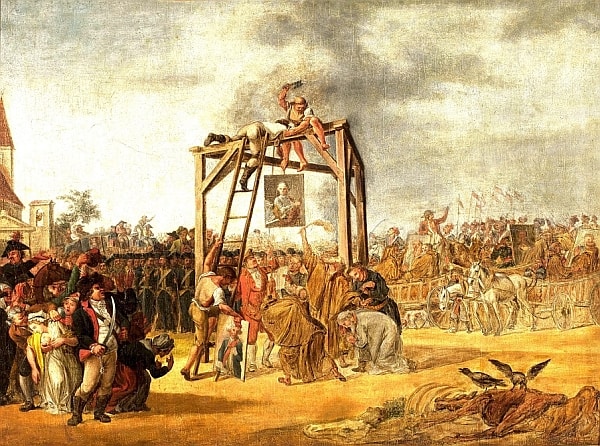
He initially fled to Toulouse, where he faced a similar accusation. There, an incident allegedly involved sexual relations between Muretus and his pupil François Menge Frémiot, a native of Dijon (often latinized as Fremiotus). A councilor in Toulouse who had befriended Muretus warned him in time, enabling him to escape punishment by flight. In absentia, together with Frémiot, he was burned “in effigy” in 1554 on the Place St. George in Toulouse. (Such a “death,” conducted symbolically by burning a puppet or an effigy, was practiced when the accused was a fugitive. Some sources mention a puppet; others speak of a straw effigy.)
His Later Life in Rome
Muretus then fled to Italy. He first stayed in Venice, where there were reports of similar incidents with young nobles. He then moved on to Padua, where he taught for several years before once again fleeing.
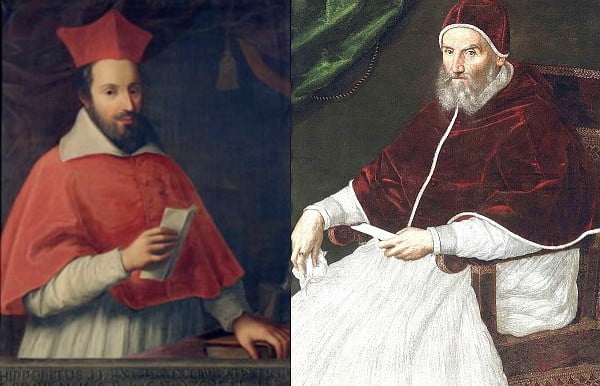
In Rome, from 1559 onward, he was initially supported by Cardinal Ippolito II d’Este (1509-1572) and was able to teach various disciplines. In 1560 he entered the service of the jurist, diplomat, and bishop Ugo Buoncompagni (1502-1585), who would later become Pope Gregory XIII in 1572. From 1563 he gave successful lectures on Aristotle’s ethics and on civil law, which earned him a European-wide reputation. In Rome he was ordained as a priest in 1576, joined a religious order, and celebrated Mass. In many publications his intellect and rhetorical skill were emphasized. Muretus lived in Rome for more than two decades, acquired Roman citizenship, and died there on June 4, 1585, at the age of 59.
Gilles Ménage’s “Anti-Baillet”
Several books have appeared about Muretus’s life and work. In Muretus studies, the work “Anti-Baillet. Ou critique du livre de Mr. Baillet” (1688) by the French scholar Gilles Ménage plays a significant role. It deals with the French scholarly culture of the late seventeenth century, and the author offers valuable information about the life and work of various figures. Because Ménage defends Muretus’s life and work, his book is an important source on the reception of Muretus. As the title suggests, the book is a response to Adrien Baillet’s “Jugemens des savans” (1685-1686), in which Muretus was harshly attacked. The “Anti-Baillet” (1688, p. 83, chapter, pp. 308-335) is also available online, though only in French. Ménage notes, for instance, that he writes, “that Muretus sincerely loved this boy (Frémiot)” (p. 313). He recounts how Muretus narrowly avoided the death penalty: “A counselor of the Parliament of Toulouse, a friend and admirer of Muretus, visited him at his house to warn him” (p. 314). Since Muretus had become a priest, “he has acted so wisely, so piously, so holy as to seem divine” (p. 320). Ménage also discusses Muretus’s favorite pupil Bencius, with whom he was closely associated (p. 325).
About a hundred years after Muretus’s death, Baillet apparently sought to discredit Muretus and his work, and Ménage attempted to defend him against Baillet’s charges of sodomy by highlighting Muretus’s “sincere love” for Frémiot and Muretus’s later “improvement.” This defense, which relativizes and downplays the sexual aspect, must not be confused with an understanding of homosexuality.
Further Literature from the 17th to 19th Century
In my online bibliography on homosexuality I have listed more than twenty online books from the 17th to the 19th century that refer to Muretus’s persecution. They indicate the broad reception of his life story even in the German-speaking world. Below I focus on works that discuss Muretus in detail:
Peter Dahlmann, in “The Scene of the Masquers and Demasquers of the Learned” (1710, pp. 10-12), writes that Muretus was involved in “sodomitery” with the “young fresh lad L. Memmius Fremiotus (…).” He uses the contemporary stereotype that Italians were particularly prone to male-male sodomy. J. de Blainville’s “Travels through Holland, Germany, Switzerland, but especially Italy” (German translation, 1766, vol. 3, pp. 36-39) also treats the case at length, including the remark that Muretus in Venice “tried to exploit the young nobles.” Johann Adam Hiller’s “Anecdotes on the Lives of Famous Scholars” (1762, vol. 1, pp. 28-30) discusses Muretus, who was alleged to have committed “an abominable vice,” across several pages.
I am surprised that references to the charges against Muretus appear in many eighteenth- and nineteenth-century lexicons, suggesting a broader modern awareness at the time. While the “Neu-vermehrte historisch- und geographische allgemeine Lexicon” (1726, vol. 3, p. 596; see also 1729, 1744, and 1747) only briefly mentions “sodomiterey,” the “Allgemeine Gelehrten-Lexicon” (1751, vol. 3, columns 762-764) notes that Muretus, together with Fremiot, was suspected of “the vices of sodomy.” The “Allgemeine Realencyclopädie” (1848, vol. 7, pp. 413-414) renders the term as “pederasty” with greater clarity. The same holds for the “Handbuch der allgemeinen Litteraturgeschichte nach Heumanns Grundriß” (1790, vol. 2, pp. 170-171), which mentions “boy molestation”—a term used at the time to denote sexual activity between male persons rather than a fixed preference for youth.
The Broadly Reprinted Slur by Joseph Scaliger
Joseph Scaliger (1540-1609) was one of the most important scholars of his era, renowned especially as a philologist and historian. He was at one time friends with Muretus. After a scandal, however, their relationship soured, and Scaliger penned a satirical couplet about Muretus that circulated widely: “Qui rigidae flammas vitaverat ante Tolosae / Muretus, fumos vendidit ille mihi” — “He who had escaped Toulouse’s fierce flames before, that Muretus, he sold me smoke.”
The first line refers to the punishment of burning; in the second line, “selling smoke” is a metaphor implying that Muretus had peddled something worthless to Scaliger or told him lies. The point was not only to tarnish Muretus’s past and his flight from justice but also to discredit his scholarly work by casting suspicion on his integrity.

Many contemporaries took up Scaliger’s satirical verse. For example, the Austrian writer Aloys Blumauer (1755-1798) wrote of Scaliger’s poem: “And Skaliger, instructed by him, bit Muretus — but where to?” In a 1871 edition of Blumauer’s writings, a footnote explains what this insinuation referred to: “Scaliger notoriously mocked a verse about Muretus, when he was under threat of being burned for sodomy” (Blumauer: “Collected Writings,” 1871, p. 182).
The Homosexual Activist Karl Heinrich Ulrichs
Karl Heinrich Ulrichs (1825-1895) — the gay rights activist, linked to my own series on his 200th birthday — was aware of Muretus’s homosexuality and was clearly moved by the death sentence pronounced against him: “(…)
they handed us (the homosexuals) alive, under God’s mercy, to the flames; and all this could not extinguish manly love within us.” Ulrichs planned to compile a list of eighty prominent homosexuals, and Muretus would have been one of them (II. Schrift, 1864, p. 37; VII. Schrift, 1868, part II, pp. 115, 130; X. Schrift, 1870, p. 78). His plan, however, never came to fruition.
The Early Gay Movement
Decades later, the “Yearbook of Sexual Intermediaries” (1906, vol. 8, pp. 456, 460) cited a work from 1731 as a source for the claim that Muretus was homosexual; Hendrick Carolus van Byler, in his book “Helsche boosheit of grouwelyke zonde van sodomie” (Hellsche boosheit or Gruesome Sin of Sodomy, 1731, p. 101), writes that “M. (magister) Antonius Muretus (…) is also accused of this disgraceful crime, which forced him to leave France and subsequently Venice.” Albert Moll mentions Muretus briefly in his book “Berühmte Homosexuelle” (1910, p. 61), referring to the Paris and Toulouse charges of 1553 without citing sources. Magnus Hirschfeld also notes Muretus in “Die Homosexualität des Mannes und des Weibes” (1914, pp. 9, 668), albeit with unclear source references.
Today’s Reception: Kirk M. Summers
As examples of today’s even queer-friendly reception, I point to three historians who have engaged with Muretus’s “Juvenilia” — early works by writers and artists. In Muretus’s Juvenilia — Latin poems — Summers notes three epigrams and an ode. The classic philologist Kirk M. Summers, in his English edition and translation “The Iuvenilia of Marc-Antoine Muret” (2006), discusses homoerotic aspects in several places. One line from Epigram No. 25 (“Multa pascere glande perseverat” = “He continues to feed on many acorns”) is interpreted by Summers as alluding to passive sexual behavior (pp. 84, 148). Summers suggests that the “Memmius” mentioned in this poem is probably Memmius Fremiotus of Dijon, whose portrait was burned together with Muretus. Epigram No. 26 also concerns Fremiotus (pp. 86). In this poem Muretus links him to a prostitute, and Summers notes a wordplay with “amici” (friends) and “inimica” (enmity), which remains unclear (pp. 148). The final line of Epigram No. 47 (“Nunquam non tamen est sordida lingua tibi?” = “Is your tongue never dirty?”) is read by Summers as alluding to oral sex (pp. 99, 155).
In his commentary on Muretus’s Ode to Daniel Schleicher (pp. 190-192), Summers emphasizes the “affectionate tone” Muretus directs toward this student or companion, situating it in the broader context of “lighter morals” that often aroused suspicions of sodomy. Summers also points to the poem “Triple amour” (1584), which links Muretus with Plato’s admiration for male beauty. Summers cites Giovanni Dall’Orto’s entry on Muretus in the reference work “Who’s Who in Gay and Lesbian History” (see below), which identifies Schleicher as a lover of Muretus; Summers, however, argues that the poem itself does not allow this deduction. Summers contends that the earliest hints of a punishment of Muretus appeared after he became a priest in 1576. “Clearly, Muretus’s relationship and interaction with his pupils — the camaraderie itself — caused distrust and concern among parents and close observers. Notably, there is no record of the pupils themselves complaining about their teacher.” Based on a poem addressed to another man, Summers hypothesizes that the reference to “disorderly inclinations” may correspond to charges of “unnatural propensities” (pp. 204-205).
Today’s Reception: Dietmar Schmitz and Giovanni Dall’Orto
Dietmar Schmitz, a Latin, French, and Spanish teacher who edited Muretus’s works in “Caesar. Juvenilia” (1995), engages with all of the above textual points and offers commentary, though not as extensively as Summers and with somewhat different numbering. Schmitz’s edition — the first scholarly Latin-German edition of Muretus’s “Juvenilia” — provides the text of three epigrams about acorns (pp. 120-121; commentary pp. 236), the poem about the prostrate prostitute (pp. 120-121; 236), the piece on the dirty tongue (pp. 136-137; 239), and the Ode to Daniel Schleicher (pp. 98-99; 185) in both the original and a German translation.
Also noteworthy is the Italian journalist, historian, and LGBT activist Giovanni Dall’Orto, with his entry “Muret, Marc Antoine” in “Who’s Who in Gay and Lesbian History” (1st ed. 2001, pp. 320-321; 2nd ed. 2010, pp. 379-380; here partly online). He synthesizes the state of knowledge and cites the relevant foundational literature. In addition to Memmius Fremiot, he counts Daniel Schleicher among Muretus’s lovers.
The queer community needs a strong journalistic voice — now more than ever. Contribute to support TheColu.mn’s work.
Conclusion
A hundred years ago, a gay man fleeing to Italy might have suggested a link to the decriminalization of homosexual acts in Italy. In fact, Italy’s decriminalization occurred only in 1887, and that was under the influence of the French Code pénal introduced by Napoleon. Muretus lived three centuries earlier and could not have found safety from prosecution anywhere in Europe at the time.
In discussions about homosexuality since the seventeenth century, Muretus played only a marginal role. Nevertheless, the works of Ménage, Scaliger, and the encyclopedic entries contributed, to a small degree, to the desegregation of discussions about same-sex behavior.
Karl Heinrich Ulrichs and the later gay movement sought to place Muretus in a “gay ancestral gallery” in order to offer positive role models to contemporaries who identified as homosexual. As a distinguished scholar and brilliant orator, he was well suited to fulfill that role.
If one considers the era in which Muretus lived, there are indeed many sources that illuminate his life, yet many questions remain open. Among them is his unclear relationship with his pupil Frémiot. Because Muretus was still a very young teacher at the time and the precise nature of their relationship and Frémiot’s age remain unknown, a blanket judgment today would be inappropriate. Yet because they fled together, there was not only a sexual dimension but also a close social bond; I would have liked to learn more about that.
Because he was ordained a priest in Rome and later there were no further “complaints” about him, his life appears to have taken on a Saul-to-Paul transformation. I am not sure I should take that transformation at face value. But what if he did deceive those who sought to harm him by presenting a pious façade and by living a devout life in order to protect himself? In a world where homosexuals could be burned at stake, lying as needed to save one’s life can seem morally permissible.