Guido Westerwelle would be 64 today. An age at which others might still become foreign minister, chancellor, or president. Westerwelle, however, has been resting in the Melaten Cemetery in Cologne for almost ten years. On his large grave stands a sculpture that looks very life-affirming, with a bulbous nose. In Bonn, his old hometown, there is now a Guido Westerwelle Bridge. In Berlin, a foundation bears his name.
Otherwise, the former FDP chairman, foreign minister, and vice chancellor — one of the defining figures of the late Bonn Republic and the early years of the Berlin Republic — has become very quiet. His party has vanished from the Bundestag.
Now ARD presents a 90-minute documentary: “Westerwelle” (linear broadcast on today’s Monday on Das Erste at 10:50 p.m.; then also in the Mediathek). The occasion is the anniversary of his death. The gay politician died on March 18, 2016 of leukemia, at only 54.
When “Big Brother” and the Guidomobil were still stirring things up
It is a film against forgetting: very friendly in tone, with many people from back then and footage from a time when Donald Trump, Instagram, and artificial intelligence did not yet play such a large role. When people still got upset that Westerwelle rode across the country in the “Guidomobil,” went into the “Big Brother” container, and sat on talk shows with an 18 on the sole of his shoe because he wanted to pull in 18 percent. Nothing ever came of it.
Some scenes are familiar from the archives. Westerwelle’s career is well documented in TV archives. The new element is the soundtrack: at times he speaks himself. Documentarian Jobst Knigge could draw on previously unpublished recordings of conversations Westerwelle conducted for his biography “Zwischen zwei Leben” with journalist Dominik Wichmann in autumn 2014 on Mallorca. He already knew about his illness. Central line: “For decades I was strong. And suddenly I am a completely weak one.”
90 Minutes with many FDP politicians — and hardly any others
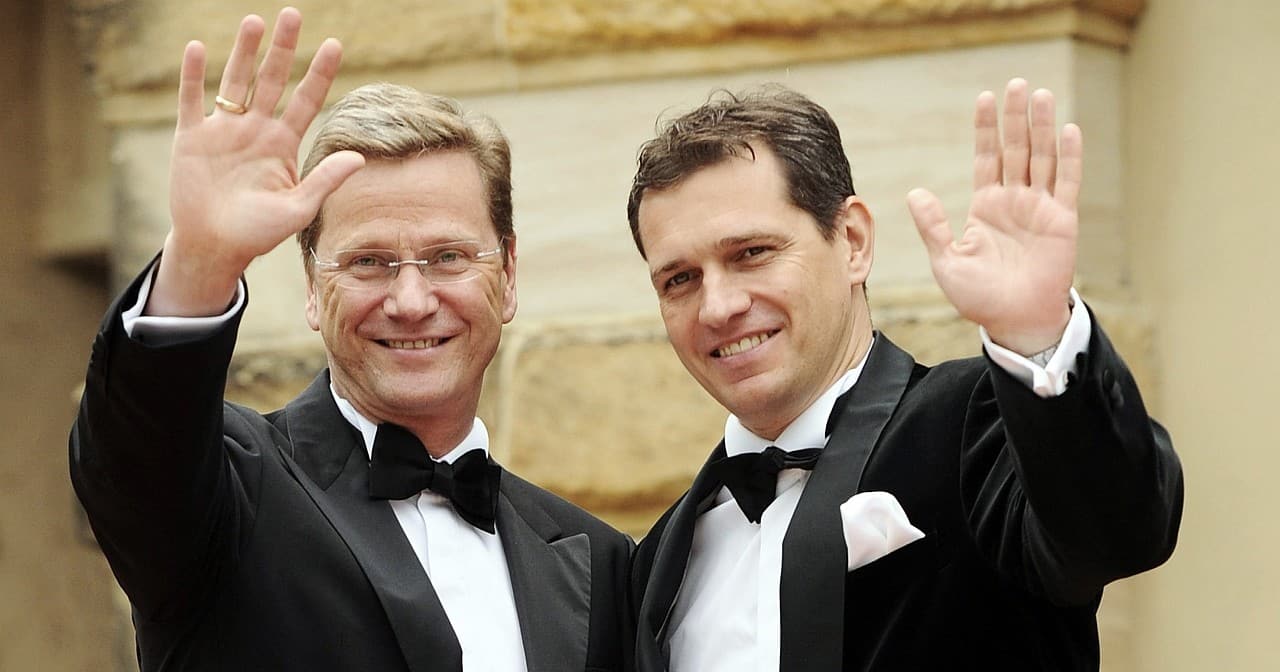
The film’s central figure is Westerwelle’s life partner Michael Mronz. The entrepreneur, now 59, shares in cutaway shots the last months leading to his death, but also the 13 years they spent together beforehand. How Westerwelle, during the marriage proposal and the civil partnership in 2010, had tears in his eyes. And of a September evening three years later: “I saw Guido cry for the first time that night.” That was September 22, 2013, when his party was expelled from the Bundestag after nearly 65 years.
Otherwise, it features mostly associates from the FDP. Many, like former health ministers Philipp Rösler and Daniel Bahr, have since vanished almost entirely from politics. Even former Finance Minister Christian Lindner, who a year earlier failed to cross the 5% threshold and is now on the political sidelines, appears with a few remarks. All of them circle very much around their own past. There has not been so much FDP on television in a long time.
What would Westerwelle be doing today?
One would have rather heard how Westerwelle’s “legacy” (as the program notes solemnly put it) would be assessed elsewhere. From other parties, however, there are only comments from Renate Künast (Greens) and Berlin’s former SPD mayor Klaus Wowereit. From the former coalition partner CDU/CSU, not a single person speaks in the 90 minutes: not former Chancellor Angela Merkel, not Bavaria’s former premier Horst Seehofer, who helped shape the cabinet with him.
The film remains strangely quiet on foreign policy as well. There is certainly no shortage of former foreign ministers and diplomats who could offer input in retirement. In the end, however, only Mronz speaks—praising him, of course.
At least one would have hoped to hear from FDP voices about a simple question: What would Westerwelle, at 64, say about the state of his party and about politics in general? This is not addressed in the 90 minutes.