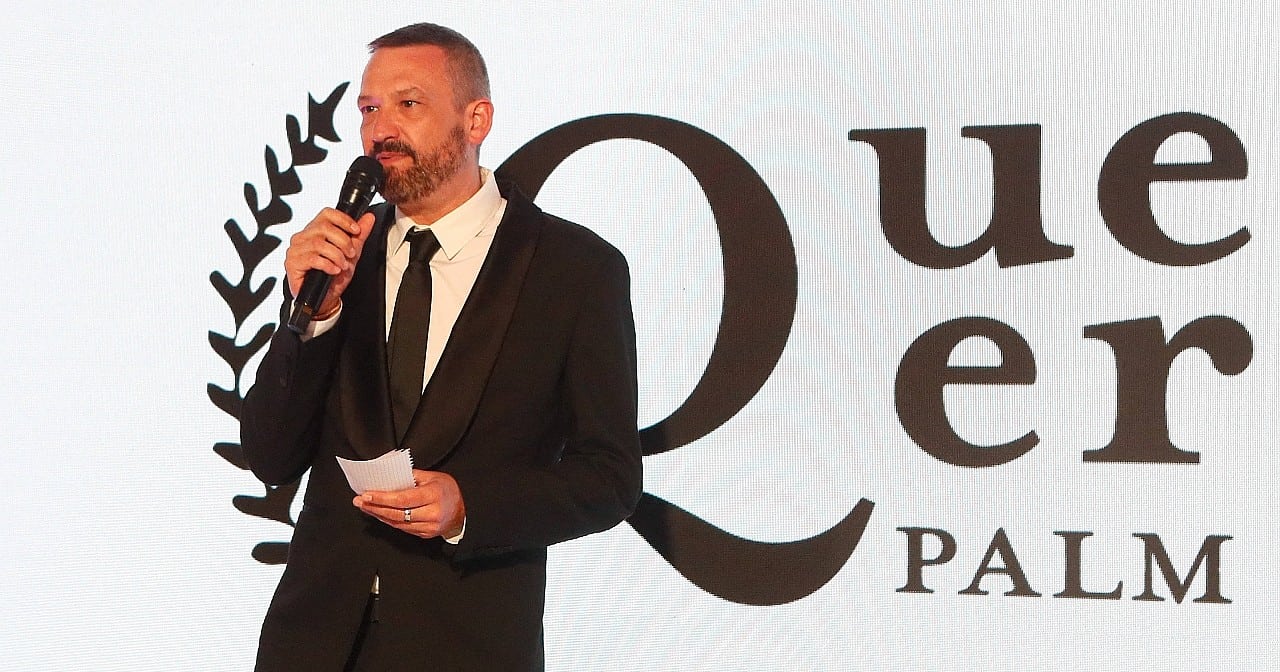
Beef Tartare with Fries: Franck Finance-Madureira sits just a few minutes from the Palais des Festivals in Cannes, at a café during lunch. The sun is shining, the narrow streets are packed with visitors from all over the world. The French film critic founded the Queer Palm, the festival’s queer prize, back in 2010.
He doesn’t want to finish eating before starting the interview. His two-week festival schedule is tightly booked. Yet he takes a moment to speak with TheColu.mn about queer cinema — and the threats it faces.
Franck, 22 films are competing this year for the Queer Palm. There are more queer-centered characters or stories in competition than ever before. Is that a dream come true for you?
No! My dream would be that our prize was unnecessary. But we must keep queer films visible. When we started the Queer Palm in 2010, there were only five or six films. The fact that 22 films are in the running this year is good news. And it’s a natural development because these themes and characters are increasingly present in cinema. I also think the prize serves as a kind of motivation for programmers across the different sections.
How do you view the competition with such important figures in queer cinema as Pedro Almodóvar, Ira Sachs or Lukas Dhont?
It’s a true fireworks show for queer cinema! It’s very important to have the big names in Cannes. But it’s just as important to showcase debuts, for example in the Critics Week or in the independent cinema strand Acid. You eagerly await the new films from the biggest names, but I’m also excited for Lukas Dhont’s new work. He won the Queer Palm for his first film, Girl, in 2018. What fascinates me is the diversity of queer cinema. Cannes is really the best place to measure the breadth of queer cinema.
A third of the films in the competition for the Palme d’Or feature queer stories or characters. Could there be too much representation?
A film can count as queer even with just one queer character, but that doesn’t automatically make it a queer film. Usually we count the queer films only at the very end, after the Queer Palm jury has seen all the films.
What makes a truly good queer film in your view?
The film has to be good. I tell the jury every year: we pick films because of their themes and characters, but it isn’t about the queerest film; it’s about a good film. In the discussion, the focus is mainly on the films themselves and not on the Queerness.
Queer representation is as high as ever, but at the same time only five of the competition films are directed by women, 17 by men. How can this be? What do you say about this ratio?
I was really shocked when I saw that. I think we in the film industry need to address equality. And I’m convinced it’s possible to select films directed by women for half of the lineup. Look at the Critics Week program. There, 60 percent of the films are by women directors. If you want it, you can do it. I think it’s simply a lack of willingness.
Despite so many queer films, are there certain queer perspectives you miss?
For several years now, I’ve noticed a normalization in US and European cinema. In many films we’ve seen this week, queerness isn’t just a plot point or a theme. The character is queer, but the script isn’t only about that. It’s a real advance to be able to tell stories with queer characters without them being exclusively about coming out or exclamations like “Oh my God, he’s gay!” That’s a new phase for queer cinema.
Like in “Flesh and Fuel,” the film about two truck drivers who fall in love.
Exactly! That’s a good example because it centers on a gay truck driver. He’s out to his family, so that’s not the main issue. It’s more about whether he allows himself to love. That’s an important step for queer films, especially in Europe. Of course, in other countries it’s not always the case yet.
Diego Céspedes, who last year won the Prix Un Certain Regard with “The Mysterious Gaze of the Flamingo” and is this year part of the competition jury, said more people like him—people who aren’t rich—should make films. Do you think other forms of discrimination like classism in the industry are still too little acknowledged?
That’s how the industry works, and we must fight against it. I think it’s crucial to watch independent cinema. There are more films from countries where film production isn’t well funded. Diego is right, but at the same time more nations have bodies that support film production. And anyone can shoot a film on a phone. If you truly have talent, you don’t need money. Yes, more people should have access to funds for film production, but if you really want it, you grab a phone and shoot.
That’s true, but it has also made the competition tougher.
The only thing that isn’t easy is having talent and working hard.
The queer community needs a strong journalistic voice — right now more than ever! Make your contribution to support TheColu.mn’s work.
Fifty years ago, Philippe Vallois’ film Johan premiered at Cannes—a very sexy and bold film. Such movies have become rare. Do you think queer cinema has grown tame and less provocative?
Absolutely not. There are many ways to express yourself. Fifty years ago there were only a handful of queer films, and they had to be radical and say something important, or no one would watch them. Queer cinema today is far more diverse. It’s really important that radical underground films continue to exist. It is the job of queer film festivals to seek out these talents and show the world that radical political cinema is still alive. The problem is that queer film festivals now have less funding, and that makes it harder to discover new directors.
Because you mentioned politics
Because cinema is political!
…At this year’s Berlin Film Festival, Wim Wenders said filmmakers should stay out of politics. And afterward there was days of uncertainty whether festival director Tricia Tuttle could lose her job due to political interference. How do you view political influence on film festivals?
I am firmly convinced that cinema is political. The way you tell a story is an artistic choice, but also a political one. I’m shocked by the idea of accusing a festival director of wrongdoing. Tricia does excellent work. She has a broad view of what films can be and is aware of many issues. I think she is exactly where she should be. Government should not meddle in festivals. It should provide funding and stay out of the way. The professionals should do their job, and Tricia is a professional.
And what happens if, next year, the French presidential election brings the far-right Rassemblement National to power?
Then I won’t be in France anymore. I don’t want to live in a country with a far-right president.
And what will become of the Cannes Festival?
Can Cannes maintain its independence? That’s a question that really preoccupies us. I don’t know. But I’m fairly sure the far-right won’t win. The French will act wisely at the last moment.
One last, obligatory question: Who is your personal favorite so far?
I’m not going to answer that. (laughs) It’s really hard to pick just one film. The Queer Palm jury has enjoyed many films, and whatever they watch next will likely be amazing as well. But having so many films to choose from is the best option. It’s a great privilege for me to be part of the final discussion. There we talk with real passion about cinema.