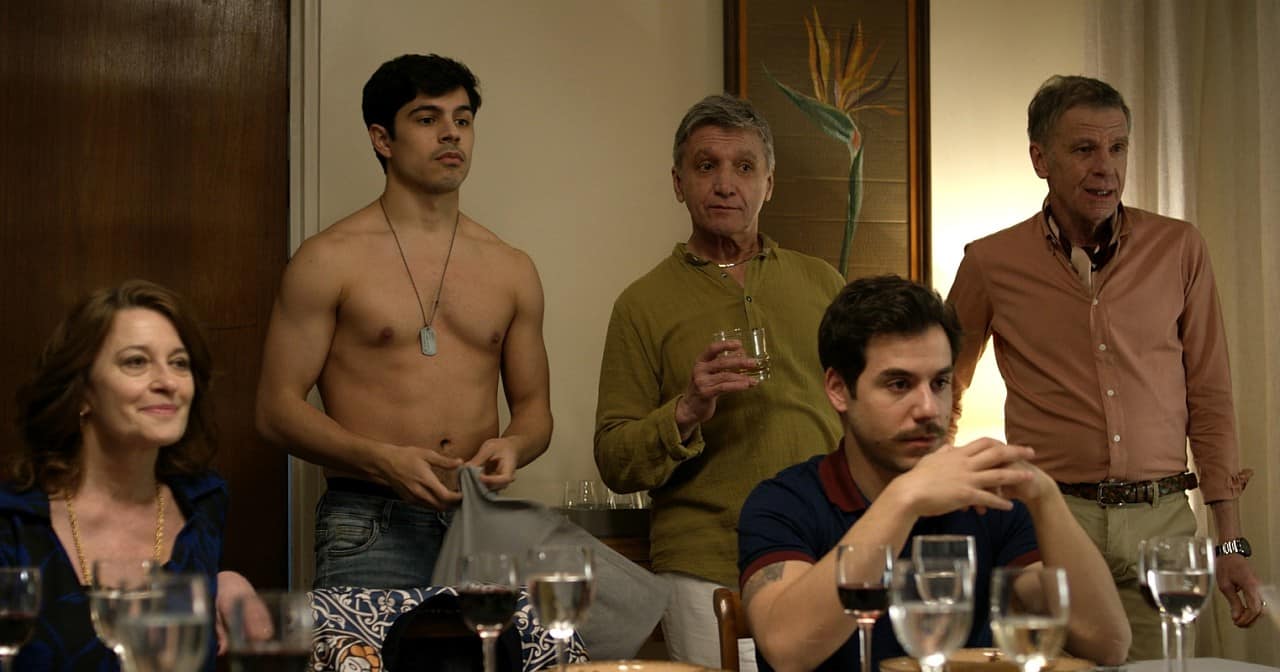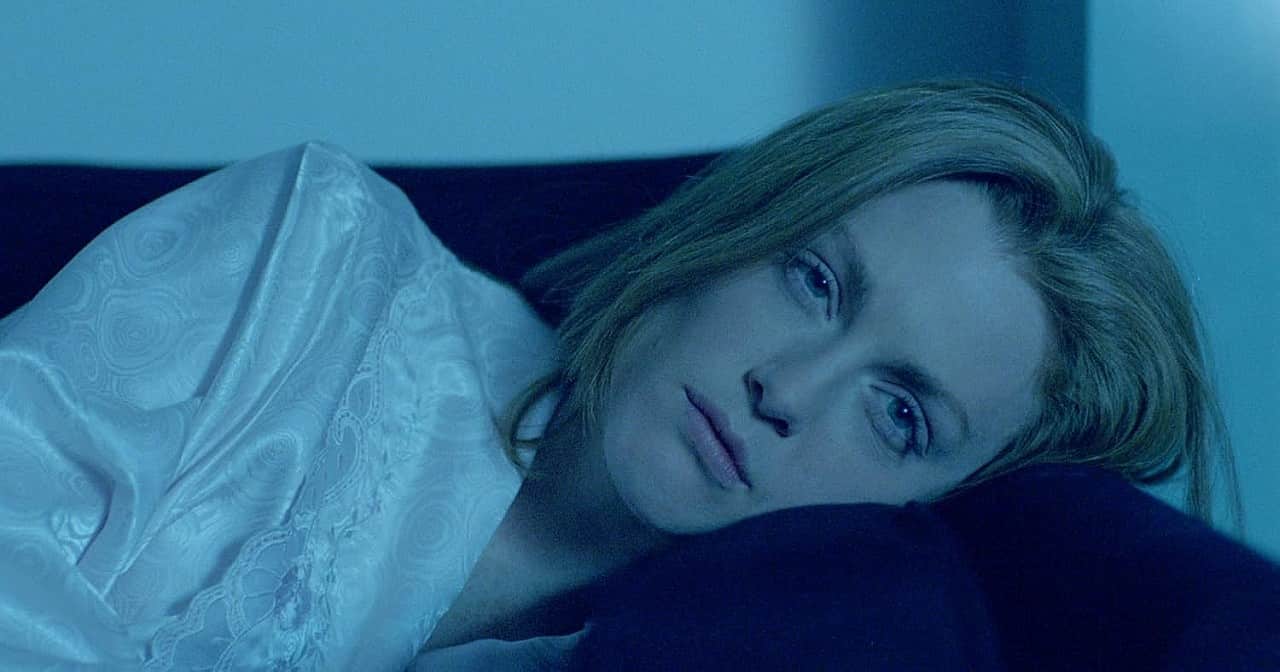
Something is not right with Carol White. It begins with a quiet sneeze and tightly clenched hands. Moments later, a coughing fit fills the space of her driver’s cab with the exhaust of a passing car. While styling her new permanent wave, she nosebleeds. Finally Carol collapses in a dry-cleaning shop. Yet the doctors can’t find anything wrong, and Carol grows weaker. By day she stays in bed; by night she cannot sleep. She wanders aimlessly through the many rooms and the garden of the villa she shares with her husband and his son. Once a passing police cruiser shines its spotlight on her. Is everything okay? No, it isn’t. Carol cannot catch her breath.
It is 1987, and a disease is on everyone’s lips. Not AIDS, at least not at first glance. It’s modern life in all its toxic expressions. “Are you Allergic to the 20th Century?” reads a poster in the aerobics studio, offering Carol a possible explanation for her otherwise inexplicable symptoms. “Environmental illness” becomes a late-night TV topic. Carol begins to investigate, finds a support group, and her urban life becomes a challenge she can only face with a portable oxygen tank. The supposed cure: a community of patients on a nature-preserved farm near Albuquerque, led by a charismatic New Age guru named Peter. He preaches self-love as the only path to healing. He embodies the message: a man who looks utterly healthy lives—a life full and content—thanks to the power of positive thinking, even while living with HIV.
Hermetically Sealed Portrait of Outsiders
Much has been written about Todd Haynes’s Safe in the more than three decades since its Sundance premiere. Roger Ebert read the film as a pathogen thriller that didn’t care what Carol actually lacked. Andrew Scahill read it as an AIDS metaphor and as a critique of the cultish strategies of international self-help subculture—precisely the kind of movement many people with HIV turned to in a moment of legislative indifference and bewildering medical-doctor silence. And of course Safe also reflects the relationship between Carol as a woman and her sense that the center of her home must be her own project—and how that pressure shapes her. It’s no accident that when asked about her child’s room, Carol replies that she only remembers its yellow wallpaper.
Safe is Todd Haynes’s second feature film and, as the director’s work tends to be, a hermetically sealed portrait of outsiders, haunted by an elusive interior mystery. The camera maintains a careful distance from Carol, watching her from afar with a nearly clinical curiosity. The audience is gently steered away from identifying with the protagonist. Julianne Moore portrays the character as a wisp—an almost translucent housewife who drinks milk with a soft, basso voice that offers few clues to her inner life. Carol drifts through the villa’s cavernous, cave-like rooms and across the sunlit New Mexican desert, all the while appearing both determined to fit in and forever misplaced. Her husband, her doctors, the guru, and the commune members repeatedly promise they can help her; yet the more they insist, the worse she seems to become.
Can Carol’s bodily reactions be understood as a genuine environmental illness, or are they triggered by a social environment that tells her who she must be? A body that rebels against attempts to mold it into a socially acceptable form—like Kafka or Cronenberg’s worlds where bodies resist are turning into a symptom of something larger.
Pathologizing Difference
With his experimental early work, Haynes crafts Safe as a pointed critique of pathologizing difference within supposedly trustworthy structures: illness that isolates because a society fears contagion or difference. And yet, in her status as an outcast, the film’s protagonists find a form of freedom—the freedom to live by their own terms. For Haynes, illness is a symptom, and the social contest over control of the individual is its root.
Haynes’s first feature-length film, Poison (1991), offers a related argument in the form of a triptych of radically distinct short films. Hero, Horror, and Homo each push against conventional definitions of desire, disease, and social danger. Hero, shot in the style of an 1980s tabloid TV show, follows a seven-year-old who shoots his abusive father, climbs out a window, and flies toward the sky. Horror, a black-and-white pulp tale, follows a chemist whoSynthesizes the essence of human sexual drive and releases a contagious disease. Homo, echoing the dreamlike world of Jean Genet, is a prison film that traces a man’s desire for another inmate—an attempt to approach intimacy that is thwarted to prevent another victim of violence.
Self-Determination in the Moment of Self-Chosen Isolation
Over time, the three narrative levels begin to bleed into one another. The audio track of one tale overlays the images of the others, and themes of desire—desires that must be corrected to fit a reproductive regime—repeat across stories. Not only does the chemist’s medical perspective inform the expression of those desires, but the seemingly innocent longing of a seven-year-old for punishment is analyzed by a school psychologist. The prisoner must disclose his sexual relationships with men to the guards, who record them in his file.
Freedom becomes the consequence of an intolerable external pressure—and the possibility of radical self-determination emerges in moments of self-chosen isolation: a child soaring into the sky; a doctor scarred by illness who leaps from a balcony to confront a gawking crowd; a man who would rather die fleeing than be imprisoned.
And what of Carol White? Even after months of following the guru’s regimen in an attempt to heal herself, her condition worsens. She blames the nearby highway and the wind that blows aerosols toward her bungalow. She attends every seminar, every singing circle, and appears to connect with people at least on the surface. She begins to adopt the language laid out for her and, during a visit from her husband, speaks of the link between self-love, personal responsibility, and a world that makes you sick.
“I love you… I love you… I love you.”
At the end, she allows her husband to embrace her only reluctantly. She tells him his perfume gives her headaches, though he wears none. Her symptoms drive Carol deeper into isolation. Eventually she moves into a sealed bunker. The walls are tiled with porcelain, a private ventilation system keeps anything from entering, and Carol lives alone in the darkness—apart from those who claim they understand her illness and promise to make it better. In the final scene she rises from her field bed and steps up to a mirror, the camera closing in on her face as she stares straight into the lens. Alone with herself, the eyes fixed on the audience, she whispers: “I love you… I love you… I love you.”
And so the film ends, finally liberating Carol from the crowd’s eager gaze and from the audience’s misguided belief that a resolution is possible.
The article series Queer Cinema Classics is supported by the Magnus Hirschfeld Foundation. It appears concurrently on sissy and TheColu.mn.
Film Details
Safe. Drama. USA 1995. Director: Todd Haynes. Cast: Julianne Moore, Peter Friedman, Xander Berkeley, Susan Norman, Kate McGregor-Stewart, James LeGros. Runtime: 119 minutes. Language: English (original). Subtitles: German (optional). MPAA rating: R. The Criterion Collection. Available on DVD and Blu-ray.
The Queer Cinema Classics series is supported by the Magnus Hirschfeld Foundation. It appears concurrently on sissy and TheColu.mn.