For gay fans of operetta, Jacques Offenbach is an idol—not only because he was the one who baptized the genre in 19th‑century Paris. As a master of masquerade, irony, and hyperbole, hardly any other composer managed to undercut the heteronormative expectations of bourgeois theater with such relish and to fuse musical elegance with subversive wit. Thus, around 1858 with the piece “L’île de Tulipatan,” he familiarized audiences with the theme of same‑sex marriage under the label of a joke.
In contrast to the satiric lightness of his operettas, Offenbach’s opera Hoffmann’s Story (Hoffmanns Erzählungen, Les Contes d’Hoffmann in the original French) is marked by a serious, romantic depth, carried by a profoundly intricate musical structure. Yet his appetite for subversion and playful fantasy remains unbroken. The unfinished work was premiered in February 1881 at the Paris Opéra-Comique, after the composer had died four months earlier and left behind a score marked with ambiguous annotations and without final authorization.
Offenbach’s Legacy
Hoffmann’s Story (or Les Contes d’Hoffmann in the original French) stands as Offenbach’s legacy: at the core of the plot are three romantic affairs in which the protagonist fails in each, before he succumbs to alcohol. Yet if you listen closely, it becomes apparent that the opera presents a nuanced examination of toxic masculinity—more than a century before the topic became a matter of public debate. Even today, this aspect of the opera feels strikingly contemporary.
The libretto is based on the 1851 drama by Jules Barbier and Michel Carré, which interweaves several tales by E. T. A. Hoffmann, the world‑renowned Berlin writer who devoted much of his artistic output to the realm of fantastical literature. The twist of the opera is that Hoffmann’s poetic fictions fuse with his biography. His supposedly authentic personality is illuminated in shimmering colors and stitched into the stories he invented: “Don Juan,” “Little Zack, Called Zircon,” “The Sandman,” “Counsellor Krespel,” and “The Adventures of Sylvester Night.”
Should some dramatists be accused of cultivating a too‑easy line between truth and fiction, the claim to authenticity is radically inverted in “Les Contes d’Hoffmann”: the imagined inner world of E. T. A. Hoffmann proves as true as external reality—or as constructed, as the outcome will reveal.
Trost von der genderfluiden Muse
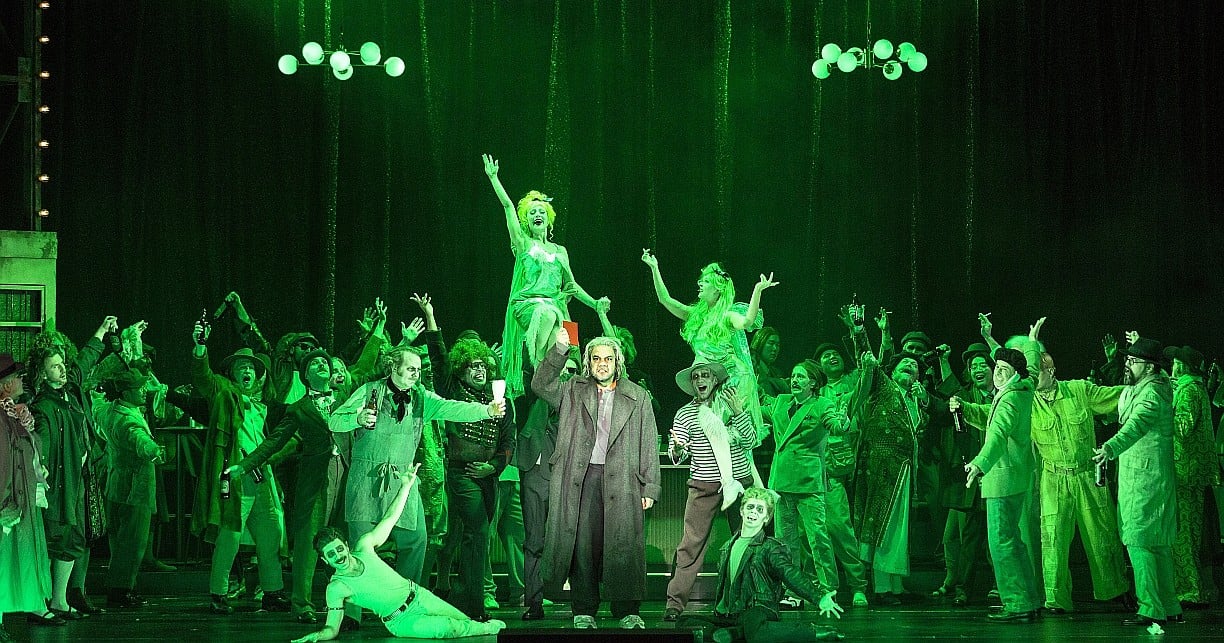
The frame for the episodic, highly disparate narrative is set by the first and last acts. Hoffmann is introduced in his favorite tavern as an artist whose masculine role has failed the heteronormative script. To console him, his gender‑fluid muse speaks in a sober, almost liturgical chorus and reveals that she loves the artist himself. To approach him more closely and to lift him out of his alcoholism and the torment of unrequited love, she—transformed into a man named Nicklausse—hopes to draw closer to him in a same‑sex relationship.
In the delirium of the following night, the relationship with his beloved becomes the focal point. Yet on a deeper level, the narrative probes Hoffmann’s self‑understanding as a man. When he first erupts in his “Klein‑Zack” aria about a misshapen dwarf who, “via fairy magic,” grows to a gleaming “zinnober” only to shrink back to Klein‑Zack at a climactic snap, it reads almost as a metaphoric lament for his own manhood and the misfortunes it has brought him.
But the real sophistication of the libretto lies in Hoffmann’s psychic fragmentation of his beloved Stella through the title character’s perceptions. From misunderstanding and despair, Hoffmann dismantles his object of desire into a sequence of fantasy figures springing from his internalized stereotypes of femininity: first the willful sex‑object Olympia, then the tender, vulnerable soprano Antonia, and finally the calculating courtesan Giulietta.
Split Personality
Offenbach and his librettist employ a dramatic device: the division of a single personality into multiple facets. Musically, Offenbach captures this theme with a short but piercing melody that first surfaces in a letter from Stella that Hoffmann tragically never reads: merely accompanied by a cello, she confesses her love and asks forgiveness. Shortly thereafter, the same melody reappears when Hoffmann, in a neurotic brainstorm, believes Stella possesses three separate souls.
This musical and textual splitting of his beloved into three projection figures reads as a mystic‑romantic anticipatory gesture to what psychoanalysis would decades later term as a crisis‑induced fragmentation of perception. It marks the entry into Hoffmann’s imagined world. Consequently, many productions cast the four female roles to a single soprano. And even the villains and antagonists—Coppélius, Miracle, and Dapertutto—are often sung by the same bass‑baritone. The latter’s interest in male mirror images adds a homoerotic facet to Hoffmann’s own shadowed masculinity, in which self‑sabotage repeatedly surfaces.
The queer community needs a strong journalistic voice — right now more than ever! Do your part to support the work of TheColu.mn.
Deconstruction of Societal Gender Roles
Indeed, the plot not only mirrors the inner workings of the protagonist’s psyche and the absence of relationships on equal terms, but also the rigid clichés of society. Offenbach previews psychoanalysis, and even anticipates postmodern deconstruction of gender roles. The apparent naturalness of these roles is revealed as a farce from this vantage point. Musically, this comes across in the artificiality of Olympia’s doll aria, where the extreme high, staccato coloratura demands virtuosic vocal prowess.
Direct link | Requires vocal acrobatics: Olympia’s Doll Aria
|
In Antonia’s death aria, the inner conflict about professional self‑realization emerges in a breathless, hysterical melodic line. And in Giulietta’s barkarolle, one of the most famous opera melodies ever, Offenbach uses a hypnotically repetitive motif in a swaying rhythm to underscore the femme fatale’s mesmeric seduction.
Hoffmann’s failure can thus be read as a sharp critique of the dominant gender order—but with Offenbach’s artistry, it remains in a musical‑aesthetic frame that preserves playfulness and fantasy. When Hoffmann finally declares that he will renounce love in favor of art, it also references Monteverdi’s Orfeo, marking the beginning of opera history—mythically, Orpheus, after losing Eurydice again, is said to have pursued only younger men thereafter.
This text has been revised from a piece that first appeared in the opera guide “Casta Diva.”