The Desire for a “World Organization” of Homosexuals (1920)
From the outset of the Weimar Republic, numerous local gay friendship societies had been founded. Through the article “From Club to World Organization” in the homosexual periodical “Die Freundschaft” (1920, No. 27, p. 2) it becomes clear that some people did not want to stop at that point and instead sought to unite all German friendship associations into a single “great federation, central association, or whatever it may be called.” Afterward they hoped to be “inspired by the German example” to connect internationally. The article ends with a programmatic appeal and the reiteration of the headline: “From Club to World Organization.”
The idea of a national federation was actually realized only a few months later, when the local associations in August 1920 merged to form the “German Friendship Association” (DFV) (see also Stefan Micheler: “Self-Images and Other-Images of the ‘Others’,” 2004, p. 5). The first international organizational consolidation of homosexuals, however, did not occur until about 30 years later: in 1951 Amsterdam saw the founding of the “International Committee for Sexual Equality” (ICSE). One can also point to the 1952 founding of the “International Homophile World Organisation” (IHWO) and the 1978 establishment of the “International Gay Association” (IGA, today ILGA).
Call for the Founding of Homoerotic Men’s Orders (1920)
In the homosexual magazine “Der Eigene” (1920, No. 2, pp. 13-15) appeared a “Call for the Founding of Men’s Orders.” The author’s name “Anagenetos” is a pseudonym meant to evoke ancient Greek and perhaps theological associations. The author spoke of his wish for a future order—fully aware that “the wheel of time keeps turning, toward a distant human ideal.” Just as in the Middle Ages, there was among “some people the old longing” to live together with “like-minded souls,” for the sake of future generations and for personal happiness. The “homoerotic” men were deemed particularly suited for this, because male communities could serve as a “substitute for a regulated family life.” An order should be a “communist community” in which “social and educational differences” would “crumble.” It envisioned “a simple shared dwelling” and a plain life, with every age welcome. The call targeted religious men of all denominations with a “homoerotic disposition.” The order should be aristocratic and follow a modified form of the Benedictine Rule.
This longing for an homoerotic, elite male order ties back to the tradition of monasteries and spiritual fraternities. Similar attempts to found elitist male homoerotic groups, such as lodges and the like, occurred more than once at the turn of the century, though with modest success. What was unusual was not the idea of an elitist male community per se—an idea that appeared in the milieu of the “Community of the Self” more than once—but rather the explicit religious reference with echoes of Catholic traditions.
There Will Be Full Understanding (Magnus Hirschfeld, 1920-1923)
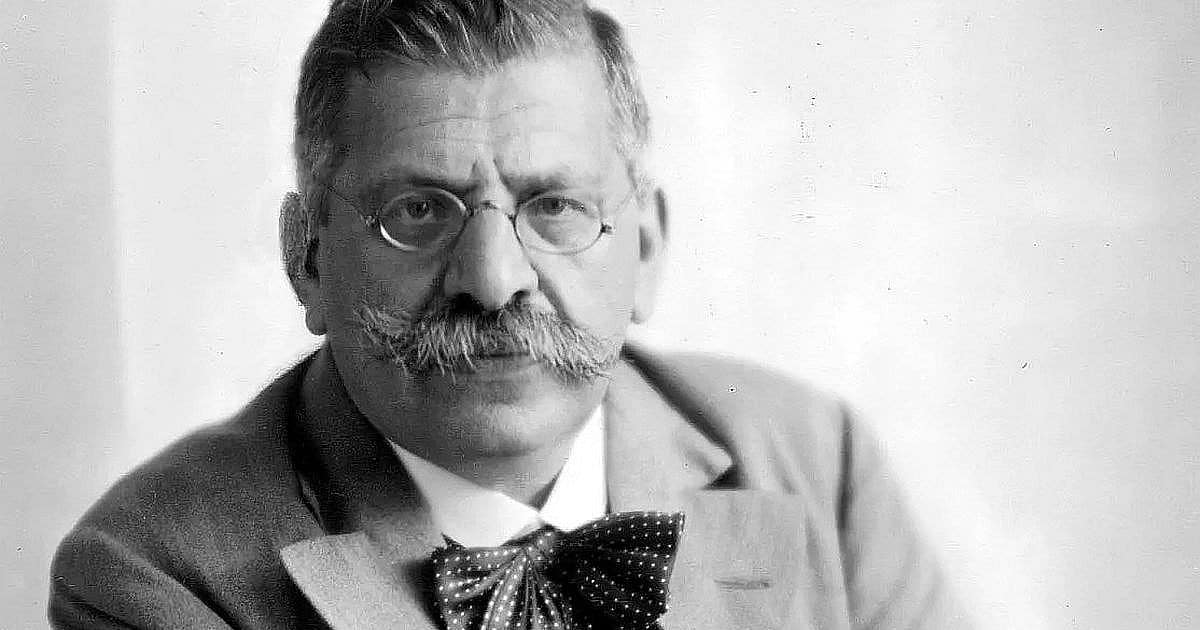
The situation of the gay movement in the Weimar Republic (1919-1933) can be summarized as a period of relative growth and visibility. Berlin remained the center of the homosexual movement, and Magnus Hirschfeld stood as one of its most important representatives.
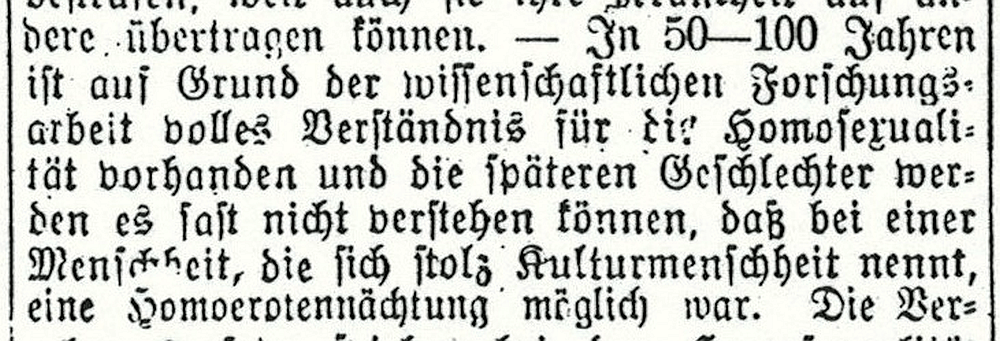
Hirschfeld remained optimistic about acceptance and legalization of homosexuality. On December 22, 1920, he closed one of his lectures with the proclamation that we “are surely moving toward a brighter future and will see the land of freedom.” In a Hamburg speech he stressed: “In 50 to 100 years, thanks to scientific research, there will be full understanding of homosexuality, and future generations will hardly be able to imagine that (… ) a homosexual aversion existed.”
Hirschfeld was a Social Democrat and, in his 1922/23 memoirs, drawing on August Bebel whom he had known personally, also spoke of a socialist “future state.” Yet he kept his own opinions in check, merely citing SPD politician Georg von Vollmar (1850-1922), for whom a sexual revolution and free love would only be realized through a social revolution. Vollmar had little hope that § 175 would be repealed beforehand (Magnus Hirschfeld: “From Then to Now,” 1986, p. 107). Thus Vollmar was as skeptical as Hirschfeld’s childhood friend, Richard Kandt, who told Hirschfeld that he would “never, ever” achieve his goal (idem, pp. 158-159).
An All-Mgay Theater Is Not a Utopia (St. Ch. Waldecke, 1924)
St. Ch. Waldecke (= Ewald Tscheck), a writer from the milieu of the “Community of the Self,” opens his article “The Theater as a Product of the Male-Male Eros” with the statement: “A theater founded on male-male eros is by no means a utopia.” By that time there was already a gay theater society known as the “Theater of Eros” (1921-1924?). Waldecke lamented, however, the lack of suitable actors and plays: “Like all great and living things, such a stage cannot be built overnight” and must be “nurtured in its growth and blooming.” But it should not be “too difficult to attract especially younger, rising talents.” “Such a theater, (…) would have the best audience there is: the youth.” He had begun plans and networking, harboring great hopes for a theater that could not alone abolish § 175 (“Der Eigene,” 1924, No. 5, pp. 211-223).
Wolf Borchers, in his dissertation “Male Homosexuality in Weimar Drama” (2001, pp. 165-177), examined both the “Theater of Eros” and Waldecke’s article and its aim: “Everything points to the fact that the attempt to establish a standalone, homoerotically specialized theater would come to nothing.”
Goals Included a Sports Bath and a Housing Cooperative (Adolf Brand, 1920/1925)
Since 1896, Adolf Brand (1874-1945) published his magazine “Der Eigene,” the world’s first regularly published homosexual magazine. With the “Gemeinschaft der Eigenen” (GdE) Brand formed a kind of homoerotic reading circle and published more works about this organization.
Brand’s worldview for his magazine stressed that “Der Eigene” stood on the “ground of individualistic anarchism,” with the philosophical program of Max Stirner and Friedrich Nietzsche as the future work program. He argued for “great and strong personalities” and therefore a need for “leaders and heroes” to be reborn in the present and future (“Der Eigene,” 1920, No. 10, December 3, p. 122). The more concrete future goals of the association were laid out in a new statute in 1925: a private light, air, and sport bath, a cooperative housing development with a publishing house, and a sanatorium and retreat home with lodging for traveling nature lovers and wanderers (Marita Keilson-Lauritz: “The History of Our Own History,” 1997, p. 133).
Aside from the publishing house Brand already ran, it seems these plans could not be realized. They illustrate the close ties between the GdE and the Lebensreform movement. Brand’s demand for “leaders and heroes” shows that as early as 1920 he linked his demands for homosexual emancipation with nationalist and volkish ideas. Twenty years later Germany would be at war. In Beat Frischknecht’s essay “A Book Project by Adolf Brand for the Second World War Era” (in: Capri, 2011, No. 44, pp. 38-43, PDF pp. 1900-1905), Brand’s postwar plans are outlined as he wrote in three letters in 1943: “As soon as the war ends, I want to reissue Elisar von Kupffer’s 1900 gay anthology ‘Liebesgesprenst and Friendships in World Literature’.” Frischknecht notes that Brand “was not only expecting an imminent end to the war but apparently also the ‘endsieg’.” The Nazi regime’s destruction of his existence is something he seems to have entirely overlooked. Brand died on February 26, 1945, in a bombing raid.
Hirschfeld’s Work Will Live On (“Friendship Banner,” 1935)
With the Nazi seizure of power, gay and lesbian life in Germany was radically and permanently destroyed. Thousands of gay men were convicted or died in concentration camps between 1933 and 1945. Only in the politically neutral Switzerland could a homosexual magazine appear even in the 1930s and 1940s. It bore the titles “Friendship Banner” (1932), then “Swiss Friendship Banner” (1933-1936), “Menschenrecht” (1937-1942), and finally “Der Kreis” (The Circle) (1943-1967), which, after 1945, also attracted international attention.
In the Swiss periodical “Schweizerisches Freundschafts-Banner” (1935, No. 11, p. 1) appeared a memorial for Magnus Hirschfeld, who had died on May 14, 1935, in exile in France: what he had accomplished would be “eternally remembered by a grateful contemporaneous and later world.” His book “Die Homosexualität des Mannes und des Weibes” (1914) “will probably remain a standard work.” Later in the same journal (1935, No. 19, pp. 1-2) it states: “His work will live on.”
At least as of 2025, that prognosis holds: Magnus Hirschfeld is not forgotten, and the mentioned book today no longer reflects current scientific and societal understanding, yet it remains a central historical source of the early homosexual movement and a rich repository on the lives and circumstances of homosexuals of that era. In this sense, it has remained a standard work.
The Utopia of a Gay Future Full of Love (Jack Argo in “Der Kreis,” 1956)
Jack Argo—pseudonym for Johannes Werres, one of the most active writers in the homosexual magazines of the 1950s—begins his article “The Future of the World. People Will Become More Human” (“Der Kreis,” 1956, No. 3, pp. 20-21) by addressing the Soviet Union’s politics, which he argues infringe upon individuals’ personal freedom and autonomy. Primarily, however, Argo, writing as Werres, articulates his own utopia: through cinema, radio, and television, people would expand and deepen their knowledge: “For the human being of the future, mere ‘living’ will not suffice if this life has no new center.” “When the object of fear has finally fallen away, such as the atomic bomb or a belligerent nation,” people will recognize their need for love. “This love will embrace all people indiscriminately of race, gender, and age (…), and therefore it will not condemn or suppress a disposition directed toward the same sex.” There is no other path, no matter how fantastical these thoughts may sound. For the homoerotic (that word would soon disappear), the task would be to live this life with ease, without fear of fellow humans, using prudence first and planning, but increasingly secure and strong, unmasked from the deadly mask that currently sustains this state of affairs.”
The “new center” the author envisions would probably be translated today as “self-actualization” or “meaning of life,” and is something people have always sought. Johannes Werres feared things that people still fear today—or fear again—like the atomic bomb or the “pursuit of Russia.”

The Distant Goals: Private Spaces and a Library (“Rolf” in “Der Kreis,” 1960)
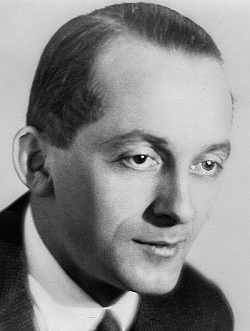
The leading figure in the editorial team of “Der Kreis” (1943-1967) was the actor Karl Meier, who used the pseudonym “Rolf.” In his article “The Distant Goal” (1960, No. 11, pp. 1-2), “Rolf” sketches the still-unfolded aims of the homosexual movement: the quiet but steadfast struggle against stigma and prejudice “will last for decades, perhaps even a century.” The magazine “Der Kreis” should be expanded further. In it, “writers of our kind” could publish their works for the first time, and “medical professionals and lawyers” could examine our tendencies from their professional vantage points. Also urgently needed were “own spaces” just for the readership of this community, including a library and rotating exhibitions. Here anyone could read a rare book, engage in discussion, recite poetry, or play music, for a few hours so as not to feel lonely. This space could become a corner of home for every homosexual. “That is and remains the distant, beautiful goal. We must continue to be optimistic and help build our future.”
The Circle maintained an organized readership that, in fact, created or rented such spaces—even if only within the limited framework available at the time. At least in the Circle’s Zürich headquarters, celebrations were held and plays were staged.
Now It Is the Next Gay Generation’s Turn (“Rolf” in “Der Kreis,” 1962)
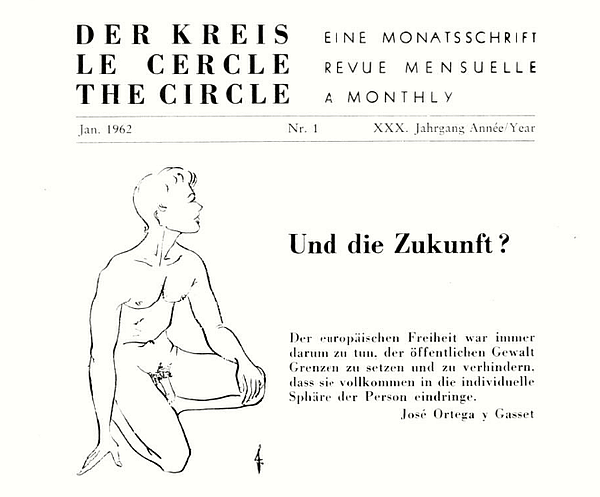
In early 1962, “Der Kreis” celebrated its 30th anniversary. On the cover, the question “And the Future?” (1962, No. 1, p. 1) posed, and on pages 2–4, “Rolf” looked back at what had been achieved and also outlined hopes for the future: “What remains for us to do? Nothing other than to stand up for what we consider our human right. (…) Now the appeal chiefly addresses the young! The creation of spaces of our own, spaces that allow us to be among ourselves with ease, is a task that must be taken up by another generation. (…) A club life must be taken into the hands of those who will shape it and whom it will someday serve.” The older generation would make room for the “initiating youth.” And just as the past still casts its glow on the necessary work, so too would the future once again bring joy to many and provide the certainty that our friendship is not a hollow illusion.
The Memory of Magnus Hirschfeld in the Year 3000 (1951)
In the Federal Republic of Germany, § 175 of the German Criminal Code, in its Nazi-amplified form from 1935, remained in force, keeping male homosexuality a crime and forcing the few activists who still existed in the 1950s to operate with extreme caution.
Herbert Lewandowski (1896-1996) was a pioneer of sexology who worked with Magnus Hirschfeld and other sexologists. His novel “A Journey into the Year 3000. Report of a Fantastical Adventure” (1951), published under the pseudonym “Lee van Dovski,” is influenced by H. G. Wells, famed for The War of the Worlds (1897) and The Time Machine (1895). Lewandowski even dedicates the Wellsian figure as a “friend.” The novel features a time machine—explicitly described as the same device Wells used in The Time Machine (p. 130). It becomes clear early on that the first-person narrator is Lewandowski himself. He ponders work conditions, architecture, clothing, television (p. 117), and a cashless society in the future, but also friendships and sexuality. His question to the future about how to handle homosexuality (p. 196) remains indirectly answered: by a return to the “free concepts of Greece” (p. 103) and by the idea that everyone should be allowed to be “what he aspires to be” (p. 188). The protagonist emphasizes that his own fate in the first half of the 20th century was “not being allowed to be what one is” (pp. 178-179). He presents himself as a man who is sexually attracted to a woman (pp. 87-91, 118-119), yet also notes: “(We) poets perhaps have a slightly feminine sensibility. The conquest of women does not give us as much pleasure as it does to other men. We want to be taken ourselves” (pp. 171). Before Hirschfeld, who sought “understanding and recognition for my life’s struggle” (pp. 81-82), he expresses great respect because Hirschfeld tried to achieve equal rights for homosexuals. The novel’s protagonist (Lewandowski) hopes that Adolf Hitler’s name will be forgotten in the year 3000 (pp. 242-244).
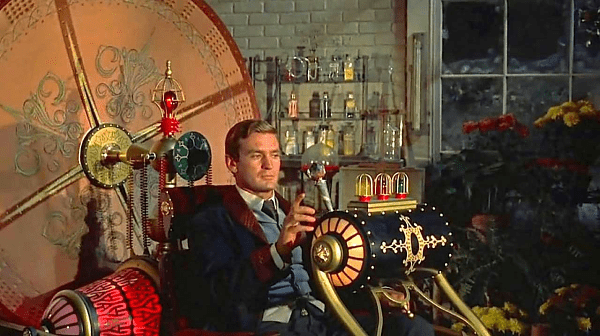
Lewandowski’s remarks about his future visions or hopes for homosexuality are brief and vague. His remarks about Hirschfeld go little beyond his own anticipations for the year 1951. His wish that Adolf Hitler be forgotten (and that the Nazi era not be re-literated) is arguably typical of the zeitgeist of the 1950s.
A Robot as an Erotic Companion (1965)
From the 1950s into the 1970s, the United States saw the rise of so-called beefcake magazines, which focused on images of attractive men. In many cases they targeted a gay readership and evaded censorship by presenting themselves as fitness or bodybuilding journals. The best-known beefcake magazine was “Physique Pictorial” (1951-1990), with the word “Beefcake” often rendered as “muscle brute” or “cream-cut.”
In a 1965 issue (October), a photo shows two nearly naked men. On the left is an open box labeled “The Century Robot.” The caption notes that it is a film scene featuring Jim Paris and David Mineric. Such a double-marketing of themes in beefcake magazines and homoerotic short films for a gay audience was not unusual. (A compilation of a five-second excerpt from this film can be viewed on the Bob Mizer Foundation’s website.)
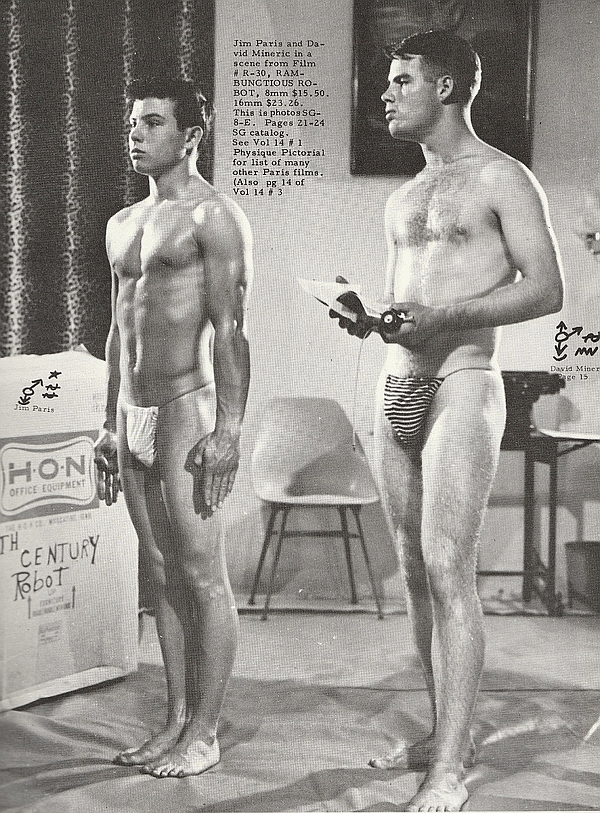
The term “robot” has existed since 1920; the first industrial robot was unveiled in 1956. The notion of robots that feel emotions is possibly as old as film characters like Tobor in “Tobor the Great” (1954), R2D2 and C3PO in “Star Wars” (from 1977), and Data in “Star Trek: The Next Generation” (1987-1994), and even in the film “I, Robot” (2004). In some films, even gay robots appear (Woody Allen’s “Sleeper” (1973), “Gay Robot” (2006), and several episodes of “The Simpsons” (e.g., 10/9, 16/5, 16/15, 20/4, 23/9, 23/17). It is unfortunate that I found no pieces about how the influence of robots on gay life was assessed in earlier times. Between erotic projections onto robots and today’s high-tech silicone dummies, there seems to be a direct link.
The queer community needs a strong journalistic voice—especially now. Make your contribution to secure the work of TheColu.mn.
On the Need for a Sexual Revolution (Felix Rexhausen, 1965)
Although the journalist and writer Felix Rexhausen (1932-1992) wrote his novel “Zaunwerk” in 1964, it was not published until 2021 from his estate by Benedikt Wolf. It ends (p. 167) with the protagonist Roland meeting a boy and wondering “what would become of this boy someday.” He also contemplates what might have happened to him if he had held back less in earlier years, and he imagines the possibility of “one day catching up” on all that he had “forbidden himself” in previous years.
Rexhausen’s better-known work is “Lavendelschwert. Documents of a Strange (Later: Homosexual) Revolution” (1966). In this political satire, gays stage a revolt and attempt—a few years before Stonewall—to spark a revolution in the bourgeois Germany of the 1960s. Looking from a 1966 perspective, the work is set in the year 1975. (The year is based on a wordplay involving 175 and § 175 StGB.) For the 1978 reissue of “Lavendelschwert,” Rexhausen wrote: “Today one can read this book and then wonder how obviously positive things that seem so normal today would have seemed fifteen years ago, and they were not.” (Reprinted in the 1999 reissue, p. V). Rexhausen hit a nerve, so the gay magazine “Du & Ich” (1970, November, p. 5) rightly asked readers: “Are we ready for a revolution?”
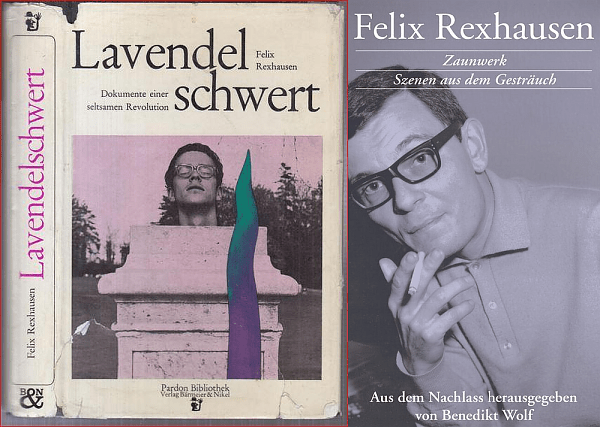
“Lavendelschwert” reads today as if it anticipated the Stonewall uprising of 1969 in New York’s Stonewall Inn—and thus the birth of the modern gay rights movement. It also, from a gay perspective, offers a critical look at the era’s gay men. Rexhausen remained a committed ally and commentator of the gay movement and gay life. In 2015, the BLSJ (Bund Lesbischer & Swhuler JournalistInnen) secured a city square in Cologne named after him. I thank Benedikt Wolf for pointing to the text locations.
Three years after the release of “Lavendelschwert,” the German federal government reformed § 175 in September 1969 so that sexual acts between adult men were no longer criminal. This marked the beginning of a new era, whose future stories I will discuss in the next part.