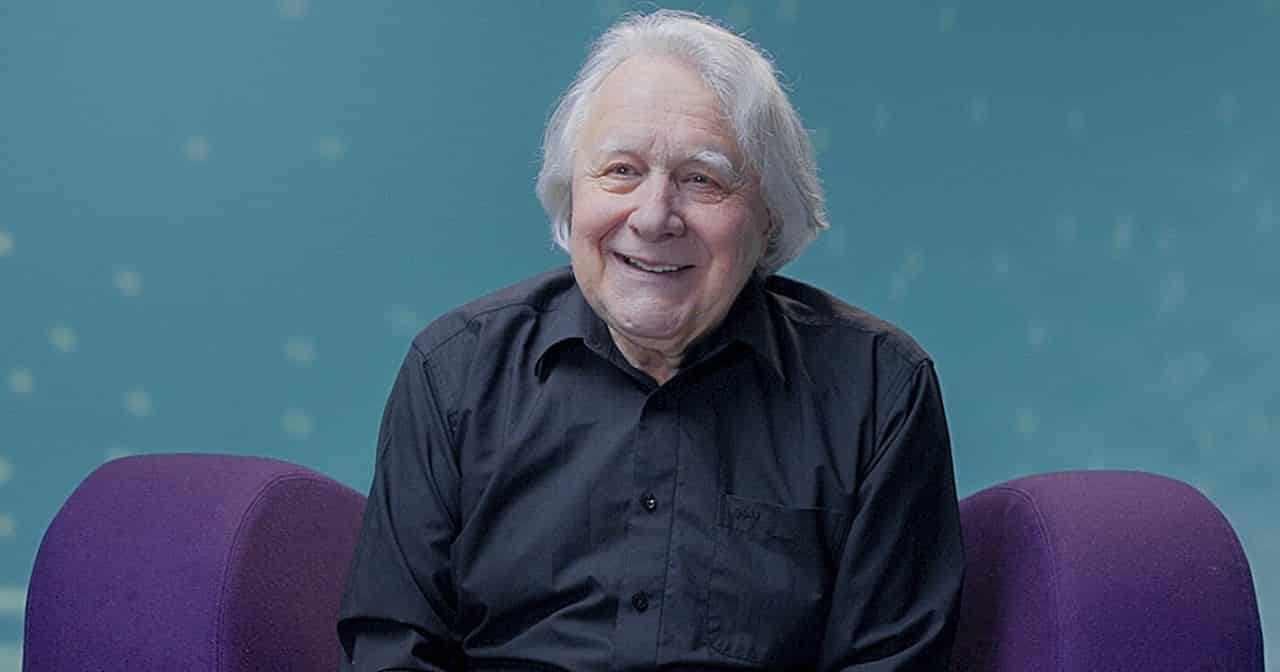
You’ve spent almost thirty years slipping into the role of Hildegard Knef’s invented twin sister…
It was 1996 when Irmgard came into the world — in the legendary “Café Anal,” run by a left-anarchist, gay–lesbian collective in Kreuzberg.
Since then you keep reinventing her. Each show feels like a work in progress: a continuous engagement with Hilda’s biography and her songs. Do you now feel you can say more about Hildegard Knef than she could herself?
No! (laughs) Certainly not. I never truly met her. This figure, this Irmgard, has nonetheless become an alter ego for me. Not one I sought, but one that found me.
How so?
A lot of what I put into her comes from my aunt, born in 1925 — this generation of Flak helpers: too young to shoulder responsibility, and yet old enough to have been shaped by it. That mentality seeps into Irmgard. At the same time, I’ve spent decades studying Knef. Even the centennial celebration still revealed new insights for me.
On stage you look like Hilde, you speak like Hilde, you sing like Hilde. Who exactly is Irmgard Knef?
Irmgard is the supposed identical twin sister of Hildegard. From the outset there was a line: “When the Kessler twins began to make a splash in 1948, Hildegard told me: Irmgard, forget it — I’m making my own career.”
The one goes to America…
… and marries Kurt Hirsch and becomes a world star. The other — with the same talents — stays in Berlin’s backstreets and becomes the perpetual underdog. That’s where the joke comes from: the loser presents the winner’s life, without bitterness but with humor. My first program wasn’t titled by chance “Arising from Ruins.”
So it’s not mockery but a tribute?
Yes, but a very special one. Even with Irmgard, red roses rain down — yet roses have thorns. When Hildegard died in 2002, Irmgard found her own purpose and became an independent artistic figure. The idea that Knef could have had a twin sister with whom she sang “Fever” — that thought is simply funny.
Above all, Irmgard carries on the “Knef spirit.”
Yes — that Berlinish bite, the laconic, the “chin up, even if the throat is dirty.” And she is — like Hilde — never maudlin. A character who looks back but also weighs the present in her own way. A piece of Knef’s character remains alive through Irmgard.
You don’t see yourself as a comedian or a drag queen. How would you describe Irmgard as a stage figure?
I play an older woman; gender hardly matters here. She sees herself as an entertainer. Hilde already possessed a certain androgyny, which only grew with age — I carry that in Irmgard as well. I step out in pants, a jacket, and some sparkle, never as the young Knef, but as the older, more fragile version. That fragility has always attracted me as a performer.
Was there a moment during your first performance when you knew: Irmgard will be the role of your life?
Yes. I came from theater, directing, dramaturgy, evening management — I hadn’t planned to act full-time. But this character seized me.
How did that happen?
My first performance at Café Anal happened around two in the morning, just after the police had left because of a noise complaint. I sang three or four Knef songs, with the mid-range voice filtered out. Live, with my own lyrics. And it was clear: the queer-Lesbian audience immediately understood I wasn’t imitating Hildegard but playing Irmgard. Instead of “But she was so lovely,” Irmgard sang “Yes, that wasn’t so lovely” — those kinds of twists. From the start, my texts connected with the original.
And when Hildegard died in 2002…
… Irmgard could finally come out as someone who wasn’t always number one but stood in the second row. Hildegard had always been first: the first leading role after the war, the first nude scene, the first German on Broadway, the first public coming out about her battle with cancer… The flip side to that was my core idea: the other side of the same coin.
That almost sounds philosophical: the idea that for every feeling, its opposite is present at the same time.
Some of her songs toy with this thought: splitting and then recombining, “I’d like to part from myself, if possible for a long time; it’s not enough to know me better, I don’t like myself anymore — I’m sorry.” Or “If my life had been different, they would have named me Natasha.”
And you transformed “Natasha” into “Hildegard”?
Exactly. Not to forget: “One and one make two.” Such lines inspired me right away. They contain poetic imagery and practical wisdom. Told through the loser Irmgard, they show her from a different angle. From the start, it was clear: I would play with outer recognizability — wig, glasses, voice — but I would never caricature. I used her quirks to convey my own messages.
Direct link | Irmgard Knef sings “Der Lack ist ab”
|
So Irmgard became, somewhat by chance, an icon for all the divas in the second tier?
Yes, following the motto: “If I’d lived in New York, I’d have become a star…” This wounded diva — that was a motif that ran through my show from the start.
Where did the story go from there?
A small hype followed: Spiegel wrote about me in 2000, then Die Zeit and many other outlets. The Kleine Theater in Friedenau was packed for years. And the question always lingered: How would Hildegard react?
And? What did she think?
I sent her my first CD. She listened and said, “Well, she has my blessing.” That mattered a lot because back then some outlets wanted to use me for a live confrontation with her — to see how Hildegard would respond. I was very careful. But the issue was settled once it was clear I wasn’t stealing from her; it was similar yet different: something entirely my own.
What does the queer audience mean to you?
It’s enormous. A mix of gay men, heterosexual couples, older ladies — it creates a wonderful dynamic with cross-generational setups: a fifty-year-old son with his eighty-year-old mother, the aunt with the nephew. Younger audiences arrive when they’ve had some exposure to diva culture. I always say: the show is recommended for ages 40 and up. (laughs)
You sensed early on, as a teenager, that Knef was something special?
Yes — I’m from the mid-1960s. In my childhood she was constantly in the media, especially in Bild: headlines like “Death Struggle in Clinic” or “I hate all Germans.” When she went to America, some tried to brand her a traitor to her country. The big headlines, the mane, that voice. Add to that the very different judgments across generations: my grandmother saw her one way, my mother another. My father watched Die Sünderin in the cinema when he was sixteen, while my mother couldn’t even walk past the cinema poster on a Litfass pole due to social norms. Yet everyone knew her, and that fascinated me.
Does that combination of an aloof diva and Berlin bluntness particularly appeal to gay men?
Absolutely. The diva as an outsider who loves outsiders. That’s a queer primal motif. In particular, the German-language divas all share a deep, resonant voice — from Zarah Leander and Marlene Dietrich to Hildegard Knef — and a man can easily join in singing along.
Did your fascination with Knef influence your coming out?
Not exactly; I came out as a gay man at 25. But the man I fell for at the time reintroduced Knef into my life and that’s where it all began in earnest.
If you watch talk-show clips from the 1960s, you’ll notice how deftly Hildegard Knef handles hostile questions or even personal attacks. Hosts and audiences often seem petty and square — a trait that even showed physically. How far ahead of her time was Hildegard Knef?
Very far. She always carried a worldliness with her — even in a stifling postwar republic where the homemaker was the norm. She was the full opposite. As early as the fifties she said, “I’m not a girl. Everyone wants a girl, but I am a woman.” Yet she remained thoughtful enough to acknowledge she didn’t see herself as emancipated, because her path was so heavily shaped by men — directors, producers, record executives — even if she never embodied the “Forester’s girl.” True independence came only when she began organizing her tours with her husband. That was radical for the time. She understood very early that we live in a patriarchal structure — and that she had to carve out her own space within it.
Where did she get that clarity?
She was an intellectual, rational, observant person — but at the same time, warm and heartfelt. That’s a rare combination.
What role did her time in the United States play?
A major one. She wanted to shake off the constraints and become a world star — but that didn’t quite click for her. Still, she was our world star: a world star for Germany. And she brought that cosmopolitan ease back into the talk shows. It was incredibly admired. She embodied the unspoken wishes of many women stuck in roles. In New York she could be daring — a word that’s hardly used today. She allowed herself things others could only dream of.
Is that another reason she’s so beloved among gay men?
Yes, for her courage and her unapologetic approach. She said, “If the role requires, I’ll strip,” and she did just that.
You reference the scene from the scandal film The Sinner (1951).
I loved how she later commented on the public outcry around the film. The uproar over a mere one-and-a-half seconds of nudity, while just a few years earlier millions had been deported and murdered. She never understood that — and rightly so.
The queer community needs a strong journalistic voice — right now! Do your part to support TheColu.mn’s work.
When you read her book “Der geschenkte Gaul” (The Gifted Mare) …
… you sense how much a queer person can take from her worldview: the longing for beauty, for the extraordinary, for a life beyond the norm. And yes, she was vain, had a big and at the same time small ego — just like my Irmgard, only in a different way. (laughs)
You studied political science and wrote your thesis on Georg Kreisler. Did that help you handle the Knef texts?
Very much. With Kreisler you learn the courage to be ironic, to bite, to use dark humor. A dual edge that many people nowadays don’t grasp. This playful approach to sarcasm, double meaning, and self-irony — I picked up directly from him. My first chansons at the theater were Kreisler songs as well. It gave me the freedom to not simply interpret Knef in a dutiful way, but to work with warmth, wit, and bite at the same time.
What does this intense proximity to Knef feel like to you?
Hilde is like a favorite grandmother to me. I grew up without grandparents and always missed that. Knef feels like this cool, smart, world-traveled grandmother figure I would have loved to be friends with. So I simply created her for myself.
On December 28 and 30, 2025, a birthday special for the 100th birthday of the “Knefs” will take place at the Bar jeder Vernunft in Berlin.