When we travel with intention, a ticket takes us farther than simply arriving at a destination. It gifts us with new shared memories. It makes us feel like we’ve really gotten to know a place. It’s an invitation to build personal connections. With this series, created in partnership with KLM Royal Dutch Airlines, we invite you to make every journey something special. After Bangkok and Cape Town, in our third installment today we head to Mexico City.
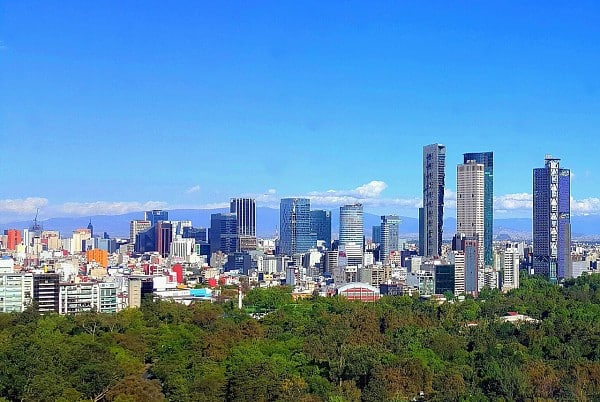
The capital of Mexico City is full of history, color, and a vibrant culture—and it offers highlights you simply must see. At the top of the list is the historic center with the Zócalo, the majestic Metropolitan Cathedral, and the Templo Mayor, where traces of the Aztecs remain visible. Art lovers should visit the Museo Frida Kahlo in Coyoacán, the so-called Blue House, where the famous queer artist lived and worked.
Equally impressive is the National Museum of Anthropology, where the pre-Columbian past and the living indigenous culture of Mexico are showcased. For modern architecture and urban flair, a stroll along Paseo de la Reforma toward the Ángel de la Independencia is worthwhile. If you want to briefly escape the big-city bustle, the Xochimilco neighborhood offers colorful trajinera boats and canals—a unique experience recalling the region’s ancient waterways.
But the following focuses primarily on the city’s queer side.
Zona Rosa: From the Gay Leather Bar to the Queer House
In the early evening in Zona Rosa: On Calle Génova the first pop remixes boom from open doors, while a group of young people gather in front of the Kinky Bar. Two teens in school uniforms kiss under a street tree, next to them a transgender woman sells handmade bracelets—she knows the street from a time when police raids were more common than party nights. Today she nods at visitors pre-drinking with plastic cups full of micheladas. The scene feels relaxed, almost casual. Yet those standing here are standing on historical ground: in no other neighborhood in the city was there such a fierce struggle to simply allow queer people to be present.
That today is possible becomes evident after just a few minutes. A gay couple from Puebla shows a tourist from Berlin the best way to walk to Tom’s Leather—“don’t take the detour through the dark side street.” Inside the bar, it smells of cleaning agents and cold smoke, a DJ is setting up his equipment. The bartenders joke, tourists snap a quick photo of the setup, then tuck away their phones because photography isn’t welcome. Despite the clear codes, the place feels less closed off than one might expect.
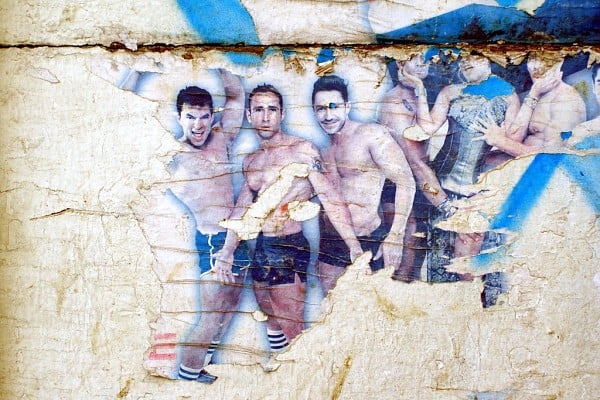
Completely different picture a few metro stops later—in the Revuelta Queer House in Roma Norte. In the afternoon students sit at large wooden tables, typing on texts, sipping cold coffee. On a staircase a drag collective rehearses a choreography that will later be performed in the evening—between an electro set and a poetry reading. A young nonbinary person with purple-dyed curls explains to a traveler from Spain how workshops are organized: “We do a lot via Telegram groups; the city funds little, we build our own structures.”
The mood in the community is raw, supportive, and direct
The energy in Roma is different: less touristy, more political. You can feel how queer identity is negotiated—not as a lifestyle but as a social reality. On the street, a group of lesbian activists sells stickers reading “No somos moda” — “We are not a trend.” Across the street, a collective distributes flyers about the situation of trans sex workers in Mexico, who remain disproportionately victims of violence. And yet there is a warmth that surprises many travelers: a bookseller, herself queer, offers recommendations of Mexican women authors who are barely read in Europe. A street musician thanks someone who slips a little change into his guitar case, and explains how the community brought him meals during lockdown months.
At night, a few blocks away, a courtyard in Colonia Doctores heats up. An anonymously announced gig by a DJ collective draws a diverse crowd. Techno blends with cumbia rhythms, the floor dusty. The bars are makeshift: coolers, plastic cups, a few strings of lights. Beside the dance floor, an activist tells the German visitor about a harassment incident that only came to light thanks to social media. Meanwhile, people dance, laugh, smoke— without grandiose drama, but with real stance. The mood is raw, supportive, and direct. Many say that this is exactly where the city’s true queer culture is born—in these off‑spaces.
The Pride Parade draws a million people
The queer highlight is, of course, the Pride March—the annual Pride parade, which with a million participants ranks among the largest in the world (2026’s parade will be held on June 27). By mid-morning the Ángel de la Independencia fills up. As the procession moves toward the Zócalo, the mood shifts into festival mode. Trucks thump, people dance everywhere, drinks, chips, and glitter are on sale. Tourists are pulled into the flow without hesitation. Parade participants share sunscreen and water, pose for photos, translate banners.
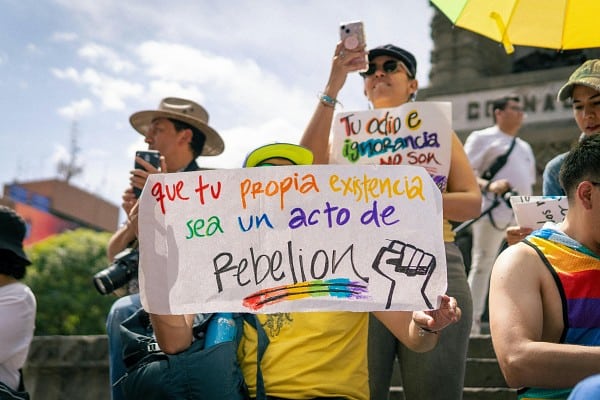
On the Zócalo, the enormous plaza in front of the cathedral, euphoria, anger, and heat mingle. Speeches alternate with spontaneous mini‑parties. And despite a crowd of a million, the atmosphere feels surprisingly solidarious.
Queer travelers often leave Mexico City altered, not with the memory of a colorful backdrop, but with a sense of a community that has built a network where a stranger never truly feels foreign. A city that not only lets you celebrate—but invites you to understand why celebrations here are more political than in many other places around the world.
KLM flies daily from Amsterdam in about twelve hours directly to Mexico City. There are connecting flights from nine German airports. There are additional daily flight connections with KLM partner Air France via Paris. Book now