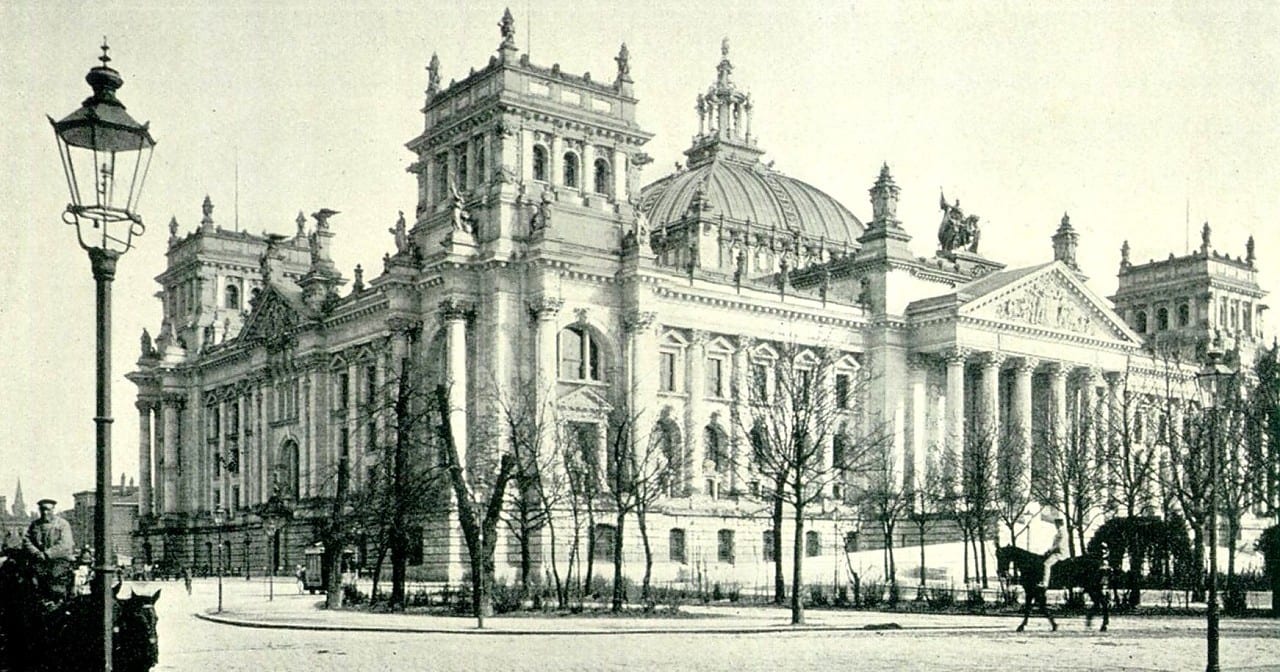
The author and homosexual activist Richard Linsert (1899-1933) wrote in his instructive book “Kabale und Liebe. Über Politik und Geschlechtsleben” (1931, pp. 494-505) about how the esteemed former Reichstag deputy Maximilian Pfeiffer (1875-1926) of the Catholic Center Party was accused in 1907 of having a sexual relationship with the younger Anton Montag. He also reported Pfeiffer’s ties to the early homosexual movement, namely the Wissenschaftlich-humanitäre Komitee (WhK) led by Magnus Hirschfeld, in which Linsert himself had been active for many years. What happened at the time and what consequences did it have for Pfeiffer?
The Backstory: A Theft and a Flight
The twenty-year-old bank clerk Anton Montag (1887-?) was accused in February 1907 of stealing a registered letter worth 1,431.31 marks. He went on the run and sought refuge with a pastor in Tübingen, where he was arrested and brought to trial. On July 9, 1907, the proceedings against him for theft took place. In this trial Pfeiffer appears as a witness; among other things, it revolved around whether Pfeiffer had helped Montag flee with money and whether he had arranged contact with the pastor. Montag was convicted of theft and sentenced to eight months in prison. Pfeiffer came under pressure and filed a criminal complaint against himself for “abetment” (the crime of the theft) against himself (“Gelsenkirchener Allgemeine Zeitung,” July 13, 1907). This case was dropped on May 22, 1908 (“Sauerländisches Volksblatt,” May 28, 1908).
The Denunciation in the Newspapers
According to Linsert, the anti-homosexual denunciation of Pfeiffer unfolded as follows: The Augsburg Abendzeitung (March 21, 1907) reported: “Pfeiffer’s thick friendship with the youthful Montag arouses general head-shaking, all the more so since Montag, although a pretty lad with delicate skin, is not a man who could satisfy a cultivated person as a partner.” In response, Pfeiffer explained—also to the Bamberg newspaper “Bamberger Tageblatt” (March 26, 1907)—that there had been “damned rumors.” He thanked “the local press heartily for not becoming accomplices in the filthy slander,” and stated that he would “in no point of my private and public life shy away from clarification.” At this time Pfeiffer lived in Bamberg, where he worked as a librarian.
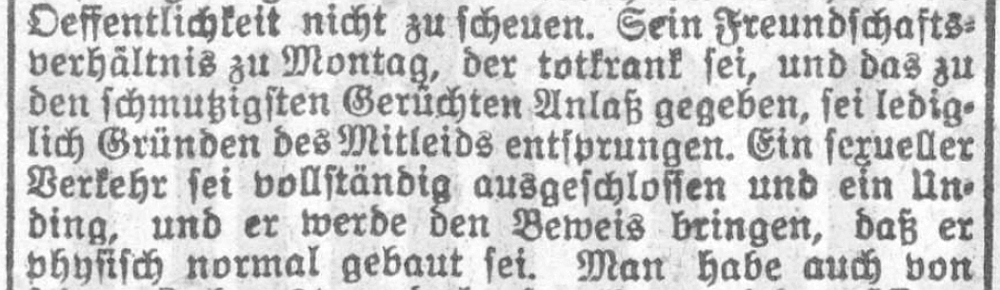
In the “Münchner Neuesten Nachrichten” (Linsert places the date as March 26, 1907; the article actually appeared on March 27), the matter was treated in depth: this newspaper noted that Pfeiffer’s friendship with Montag gave rise to “the dirtiest rumors.” He publicly defended himself at a meeting and declared, “a sexual intercourse is entirely impossible,” and he would “prove that he is physically normal” (this phrasing should be read in light of the era’s stereotypes about homosexuality). A few months later, on July 9, 1907, the trial against Montag for theft was opened. The “Augsburger Anzeiger” published a detailed report of the proceedings. According to that report, Pfeiffer was “charged by the court with maintaining a culpable relationship” with Montag. Yet this apparently had no further consequences for Pfeiffer. It is possible Montag testified that he had had a relationship with a “girl.” The lack of a broader denunciation against Pfeiffer for homosexuality in the press may also have been due to Pfeiffer’s threats of defamation suits or the bourgeois press’s skepticism about the accusations.
Where possible with little effort, I have checked the sources Linsert cites. Of the newspapers named, only the “Münchner Neuesten Nachrichten” is available online. The quoted substantial article was found not in the March 26 edition but in the evening edition of March 27, 1907, on page 2. I have no reason to doubt Linsert’s other source references and quotations.
Pfeiffer’s Connection to the Early Homosexual Movement
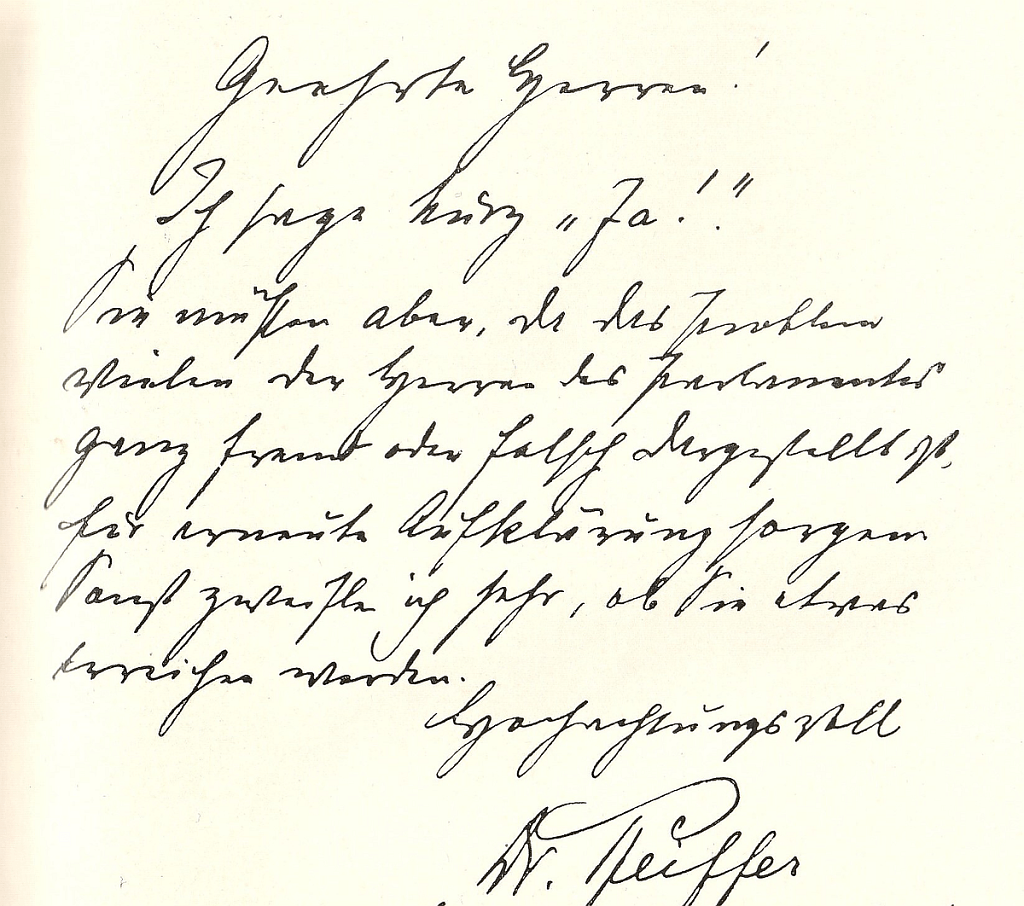
In two places in his book Linsert discusses Pfeiffer’s links to the early homosexual movement. First, Pfeiffer’s reply to a question from the WhK about his stance on repealing § 175 of the Reich Criminal Code (RStGB) is noted. Pfeiffer answered on January 1, 1912: “Dear sirs! I say briefly ‘Yes!’. You must, however, since the problem is unfamiliar to many of the gentlemen in the Parliament or misrepresented, provide further elucidation. Otherwise I doubt you will achieve anything. Respectfully, Dr. Pfeiffer” (pp. 494-497). It is striking that, despite this unequivocal “Yes,” Pfeiffer was never listed as a supporter of the petition to repeal § 175 in the WhK’s rosters. The WhK would presumably have published the signature of a prominent Reichstag deputy like Pfeiffer. It is possible that Pfeiffer did not want to publicly disclose his position on § 175 because he was a reformist within the Center Party on this issue. Linsert notes that “some time ago” members of the Center Party’s Reichstag faction visited the WhK to scrutinize the material and confirm its authenticity in the struggle against § 175.
Secondly, Linsert notes: “Even in the years 1922 to 1923 he (Pfeiffer) was thoroughly informed about the status of the movement against § 175, and he gave valuable suggestions to bolster the movement’s force” (p. 505). Given that Pfeiffer was subjected to an attempt to brand him as homosexual in 1907, his indirect support is notable. Pfeiffer may not have been the sole “affected” person navigating a hostile, homophobic milieu who chose to aid the WhK only indirectly and not publicly. It seems plausible that after 1907 Pfeiffer might have preferred not to speak publicly about homosexuality due to the negative experiences he had endured. Linsert’s reading suggests empathy for Pfeiffer’s position, especially since Pfeiffer likely understood firsthand how quickly someone could be torpedoed by a sexual accusation.
Pfeiffer and the Center Party’s Politics
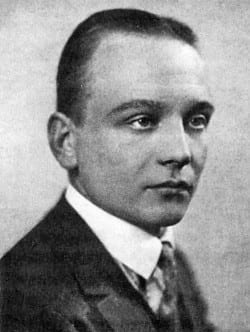
Pfeiffer sat in the Reichstag as a member of the German Center Party, the party of Catholics and the Catholic political movement. Because of its Catholic orientation, the party as a whole was squarely opposed to the WhK’s agenda. Pfeiffer’s liberal stance placed him in the minority within his party. He was a prominent representative of the party’s “left” wing, promoted Christian trade unions, and advocated for the Weimar Republic. Notably, after 1918, although he resided in Bavaria, he did not join the reactionary Bavarian People’s Party (BVP), but continued to run for the Center Party in Berlin—somewhat akin to how the CSU and CDU would later form a parliamentary configuration at the national level for several years. These background details fit Pfeiffer’s unusual openness toward the WhK petition.
Today Misstated: There Was Never a § 175 RStGB Case
Bernd-Ulrich Hergemöller wrote in his biographical lexicon Mann für Mann (2010, pp. 922-923) that Pfeiffer “was accused by the Bamberg court of ‘unlawful relations’ with the 19-year-old bank clerk Anton Montag (…); however, he managed to settle the proceedings.” This is a misleading formulation.
In Wikipedia, this has been turned into the false claim: “Before the Bamberg Amtsgericht Pfeiffer was charged under § 175 (…); the case was settled by compromise.” (The page number 533 refers to an earlier edition of Mann für Mann.) In fact, no case against Pfeiffer under § 175 RStGB ever occurred, and the Wikipedia entry should be corrected accordingly.
What Remains
What remains is a relatively mild denunciation that did not injure Pfeiffer politically. If Pfeiffer had been imprisoned, I would not find the case more exciting. It is not about determining whether Maximilian Pfeiffer was homosexual or about reclaiming him as a homosexual. Rather, the aim—guided by the same intent Linsert shows—was to illustrate what a sexual denunciation meant at the time, how Pfeiffer was denounced, and how he responded. Pfeiffer’s denunciation can be read in connection with the Harden-Eulenburg affair (1907-1909). These legal proceedings and the reports surrounding them vividly demonstrated to the public how potent sexual denunciations could be and that sometimes suspicion alone could damage an unpopular figure. Today there are several monographs on the phenomenon of sexual denunciation that show that political interests, personal conflicts, or other motives could underpin such acts. Linsert clearly shows deep respect for Pfeiffer, whom he regarded as one of the most capable people in his party, even praising him for showing extraordinary personal courage in the scandal. For Linsert, this case was “a classroom example of the extraordinary danger that same-sex relationships can pose to an active politician,” and one of the most remarkable cases of the unfortunate entanglement of politics and sexuality. Pfeiffer, fortunately, escaped with a black eye.