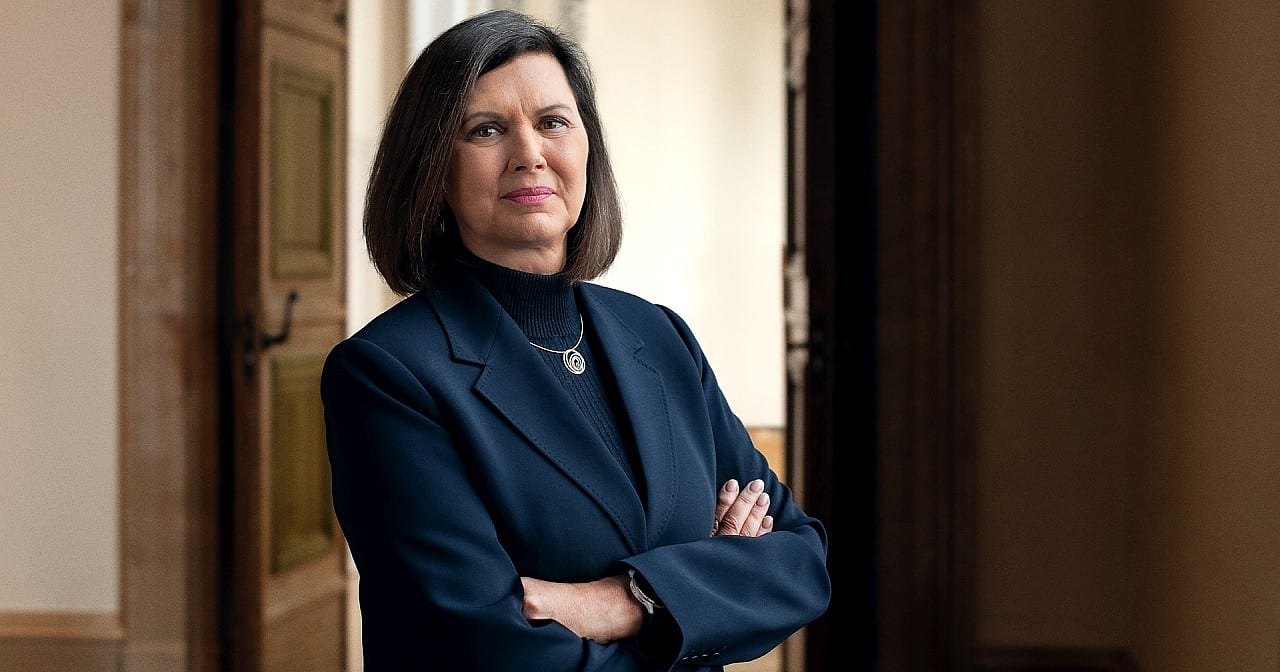
Germany is all but certain to elect its first female president: after the CSU, the CDU has also settled on Bavarian State Parliament President Ilse Aigner as its candidate. According to information from the German press, Chancellor and CDU leader Friedrich Merz intends to officially propose the 61-year-old to the leadership bodies of his party this Sunday and Monday. The Union and the SPD hold a slim majority of roughly 50 votes in the Federal Convention, which will elect the successor to Federal President Frank-Walter Steinmeier on January 30. SPD leader Lars Klingbeil has already signaled his support.
The Greens, despite criticizing the Union’s process, also show sympathy for Aigner. “We appreciate Ilse Aigner. In her previous political offices she has always come across as approachable and responsive,” said party floor leader Britta Haßelmann. Aigner is opposed by the AfD and Die Linke. If elected, she would be not only the first woman to hold the highest state office but also the first CSU politician to occupy Schloss Bellevue.
From a queer perspective, Aigner’s career is notable because it moves from opposition to legal equality to clear gestures of solidarity with the LGBTQ+ community.
2013: Family as the “backbone”
For a long time, Aigner defended the homophobic stance of her party. In March 2013, when the Union, after a Karlsruhe ruling on adoption rights, debated equal rights for registered civil partnerships alongside marriage, the then Federal Minister of Agriculture explicitly opposed equal rights for lesbian and gay couples. She argued that the family is a “backbone of society” and therefore deserves special protection—indeed, she said, constitutional protection as well.
After moving to state politics, Aigner kept to this course. When the Bavarian parliament on November 30, 2016 voted on a Green proposal to push for marriage equality at the federal level, the then Minister for Economic Affairs voted no. The CSU majority rejected the proposal 71 to 49, claiming that same-sex marriage was not compatible with Article 6 of the Basic Law (German constitution).
Homosexual rumors: “That’s more than shabby”
Personally, the topic hit home for Aigner in 2017. In an interview with Spiegel, the unmarried politician addressed for the first time rumors that she might be lesbian. “And it really angers me. So: I’m not it,” she said. At the same time, she made clear that sexual orientation should not be a reason to discredit someone: “That is more than despicable. Privatizing the private lives of others for political gain is basically bottom-barrel.” Aigner noted that a single woman is often viewed as a “completely unacceptable condition,” lamenting: “One can be divorced, married four times, be gay, lesbian, or something else, but being single—there is something wrong with that.”
That Aigner’s private life remains a topic is illustrated by an interview of a fellow party member, Monika Hohlmeier, with Abendzeitung (subscription article). When asked about Aigner being single, the CSU politician replied: “We are not valued only if we have a man by our side.” She dismissed rumors of a relationship between the two as “nonsense”: “If we were lesbians, we would show it openly; that’s no longer a problem today.” There are homosexual colleagues in the CSU as well; some have chosen to go public, others keep it private. “In Bavaria, life goes on and lives are allowed to live!”
Backing for Tessa Ganserer
Since 2018, as state parliament president, Aigner shifted focus. When Green deputy Tessa Ganserer came out as the first transgender member of the German parliament in early 2019, Aigner told her in a private conversation that she should be addressed as a woman in the state parliament. In a plenary session, Aigner urged deputies to address Ganserer as a woman in private conversations.
In 2022, under Aigner’s leadership, the state parliament placed the homosexual victims of National Socialism at the center of its annual Holocaust remembrance. At the Flossenbürg memorial, Aigner dedicated a commemorative plaque honoring the victims of Paragraph 175. “With this year’s focus, we want to give a voice to homosexual victims,” she said. She also reminded everyone that queer people around the world still face discrimination, hostility, and laws targeting them.
Rainbow flag in front of the Parliament
In July 2022, at the initiative of the Greens, SPD, and FDP, Aigner for the first time allowed the rainbow flag to be raised in front of the Maximilianeum for Munich’s Pride. “Respect and tolerance are not only values enshrined in our Bavarian constitution,” she explained at the time. The flag, she said, stands for diversity, tolerance, and openness—“very democratic values,” she told the Süddeutsche Zeitung. It is a symbol of equality, acceptance, and solidarity with queer people, she added. Whether Aigner has revised her stance on marriage equality since then has never been publicly explained. (mize)