The queer historical drama “Rose” by Markus Schleinzer has won the Günter Rohrbach Filmpreis 2026. The €10,000 main prize was awarded Friday evening at a gala in the Neue Gebläsehalle in Neunkirchen, in the Saarland. Together with the Austrian director, the producers Tobias Walker, Philipp Worm, Karsten Stöter, and Johannes Schubert were honored. In addition, two of the four special prizes went to “Rose.”
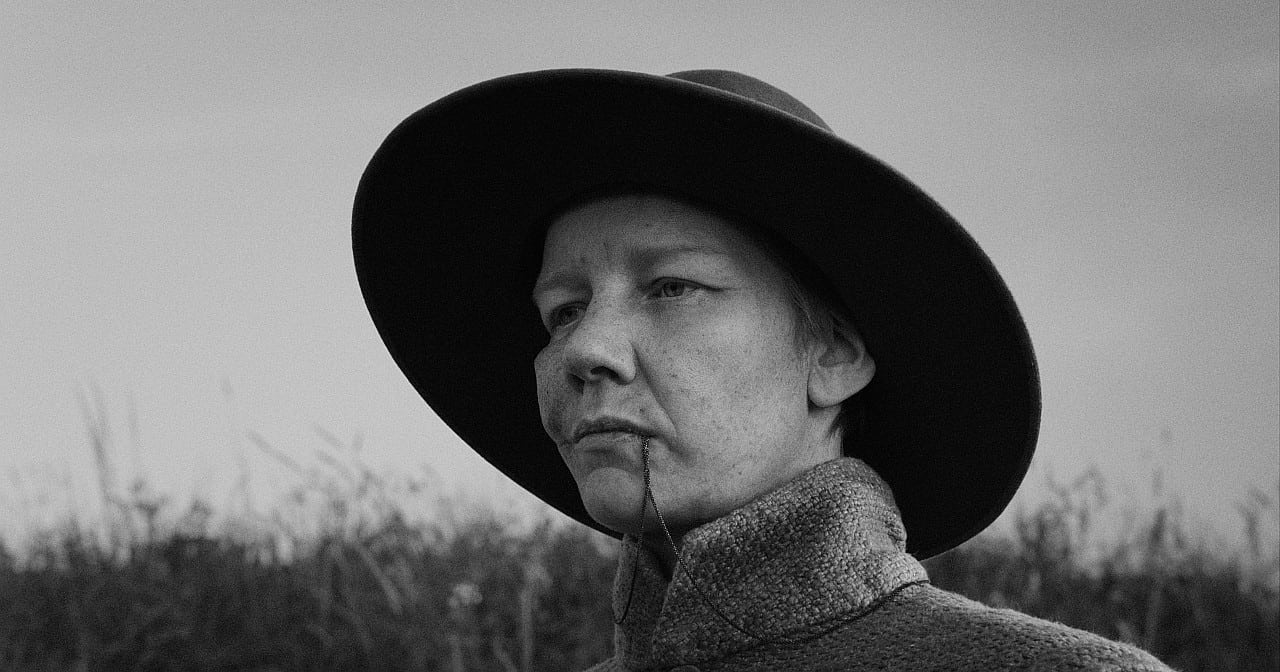
Shot in black and white, the film stars Sandra Hüller as a woman who, after the Thirty Years’ War, arrives as a soldier in a remote Protestant village, where she assumes a male identity to run a farm and marries the young Suzanna. When Rose is unmasked, the village community shows no mercy (TheColu.mn film review). For the story, Schleinzer and co-author Alexander Brom researched more than 300 historically documented cases of women who lived as men.
“The film tells the story of a woman who, in the patriarchal 17th century, resists social constraints and asserts the right to self-determination,” reads the jury’s statement led by president Sönke Wortmann. “It is an powerful plea for self-empowerment and the right to shape one’s own identity and life story.” In its restrained storytelling, “Rose” also unfolds “a concentrated cinematic poetry and, not least, celebrates the possibilities of cinema.”
Schleinzer: “Wie Figuren sexuell begehren, gehört den Figuren”
Schleinzer emphasized at the Berlinale press conference in February that he himself is queer. Queer identity and queer history are therefore always part of his work. The relationship between Rose and Suzanna is left deliberately open. “How characters desire sexually belongs to the characters,” the director said in an interview with TheColu.mn ahead of the film’s release. He does not want to present it as, “this is a film about two lesbian women desiring each other,” but rather: “a film about perhaps two lesbian-desiring women who nonetheless want more freedom in society.”
Even if Rose is not a trans man in the contemporary sense, the character crosses the norms of her time and does not settle for the gender-assigned role. Lead actress Hüller sees a link to the present. “Our freedoms are hard-earned,” she told the weekly Die Zeit (TheColu.mn reported).
Prices for Caro Braun and Tara Nome Doyle
The €5,000 prize from Saarländischer Rundfunk went to Caro Braun, who lands her first big film role with Suzanna. The jury praised how the initially reserved, submissive young woman develops into a self-confident person with a strong will and clear stance. “Especially in the intimate, chamber-play scenes with Sandra Hüller, presence and acting maturity are demonstrated. The tension that arises here enriches the film.” Braun had come out as trans on Instagram last month.
With the Mayor-President’s Prize (€2,500) the Berlin-based singer and composer Tara Nome Doyle was honored for the film’s music. The soundtrack consists of ten a cappella pieces she composed and recorded in multiple vocal layers. The music harmonizes with the images in a special way and lends the film a mysterious, wistful atmosphere, the jury said.
“Rose” has already received numerous awards: Sandra Hüller won the Silver Bear for best acting in a leading role at the Berlinale in February; in September the film was named Best Film at the Ludwigshafen Festival of German Film (TheColu.mn reported). The Austrian-German co-production is also in the running as Austria’s submission for the Foreign Language Oscar (TheColu.mn reported).
Valerie Pachner and Charly Hübner also honored
The acting prizes, endowed with €3,000 each, went to Valerie Pachner for her role in “Vier minus drei” and to Charly Hübner for “Spaziergang nach Syrakus.” The Minister-President’s Prize (€3,500) went to the production companies Pandora Film Produktion and Florida Film, also for “Spaziergang nach Syrakus.” In addition, Liv Lisa Fries and Leonie Benesch accepted their prizes from the years 2024 and 2025 in person.
The Günter Rohrbach Filmpreis has been awarded since 2011 by the Günter Rohrbach Filmpreis Foundation together with the city of Neunkirchen, marking its 16th edition this year. Entries can be feature films of at least 80 minutes in the category “Work Life and Society.” This year, 60 films were submitted, eight made it to the final selection. The namesake is the Neunkirchen-born producer Günter Rohrbach (born 1928) known for “Das Boot” and “Berlin Alexanderplatz.”