A young woman experiences the first and most staggering orgasm of her life — during a lesbian encounter. Afterwards she is so overwhelmed with happiness that she must tell someone about it. And she does so — singing, on an opera stage in Venice in 1651.
That is how Vienna-based dramaturg Kai Weßler described the extraordinary moment during the orchestra dress rehearsal at the Berlin State Opera.
The principal character is named Calisto, and the supposed lover is none other than Diana, the goddess of the hunt, who has devoted herself to a vow of chastity. But appearances are deceiving: in truth she is seduced by Jupiter, the king of the gods, who has taken on the form of Diana for the occasion. It is one of the most astonishing deceits in the history of opera in a work dating back roughly four centuries, which the Norwegian director Stefan Herheim now stages at the Berlin State Opera.
A Play with Sexual Desires and Shifting Identities
When Francesco Cavalli’s La Calisto premiered in Venice, opera as public entertainment was still a young art form. Only in 1637 had the first public opera house opened in the lagoon city. Unlike the aristocratic performances of earlier decades, the Venetian theaters had to attract paying audiences. And they demanded not only lofty feelings but also risqué entertainment.
To satisfy that appetite, myths from antiquity supplied ample material. The immortals were by no means moral exemplars: they desired, deceived, and schemed, while humans were left to contend with their caprices. The librettist Giovanni Faustini drew on Ovid’s Metamorphoses and turned it into a game of sexual desires and shifting identities. The fact that Diana leads a circle of women who want to live without men is more than a mythic aside: The goddess and her companions have become a crucial motif in the cultural history of lesbian desire.
From Baritone to Soprano
Moreover, in Herheim’s staging Jupiter’s transformation takes on a surprisingly queer dimension. For the god-king not only assumes the form of a woman, but also switches vocal ranges: from baritone to soprano. Cavalli himself had already embedded this effect in the music. Milan Siljanov, who portrays Jupiter, suddenly must sing in the high tessitura of Diana. What on stage might look like a modern drag performance is therefore already embedded in the score.
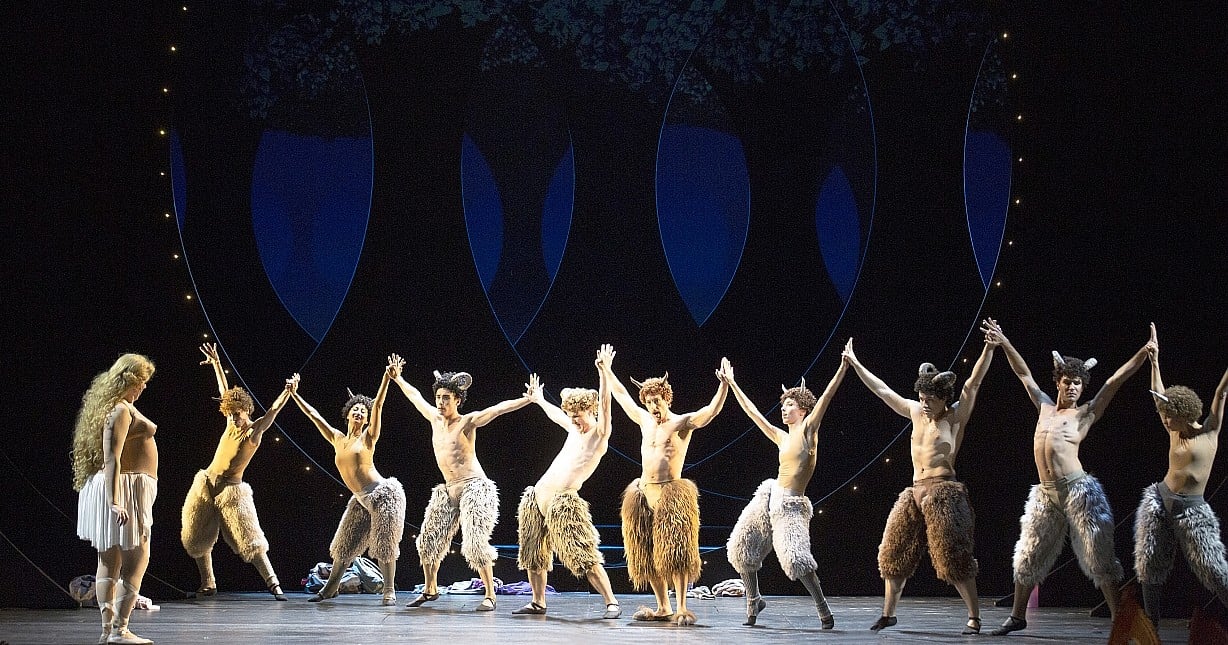
Herheim relishes these transformations with evident pleasure. Yashi’s costumes play with gender roles, fetish fantasies, and a generous dose of extravagance. Diana’s companions appear as Amazons with bare breasts and bows, Satyrs with horns and shaggy legs populate the stage. Jupiter, too, makes a magnificent figure as a woman. And with Linfea, another nymph from Diana’s retinue, a female character appears who is sung by a man: the tenor Marcel Beekman portrays her with pronounced comic temperament. Into the jubilant mood also flows the dance ensemble, whose playful choreography is directed by Beate Vollack.
Anything But a Reverently Conserved Museum Piece
Not only are the genders and desires fluid in this opera, but the stage itself as well. Silke Bauers’ magic-box set taps into the tradition of the baroque theatre-in-a-box: Perspective walls shift, telescope apart, and with the help of modern projections transform into forests, moonlit landscapes, or a starry sky.
Musically, La Calisto is far from a reverently preserved museum piece. Christina Pluhar and her ensemble L’Arpeggiata take advantage of the freedom that Cavalli’s sparsely worked score leaves open. Historical instruments, improvisatory flair, and rhythms that sound surprisingly contemporary combine to create music that swings between intimate tenderness and riotous comedy. When the Satyr on stage engages in a walking bass with a grand dance, the sound momentarily even hints at Broadway.
Direct link | Impressions from Stefan Herheim’s staging
Even amid the relish for transformations, one must note a tension in the libretto. As Sven Limbeck points out in the gay opera guide Casta Diva, the lesbian love in La Calisto ultimately reveals itself as veiled heterosexuality. The same-sex longing thus becomes a tool of a god who seeks to overcome chastity. Herheim counters that limitation with an exuberant universe of sexual possibilities. And when Calisto finally strides on stage as a glamorous diva with a fur coat and sunglasses, she appears to have emancipated herself from the gods’ schemes and freed herself from their manipulations.