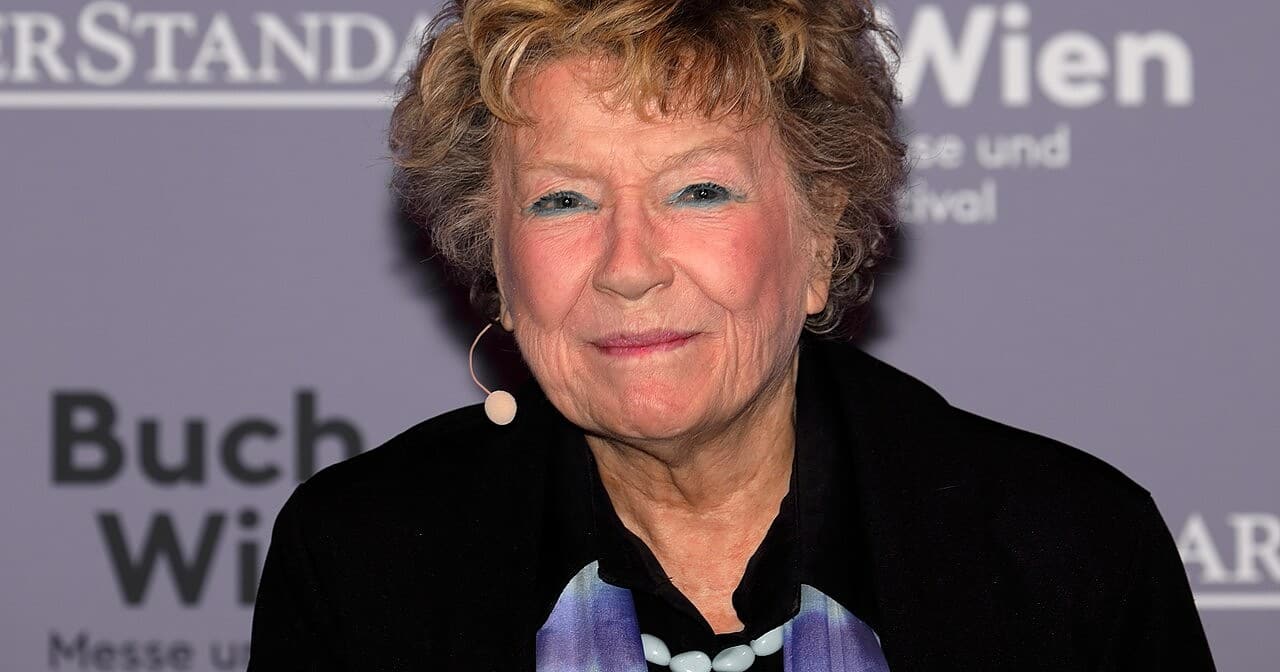
Maybe she did glance at the phone after all when the Nobel Prize in Literature was announced again. The name of the Italian writer Dacia Maraini has surfaced for years in conversations about potential laureates. Yet this time the phone didn’t ring either; the call didn’t come. For decades she has been one of the most important voices in Italian literature. It’s no accident that she’s often described as its grande dame.
Violence against women, forced prostitution, incest, or lesbian love: Maraini tackles topics in her books that Italians long preferred to keep quiet. She writes about female self-determination in a society where women are too often confined to traditional roles—about abuse and humiliation, and also about resistance to patriarchal power.
‘I never liked celebrations’
Next Friday (November 13) Maraini will turn 90. The writer, whose trademark is always impeccably applied blue eyeshadow, doesn’t want to celebrate. “I never liked celebrations,” she told the ANSA news agency. Her schedule, however, is far too full for that. “Life goes on, I work constantly, even on Sundays. I do what I enjoy: I write, I read. My life has always consisted of that.”
The body of work speaks for itself. Her output includes not only novels but also essays on contemporary culture and feminism-era critiques, as well as feminist plays. Almost all of her books hold a mirror up to society. For “Children of Darkness” (1999), which deals with abused women and children, Maraini was awarded the prestigious Italian prize Premio Strega.
Her commitment does not come from nowhere. Born in 1936 in Fiesole near Florence as the daughter of an ethnologist and a painter, and raised in Japan, Maraini spent part of her youth with her poor noble grandparents on Sicily. Raised by progressive parents, she experienced a culture shock there in Bagheria near Palermo and confronted the traditional male-dominated culture of the Mezzogiorno, the southern part of Italy.
Historical novel about a deaf duchess
Those years left a lasting mark on her work. She even dedicated a book to Bagheria: “Bagheria — A Childhood in Sicily” (1993). Sicily also features in her perhaps best-known work, “The Silent Duchess” (1992). In it she portrays the life of the deaf Duchess Marianna Ucrìa in 18th-century Sicily and her struggle for emancipation and equality.
Equally formative was her time in Japan. Her parents emigrated there with her in 1939. The year 1943, however, changed the family’s fate. As anti-fascists, the parents and their children were interned in camps, with hunger and exhaustion shaping their lives there. “A terrible wound that I carry with me,” she calls those memories. Japan was an ally of Nazi Germany and Benito Mussolini’s fascist Italy.
Kampf um Frauenrechte im Mittelpunkt
At the start of her career, Maraini began to build a name in smaller circles with her journalistic writings and early books. She endured for a long time the machismo and misogyny that characterized Italian society in the 1960s. She lived for two decades with the writer Alberto Moravia, yet often stood in his shadow and was seen as his writing partner or girlfriend.
In 1962 she achieved her first major success with “Days in August.” The novel follows a 14-year-old girl who during the summer holidays first encounters the predatory gazes of young and old men and experiences her first sexual encounters. More books followed, many of which were translated into German. The throughline in nearly all her works is the struggle for women’s rights.
Awarded for Lifetime Achievement
Maraini is among the world’s most-read Italian authors, and her books have been translated into 20 languages. On the occasion of her 90th birthday, Folio Verlag is releasing the German first edition of her short story “Girls from Palermo” (Ragazze di Palermo) and a limited special edition of “The Silent Duchess.” In Italy she is regarded as one of the most important voices and a feminist pioneer. In addition to the Premio Strega (1999), she was also honored with the Premio Campiello (1990) for lifetime achievement. Yet the world’s highest literary award, the Nobel Prize in Literature, has so far eluded her.
New book already in the works
“My dream was always this: to write pages that the people who read them will love. Nothing more. I have no other ambitions,” she once said in an interview when asked about the Nobel Prize. She doesn’t seem entirely indifferent to the possibility, though. A few years later she admitted: “I hope it comes. But the most important thing is not to chase after it, or you’ll live in fear.”
Either way, Maraini keeps moving forward. She’s already working on a new book again. “But I’m not going to talk about that yet,” she told ANSA.
She continues to weigh in on social and political issues. Several times a month her opinion pieces appear in the newspaper Corriere della Sera. And for the new generation—young women and men—she advises in light of the current global situation: “Be attentive.”