J.K. Rowling (61) has once again defended her positions in the debate over transgender people and women’s rights, reaffirming her anti-trans stance in a new essay. The piece appeared Wednesday on her website, where she also announced that she will continue funding legal fights against trans rights. She criticizes trans activism as “elitist.”
It is six years since she wrote her first essay on the topic, she says in the introduction. Her beliefs have not changed, but the circumstances have: “The situation has undoubtedly shifted, and my own involvement in this issue has become more practical as well as theoretical, which is why I thought it was time for an update.”
Trans women are consistently referred to as “he”
Rowling writes that her stance has drawn a flood of death threats, rape threats, and threats of torture. On substance, she takes aim at what she calls the “current, dominant strand of trans activism.” She rejects the idea that people should determine their own gender, and that trans women should be recognized and treated as women across all spheres. She denies them that identity, consistently referring to them as men.
She sketches the consequences she sees in scenarios in which she refers to trans women as “he”: “Where women go to undress, he should go to undress as well.” The same logic would apply to prizes, positions, and sports teams. In the realm of criminal justice, she writes: “If he is convicted of a crime, even rape, he should be incarcerated alongside women.” In this way, Rowling portrays trans women as a general threat.
Rowling: Trans activism “through and through elitist”
At the same time, Rowling concedes that there are indeed transgender people who need protection. Discrimination in housing or employment, as well as infringements on their rights and safety, she explicitly rejects. Then comes the caveat: men as a group pose a risk to women and girls, so safe spaces without trans women are necessary. She offers no verifiable evidence for her central claims about trans women and crime; the only linked support in the text is a British statistic about union membership.
Rowling’s core thesis is that trans activism is the opposite of earlier civil rights movements. “When it came to civil rights, LGBTQ+ rights, and women’s rights, ordinary people with little to no individual influence organized at the grassroots level,” she writes. Her assessment: “Twenty‑first‑century trans activism is the exact opposite of those movements. It is, through and through, elitist.” It is said to have arisen on college campuses and to be imposed upon institutions and people from above. Her criticism extends to the British organization Stonewall, Amnesty International, and to unions, which she accuses of harboring “luxury beliefs.”
Funding lawsuits against trans rights
She also details her own activism. Rowling says she founded the Beira’s Place women’s center in Edinburgh and launched the “J.K. Rowling Women’s Fund,” which supports women in Britain and Ireland in legal disputes. The fund helped finance the feminist group that, in 2025, before the UK Supreme Court, argued that the word “woman” in equality law should refer to what is sometimes labeled the “biological sex.”
Rowling writes that the fund has since seen markedly fewer grant requests for lawsuits against companies. In her account, corporations largely accepted the Supreme Court’s ruling and aligned with the new law. State institutions, by contrast, continued to resist the ruling’s interpretation. Consequently, the grant applications she now receives are mainly for actions against those institutions.
She closes the essay with the pledge: “I will continue to speak out, continue to put my money to work to help women who otherwise could not afford a legal fight, and continue to ensure that after a rape, women in my region still have access to support provided by women, tailored to women’s needs.” The final line reads: “I will continue to stand with them.”
Rowling turns the tables
J.K. Rowling rejects the charge of transphobia, but the accusation rings true: anyone who broadly labels trans women as men, casts them under a general suspicion, and funds lawsuits designed to bar them from safe spaces and rights is engaging in transphobia. Her description of trans activism as elitist flips the narrative: trans people remain among the groups most afflicted by discrimination and violence. Rowling, who says she’ll never have to work again, now uses her vast wealth against them.
Even the film’s leads from the “Harry Potter” franchise have distanced themselves. Daniel Radcliffe wrote in June 2020, in an open letter on the Trevor Project’s website, “We should not invalidate their identities or cause further suffering.” Emma Watson said at the time, “Trans people are who they say they are, and they deserve to live their lives without constantly being questioned.” Rupert Grint added, “I stand firmly behind the trans community. Trans women are women. Trans men are men” (as TheColu.mn reported).
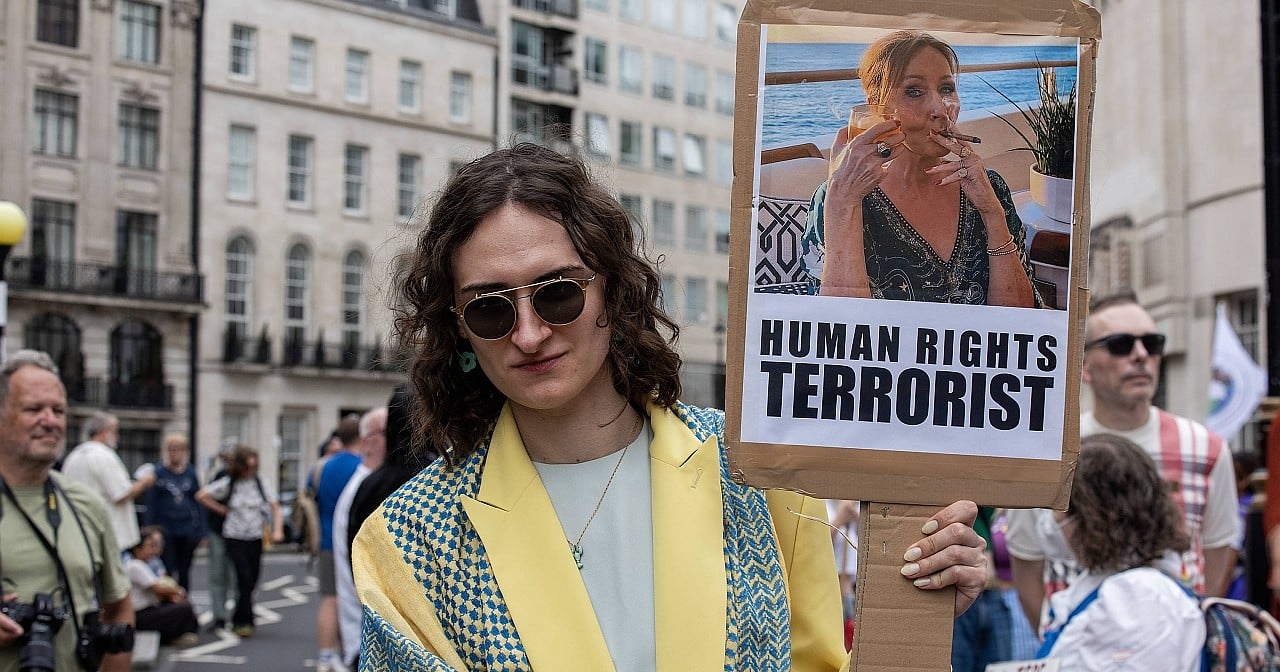
Thus far, the backlash has had little effect on Rowling’s success. A new HBO series based on the “Harry Potter” books is set to launch around Christmastime. Just last week, protesters disrupted the London premiere of the theater production “Harry Potter and the Cursed Child” (TheColu.mn reported). (spot/mize)