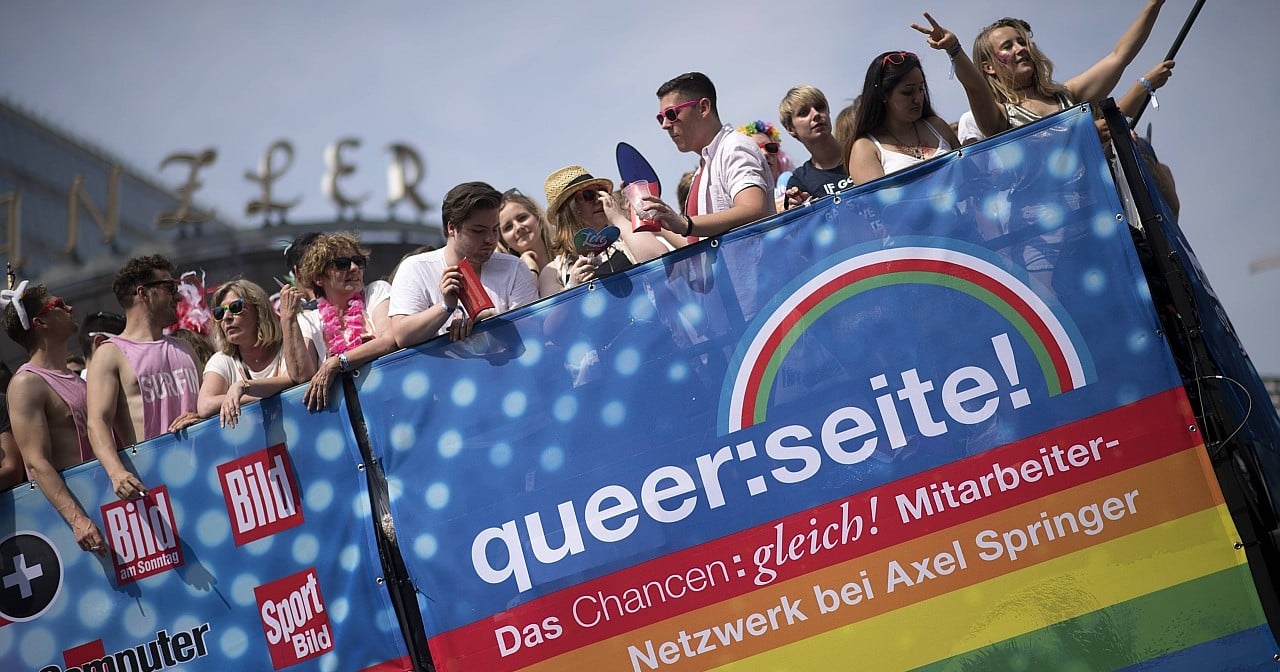
The Axel Springer Verlag marks its 80th anniversary this year, and from a queer perspective these eight decades form a history of contradictions. “Bild” spent decades turning homosexuals into the subjects of sensational headlines. Today, the group outwardly champions LGBTQ+ rights, yet its media properties are rallying against the Self-Determination Act. Since 2014 there has been an internal queer employees network, the “Axel Springer Queer Page,” now with 820 members.
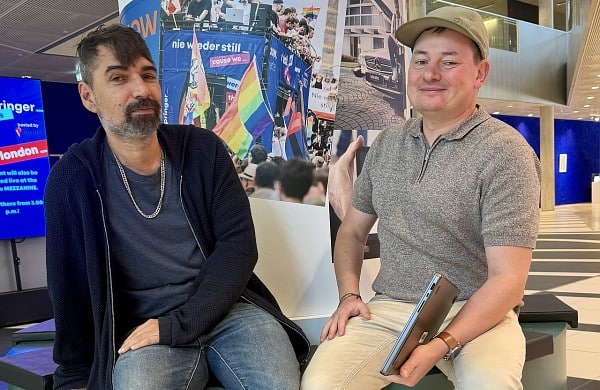
How do all of these threads fit together? We spoke in the venerable Journalists’ Club at the Springer building with Philipp Kaste and Dirk Walsh of the “Queer Page” about the era of homophobic reporting, the boundaries of free speech, “old-conservative” colleagues, culture wars at Springer—and why, despite criticisms of “Bild,” they still enjoy working for the media group.
Why was there a need for a queer employee network at Axel Springer in 2014?
Philipp Kaste: When I started at the “BZ” in 2013, I wondered whether there was a queer group. There had been earlier attempts, but not enough people ever came together.
Dirk Walsh: You can’t just call up HR and say, “Tell me all the gay, lesbian, or non-binary colleagues.”
Philipp Kaste: We went looking on our own. It was important to us to get the backing of the board.
Were there real obstacles?
Philipp Kaste: Not so much obstacles, but the house back then, despite its openness, still carried a certain venerability. The way I’m dressed now, I wouldn’t have gotten into the venerable Journalists’ Club. We wanted to prevent colleagues who were socialized differently from pushing back against us. We presented it to the board, led by Matthias Döpfner. He said he thought it was wonderful and had long looked forward to someone finally doing this.
What has changed because of the “Queer Page?”
Dirk Walsh: We created awareness that you have to actively work to make people feel safe showing up to work as their whole selves: “Bring your whole self to work.”
Phillipp Kaste: We’ve made sexual diversity visible within the company. Today it feels completely natural. For instance, if a transgender person starts here, no one asks, “How do we do this now?” It’s more like, “Okay, cool. Do you need help?”
And where does your influence end? Do you step in if something in the editorial offices disturbs you?
Dirk Walsh: None of us would stand in front of an editor-in-chief to try to restrict editorial freedom. But we do have the freedom to address issues and publish something ourselves if we disagree.
Philipp Kaste: We love to argue in this house. (laughs)
Dirk Walsh: What does arguing mean? We debate loudly. That’s also diversity: that we don’t all have to agree. You have to tolerate that different viewpoints exist side by side, without someone coming at you with a cudgel and saying, “Let me muzzle you.” We rely on that ourselves.
Is there a boundary for you where you say: This is no longer a legitimate disagreement, but a targeted attack on queer people?
Philipp Kaste: At some point we integrated into our strategy that we address matters internally if we see something we don’t find acceptable. In 2022, for a guest post, this happened. The piece — and you can quote it — was a “crappy article.” We addressed it openly, which sparked a huge internal backlash. First the piece itself, then when Matthias said: This article is garbage; we don’t want to see that again. That triggered counterarguments that it was a violation of free speech. That discourse ultimately led — and I’m personally not unhappy about it — that some old-conservative people left the company.
Dirk Walsh: There was a small wave of people leaving because Bild is too queer, because the place is too “woke.”
Philipp Kaste: Some who found Springer too “woke” are now at “Nius.” I personally take that somewhat as a success of our “Queer Page.”
The guest post from back then with the headline “How ARD and ZDF are sexualizing and reeducating our children” is no longer online. Did you push for its removal?
Philipp Kaste: No, we can’t do that. After about a week it was removed due to an editorial decision. After that, mechanisms were tightened, for example in the oversight of guest contributions.
Last year Jacques Schuster again wrote in Welt am Sonntag that LGBTQ+ topics are being “bothered,” and asked if it might be “a little quieter.” You publicly disagreed with the piece with “No, we won’t be quieter.” How did that play out internally?
Philipp Kaste: We thought: This is not acceptable. We wrote to the editor-in-chief asking if we could publish a counterpoint. The response was: “Go ahead.”
The Schuster article remains online.
Philipp Kaste: Of course. That’s part of it. Schuster’s op-ed is, unfortunately, an opinion that not only he holds but that a portion of society still holds. It’s important to widen the range of viewpoints so that the other side can also weigh in.
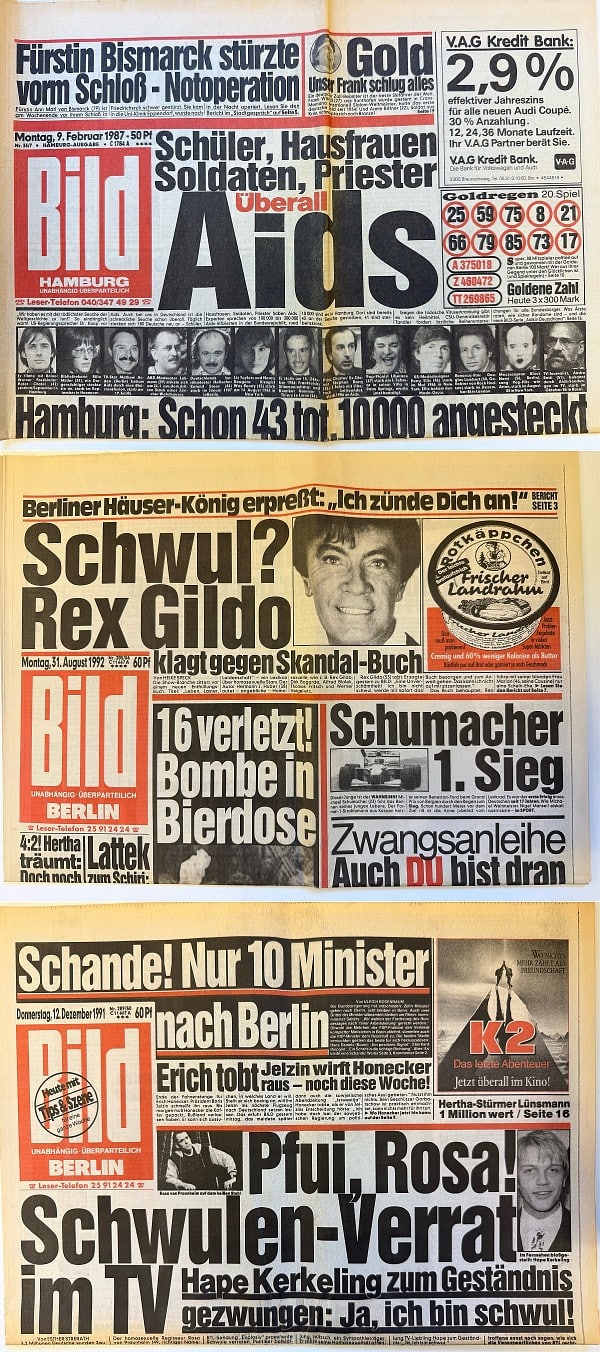
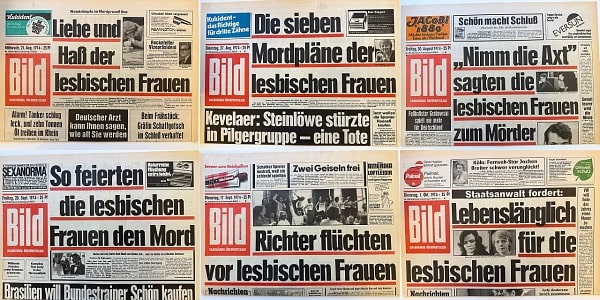
If you look back on 80 years of Springer, you find headlines like “The homosexual lust-murderers” or “The crimes of lesbian women,” but also coverage of the Walter Sedlmayr murder with the headline “The killer came from behind.” Shouldn’t the company’s cultural shift include confronting this past in journalism?
Dirk Walsh: This must be seen in the context of society as a whole. Back then, being a gay man was nowhere near funny. And we don’t even want to talk about trans people.
But doesn’t that argue for an apology or at least a reckoning?
Dirk Walsh: No, of course not. But with whom would you conduct that reckoning? The people who wrote it aren’t around anymore.
Philipp Kaste: Newspapers — and this isn’t exclusive to Springer — reflect their own era as well.
But wouldn’t a historical reckoning be desirable in principle?
Philipp Kaste: Absolutely. I wouldn’t limit it to queer people, but to how minorities were written about in the seventies and eighties across all media. How, for example, the Yugoslavs were written about: it’s appalling. Such a reckoning would be worthwhile. But even if I publish it, someone who seeks the negative fact will always pull it forward again.
For a segment of the public, the Bild brand is so morally discredited that the internal changes to the corporate culture don’t matter. Max Goldt called it an “organ of malice” and said working with it is socially unacceptable. What does such fundamental rejection trigger in you?
Philipp Kaste: A political influencer, Fabian Grischkat, essentially told me the same in a chat. Even after I answered Schuster, he said he still couldn’t take it seriously. Anyone who works for this group would practically have to quit if they were truly openly queer. That’s a knockout argument. It deprives everyone of a basis for discussion. If someone throws that at me, I’m not angry; I’m sad. Then I think: Okay, the conversation with you is over. I’d actually like to continue debating with you.
Now I’m speaking personally, not for the “Queer Page”: Do I think there are odd things going on in this house? Would I sign off on every opinion in “Bild” or “Welt”? No, of course not. The good thing is: I can rely on being able to talk to people here — even Schuster — about it.
Dirk Walsh: “Bild” is a tabloid. Everyone can choose to buy it or not. I’d almost say: “Bild” is harmless compared to Instagram and Facebook. There I see far bigger problems.
Have you personally faced rejection or discomfort in your private queer circles because you work for Axel Springer?
Dirk Walsh: When I was offered this job in 2009, I asked a colleague from taz, a writer from Spiegel, and someone from the Schaubühne: “Do you think I can do this?” All three said: “Sure. Why not?” Of course there are still insults when someone says it’s “Axel Springer Queer Page.”
Philipp Kaste: In my private life there was some initial discomfort. But that changed over time. With the years and with the Queer Page, some friends became more respectful and say: It’s actually cool what you’re doing.
Is there a common political self-understanding within the Queer Page?
Dirk Walsh: Even within our core team we are politically diverse, ranging from the FDP to the Left. When we met with Görlitz’s Pride board, someone commented afterward: “It’s wild how you guys with such different characters work together.” There are political worlds between us. Yet we share a common goal. If you look at it from the outside, it might be something that sets us apart from parts of queer movements or communities: no matter how divergent our views, we try to focus on the shared objective. We are not a queer organization with a fixed political stance. We are together because we collaborate on queer rights inside a large, diverse corporate environment.
How large is the network now?
Philipp Kaste: It currently includes 820 people.
Philipp, you yourself warned of a coming “culture war” from the United States in which minority freedoms could again become bargaining chips. At the same time, Springer faces accusations of intensifying public conflicts in a culture-war way. How do you reconcile that?
Philipp Kaste: Personally, I find alarmism in our discourse generally irritating and detrimental to the debate. Not everything is bad. I don’t have to keep pulling out the negatives. “Germany is doing so poorly” — a classic “Bild” theme. By doing that, I contribute to widening those centrifugal forces. I’m not a fan of some libertarian currents within the house. I’ll say that openly. I consider them sometimes too alarmist.
What do you mean by libertarian currents?
Philipp Kaste: Well, the self-styled “freedom fighters” for free speech. They’re, in my view — I’ll quote Jacques Schuster now — sometimes too loud. What’s good, what I also see in this house, is that if they broadcast their stuff on X or present their views on Welt TV, an hour later the opposing view comes just as loudly. As long as that happens in this house — and it always does — I can handle these currents. I don’t see any campaign inside this house being steered to make an ideology shift left or right, and certainly not against minorities.
The queer community needs a strong journalistic voice — especially now. Contribute to support TheColu.mn’s work.
What does the Queer Page actually do outside the company?
Dirk Walsh: Take Görlitz. In the run-up to the Pride parade there were major security concerns. Our thinking was: How can you give these people the greatest possible protection? Through visibility. We install cameras. That protects the event against right-wing threats, but also against potential abuse by authorities. If something happens, it’s live on camera, travels to the world, and is documented.
There’s always the accusation of pinkwashing: a company drives a truck through Cologne handing out something. We’d rather focus on smaller places that rely on partners and supporters. With a livestream, we gain visibility. Publicity provides protection.
Other companies promote diversity outwardly. I don’t care about whether we post on LinkedIn praising how wonderful we are. If we can concretely support the Dresden Pride or the Berlin Pride, I’d much rather do that. And after a Pride event, the reality often looks like this: we stink because we’ve spent the day carrying things and laying cables. While others are already celebrating, we’re still on the square at 10:30 p.m. packing up. It’s not very glamorous.