The Gay Movement in the Weimar Republic
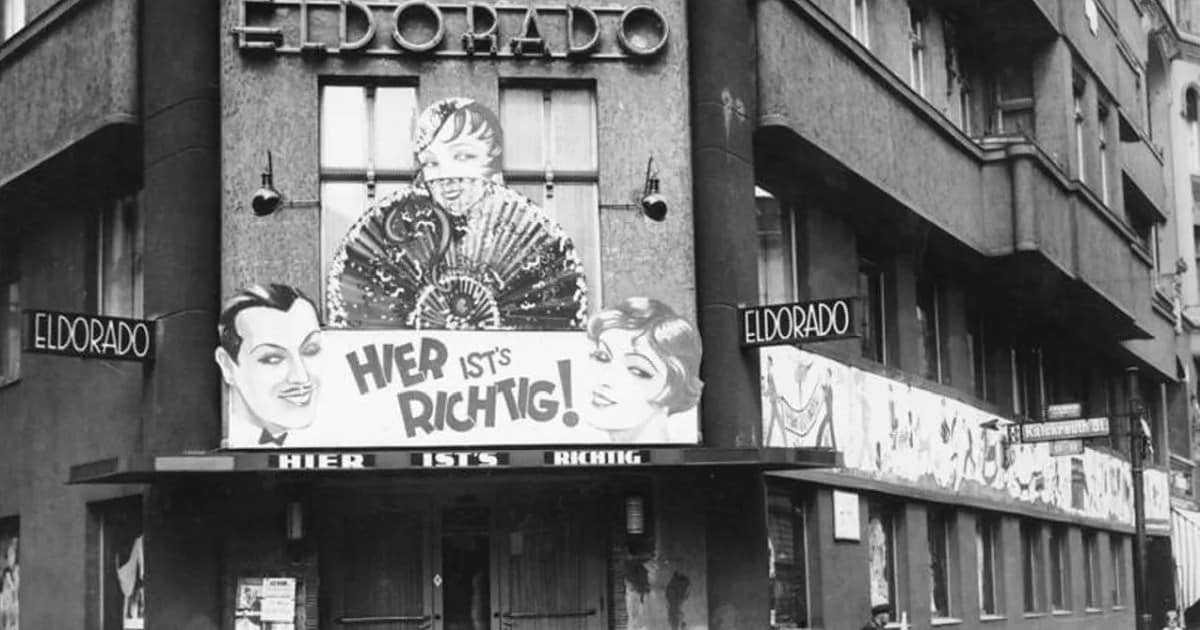
The homosexual movement in the Weimar Republic was defined by a sense of rupture, intense political mobilization, and a flourishing subculture. In Berlin there were more than 100 queer venues—bars and dance cafés—such as the famed Eldorado, and a lively press landscape spawned gay magazines like Die Freundschaft and Die Freundin. With the Bund für Menschenrecht (BfM) there emerged the first major civil rights organization for homosexuals. The fight to repeal § 175 of the Reich Criminal Code (RStGB) remained the central political objective.
The era’s major achievements associated with Magnus Hirschfeld are treated in the third installment. He founded the Institute for Sexual Science in 1919, a pivotal institution for the history of homosexuality, and he acted as a consultant for the film “Anders als die Andern” (1919), a pioneering emancipatory film about homosexuality that stood unrivaled for half a century.
The SPD and the § 175 RStGB
The Social Democrats (SPD) in the Weimar Republic, much like the Communist Party (KPD), were almost continuously a driving force behind attempts to legalize homosexuality and pressed for the repeal of § 175 in the Reichstag. This stance is echoed in the party’s newspaper Vorwärts. Although the so‑called Heidelberg Program adopted by the SPD at the Heidelberg party convention on September 18, 1925 did not explicitly mention § 175, it is worth noting that a month earlier a draft of this new party program proposed the legalization of homosexuality (August 16, 1925). Among Vorwärts’ notable statements on this topic is the closing line of an article about a court case against homosexuals: “But § 175 still makes homosexuals easy prey for blackmailers” (March 17, 1927). Vorwärts also made its position clear in responding to physician Joseph Mayer, who in Das Deutsche Ärzteblatt urged clinging to § 175: Vorwärts stressed that society should be protected from Joseph Mayer, not from homosexuals (March 4, 1930). Vorwärts carried coverage advocating the repeal of § 175.
Ernst Röhm’s emergence soured the political climate, and within Vorwärts by 1931 the stereotype of the “homosexual Nazi” was pervasive. Yet it is notable that even after, a significant voice persisted, emphasizing the need for impunity. In the Reichstag on May 11, 1932 the former Reich Interior Minister Wilhelm Sollmann (SPD) noted that his party was accused by political opponents of propagating homosexuality merely because it had acted “out of deep social compassion for the victims of a pathological inclination” in the pursuit of exemption from punishment (May 12, 1932).
As early as 1929 the reform of criminal law stood on the cusp of breakthrough, and in Vorwärts one could read the promising headline: “Homosexuality is no crime. (…) The penal provision is gone” (October 17, 1929). The republic’s political paralysis, however, prevented the removal of the paragraph, which under the Nazis would be tightened even further. The gays had celebrated too soon.
The Scandals of the Weimar Republic
The numerous scandals involving gay men affected the gay emancipation movement in varied ways. Oscar Wilde’s 1895 conviction in England was a tragedy for him personally, but it substantially aided the founding of the homosexual movement. The 1902 Krupp scandal promoted a broader social opening, while the Harden-Eulenburg affair, the Fritz Haarmann case, and the Ernst Röhm affair pushed the movement back severely. With all other scandals, I assume they did not have a negative impact on the gay movement. Using Hirschfeld’s expert assessments as a guide, I will address certain scandals of the Weimar Republic—such as the so‑called “Steglitz pupil tragedy” (1928)—in the third installment. I will return to the Röhm scandal (1931–1932) in the fourth installment about the Nazi era.
Two Scandals that Echoed from the Kaiserreich into the Weimar Republic
Two examples—well-known to this day—show how scandals from the Kaiserreich continued to resonate into the Weimar period. One is Oscar Wilde’s 1895 conviction in England for homosexuality. In a review of the highly regarded Oscar Wilde biography by Frank Harris, Vorwärts again highlighted Wilde’s homosexual relationships with other men (December 4, 1923), and in connection with Carl Sternheim’s drama “Oscar Wilde” it was emphasized that Wilde was imprisoned “because he indulged in male‑to‑male love too provocatively” (April 1, 1925). In Vorwärts’ coverage of Wilde’s letters to Robert Ross—collected as Last Letters in 1925 by Max Meyerfeld—the paper again referred to the conviction for “homosexual offenses” that had sent him to prison (March 13, 1926). In contrast to Vorwärts’ reporting in 1895, these later articles spoke more openly about sexuality, though attitudes toward Wilde varied. The hint that Wilde “worshiped male-male love too provocatively” can be read as an indirect blame, given that he might have faced no trouble had he restrained himself a bit more.
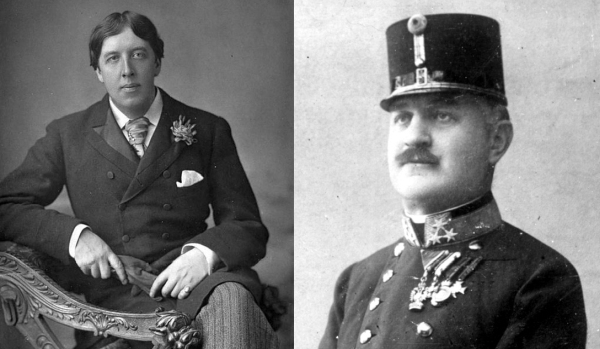
The second example is Colonel Alfred Redl, head of the Austro-Hungarian counter-espionage. Because of his homosexuality, he was blackmailed and betrayed secrets to Russia. When he was unmasked in 1913, he shot himself. That sensitive topic was frequently processed by the media at the time. Of six film adaptations, the first three come from the Weimar era: “Colonel Redl” (1925), “Colonel Redl’s Heirs” (1926), and “The Case of Colonel Redl” (1931). In 1930 the theater play “The Case of the Chief of Staff Redl” was performed. Reviews in Vorwärts suggest that films and the play treated Redl’s homosexuality differently. For the 1925 film, it was noted that a heterosexual blackmail plot was invented (April 12, 1925), while the play clearly depicted Redl as being blackmailed because he was a homosexual (November 27, 1930). The 1931 film, according to the director’s brushstrokes, discreetly hinted at Redl’s homosexuality (February 28, 1931).
The Murders of Schöning, Daube, Schnäpel, and Lehrke
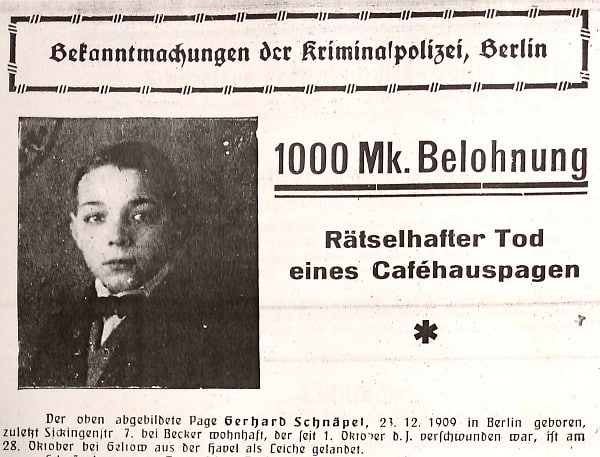
Next I summarize Vorwärts’ coverage of four murders that may have had a homosexual background. In late October 1925, 16-year-old Gerhard Schnäpel was found murdered in the Havel (October 30, 1925, article without reference to homosexuality). Months later the body of a 15- to 17-year-old apprentice baker, Kurt Lehrke, was recovered from the Luisenstadt canal; police suspected he might have fallen into the hands of a “boy molester” (May 27, 1926). In August 1932, in Berlin, 16-year-old Kurt Schöning was murdered; his throat had been slit with a razor and his genitals cut off. Vorwärts reported that the “Special Department for Homosexual Offenses” had been activated (August 23, 1932). Earlier, in March 1928, in Gladbeck, 19-year-old Helmut Daube was murdered in a similar fashion. According to Vorwärts, in the subsequent trial the homosexuality of the 20-year-old suspect Fritz Hussmann played a decisive role. The newspaper also published a photo from the crime scene (October 16, 1928). In later trial reports about this case, coverage focused on the “suspected abnormal inclinations” of the defendant (October 24, 1928; see also October 25, 1928). Vorwärts reported the matter largely in a factual manner, without an overtly anti‑gay tone.
It is possible that all four youths were killed by Rolf vom Busch, a claim he later admitted regarding the Kurt Schöning murder. Viola Meike and Sarah Baldy trace many clues in their book “Zeuge Waldeck. The Invented Life of Rolf vom Busch” (2019) and connect the dots, allowing these four victims’ stories to be told together and expanded somewhat (see Jens Dobler’s book review in: “Mitteilungen der Magnus-Hirschfeld-Gesellschaft,” Nos. 65/66, December 2020).
The Serial Killer Fritz Haarmann
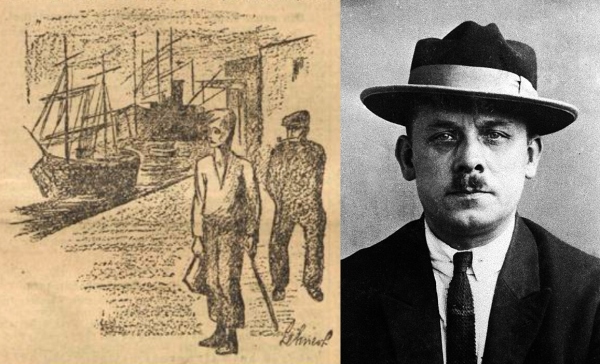
The homosexual serial killer Fritz Haarmann was condemned to death in Hanover in 1924 for the murders of a total of 24 boys and young men aged 10 to 22. Haarmann’s crimes and the lurid media coverage surrounding them set back the gay emancipation movement and influenced discussions about § 175 as well. In my TheColu.mn article “The Worst German Gay Serial Killer of All Time,” I explore many aspects of this case in more depth.
Among the more than 220 Vorwärts articles on Haarmann, I link only the 60 items that address homosexuality on my site. In the first Vorwärts article about Haarmann, attention is drawn to the “unnatural intercourse” the perpetrator had with his victims before their deaths (July 3, 1924). Haarmann’s case also served as a peg for a longer article about Berlin’s missing persons bureau, which, in the context of missing persons notices, criticized parents who failed to disclose their sons’ homosexual orientation, thereby hampering police work. The article includes an illustration depicting a young man at the harbor drawing the gaze of a man (September 4, 1924). A broad, multi‑page coverage followed during the trial from December 4 to December 19, 1924 (December 4 through the evening edition of December 19, 1924). In the morning edition of December 19, 1924, a passionately worded commentary stated, “Lustful fate was what ruled Haarmann.” The verdict was discussed on December 20, 1924. On April 15, 1925 Haarmann was executed, and Vorwärts carried the pieces “The Right to Death” and “Haarmann Executed” (April 15, 1925). Further articles treated his accomplice Hans Grans, who was also linked to a sexual relationship with Haarmann.
Reporting on the Homosexual Movement in Berlin
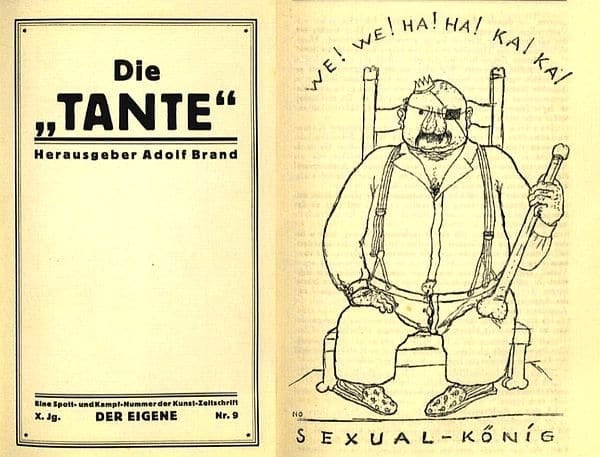
When it comes to Vorwärts’ coverage of the homosexual movement around Magnus Hirschfeld, there is a lot to write about (see Episode 3 of this series). The situation with reports on the segment around Adolf Brand, however, is very different. The handful of pieces about Brand’s activities suggest only that he was a controversial activist willing to endure legal trouble to publish his homosexual magazines. Vorwärts reported on Brand’s lawsuit over the allocation of paper quotas needed for his magazine Der Eigene, which he relied upon (August 14, 1920). Later, two early issues of his magazine Freundschaft und Freiheit were confiscated by the police for their critical or insulting content toward the Catholic Church (February 15, 1921). A special issue of Der Eigene, titled “Die Tante” (the quean), was confiscated for distributing obscene writings and images. Texts and caricatures critical of Hirschfeld were singled out. Vorwärts’ coverage presents a highly distorted picture of Brand as a provocative troublemaker rather than recognizing the positive contributions of his magazine Der Eigene and the Gemeinschaft der Eigenen, which achieved much for the community.
Vorwärts did not report on the homosexual activist Friedrich Radszuweit. In his publishing house, Radszuweit produced several homosexual magazines such as Blätter für Menschenrecht, Das Freundschaftsblatt, and Die Freundin. In 1926 Germany passed the “Schund- und Schmutzgesetz” (Contemptible and Obscene Law) intended to shield children and adolescents from “youth‑endangering writings.” Some of Radszuweit’s magazines landed on these lists. Vorwärts, while generally opposed to censorship, argued that this law targeted only “trivial stuff” and “one or the other homosexual marginal magazine” that would be rejected by most normal people (June 8, 1929).
Lectures on Homosexuality
The various strands of the homosexual movement actively educated the public in Weimar Germany through lectures on homosexuality. I have documented the public talks from 1924 and 1925 in TheColu.mn. In Vorwärts, the announcements and coverage almost exclusively highlighted the lectures of Magnus Hirschfeld or those at the Institute of Sexual Science (as discussed in Episode 3 of this series). Lectures from other segments of the movement appear to have been largely ignored. Thus, even in the realm of lectures about sexuality, Vorwärts presents a rather distorted picture. It seems that openly discussing sexuality outside Hirschfeld and the Institute was mostly perceived within a gay “bubble.”
The few notes about other lectures in Vorwärts are difficult to interpret. For instance, two lectures announced for May 21 and September 26, 1924, on “The Nature of Homosexuality” at a Berlin-Niederschöneweide school offered no information about the speaker, organizer, or content (May 21, 1924; September 26, 1924). This lack of detail is not due to the topic itself but reflects the magazine’s sparse archival notes across announcements.
Fiction and Contributions on Gay Literature
Vorwärts seldom engaged with gay fiction, but I want to highlight four examples. Alec Scouffi’s novel Hotel zum Goldfisch, about male prostitution, was reviewed rather positively (July 1, 1930). The novel remains influential and was reissued by Männerschwarm in 2019. Vorwärts also covered a court case that decided whether Eugen Ludwig Gattermann’s novel Die Erlösung der Freunde was “obscene.” The work was defended with an expert opinion from the Institute of Sexual Science (November 18, 1921). For context about this gay‑themed, is-it-kitsch work, see my piece on TheColu.mn.
Two authors stand out for Vorwärts’ coverage of gay writers. One is the activist Peter Hamecher, who regularly published poems in Vorwärts. His piece “Das trunkene Schiff” treated the love between Arthur Rimbaud and Paul Verlaine (October 21, 1924). His 1913 Vorwärts-poem “Von Lucifers Geschlecht” (September 22, 1913) can be read as homoerotic as well. See also the chapter on Hamecher in my book Anders als die Andern (2006, pp. 135–138).
The other author is Bruno Vogel. A sometime SPD member, he wrote for the socialist Leipziger Volkszeitung starting in 1923. His antiwar work “Es lebe der Krieg!” was promoted in Vorwärts (May 29, 1925). When Vogel faced trial for alleged “obscenity” of this work—containing homosexual references—the Vorwärts ran several pieces defending him, noting the apologetic extolling of Hirschfeld and Thomas Mann and referencing supportive affidavits (June 1, 1926; January 14, 1927). Vogel’s novel Alf was later reissued as a reprint by Männerschwarm.
“Transvestites” Remain Underrepresented
There are only a few Vorwärts pieces on transvestites, which show, in line with Magnus Hirschfeld’s views, that they are a natural part of the “sexual intermediate states” he championed. Connections to Hirschfeld’s Die Transvestiten (1910/1912) are noted (February 17, 1925), and a piece titled “Half Man Half Woman” about Dora Hiese reports that, based on Hirschfeld’s testimony, she could wear men’s clothing (January 4, 1924). Vorwärts also advertised a Hirschfeld lecture on “Sexuality and Clothing, with special attention to the habits of transvestites” (February 25, 1926). These items show that Vorwärts, at least theoretically, aligned with Hirschfeld’s views on transvestites.
Yet Vorwärts also connected transvestites to crime and lower social strata. They are mentioned in the context of a police raid (March 17, 1925). Elsewhere, a piece titled “Boys in Girls’ Clothes: Raids and the Arrest of 32 Transvestites” described their “repulsiveness” as they gathered at places like Friedrichstraße, several major train stations, nearby brothels, and the Unter den Linden arcade (December 10, 1923). Other articles refer to “old transvestites in slovenly women’s clothing who performed as ‘lady performers’ in third-tier gay social circles” (October 26, 1930) and a transvestite who faced trial for marriage fraud (March 23, 1932).
The opinions expressed in Vorwärts are not always consistent. The newspaper’s diverse sections—some aimed at enlightening readers, others reporting on court cases, police actions, and crime—likely contributed to a mixed portrayal where transvestites could be fetishized as curiosities or linked to prostitution and crime. Even today, many outlets reproduce police reports uncritically, reproducing discriminatory stereotypes and questionable categorizations without challenge.
One piece to commend: on November 10, 1924, Berlin-based 65-year-old Dr. Franz Duysen—an agrarian university lecturer who had lived with his life partner for 31 years—died in Berlin. In the emotionally charged closing passage of the Vorwärts article “Transvestites. On the Case of Dr. Duysen,” the paper wrote: “The Duysen case invites reflection” and posed questions for readers: “How does one educate people toward greater lack of prejudice, inner freedom in relation to others, attentiveness, seriousness, and love toward the inner lives of those akin to us and not our own?” (November 18, 1924; see also my TheColu.mn piece on Franz Duysen and his life partner Dr. Kraatz). These are questions that Vorwärts could have asked itself.
Lesbians Remain Underrepresented
Public life in the Weimar Republic was male‑dominated, and only male homosexuality was criminalized. Accordingly, press coverage focused almost exclusively on male homosexuality. When lesbians were discussed, scandals again produced a distorted picture of lesbian life. In addition to some criminal cases, the major cases around Ella Klein and Margarete Nebbe (1923), Dora Hiese (1924), Mathilde Staverock (1924), and Käthe Hagedorn (1927) are mentioned to be addressed in the third installment of this series. Vorwärts’ pieces on the gay scene in bars and clubs tend to treat lesbians with brief mentions of kissing women rather than substantial coverage (December 25, 1927).
I was surprised to find that several plays referenced lesbian subplots. Hans Kaltnecker’s play Die Schwester is often cited for its “mystery of lesbian love” (September 30, 1927), though it characterizes the lesbian role as “the summit and center of egoism” (December 23, 1924). The play Tumult der Herzen, attributed to an Alatscheff, was panned as “trash” and “filth” yet included a defense of lesbian love (June 8, 1927). In Ferdinand Bruckner’s Krankheit der Jugend, the heroines are claimed to be desirous (April 27, 1928), and in Alfred H. Unger’s Menschen wie du und ich a “luxury woman” allegedly seduces a “pure girl” into lesbian relations (November 2, 1929). Heinz Eule’s Das Mädchen aus der Fürsorge shows a house maiden guiding a man into lesbian love (July 15, 1931).
Two smaller Vorwärts items deserve note. In 1925 the paper covered a woman’s lawsuit who was perceived as lesbian; a man on the stand said, “I thought so too,” and he was fined 50 marks for “insult.” Vorwärts criticized the verdict because only male homosexual actions were criminalized, not a general homosexual orientation (September 26, 1925). In another piece, a 15-year-old female student at a Berlin girls’ gymnasium allegedly asked how female–female intercourse works, received no answer, and complained to the principal. The Prussian Minister of Culture was informed and ordered an answer. This story, published by the Bavarian Courier, turned out to be a fake, but Vorwärts cited it as an example of right-wing political propaganda in Bavaria against Prussia and Berlin (May 8, 1930). It is thus not a real school story, but it does illuminate the political climate of the time.
The Film “Girls in Uniform”
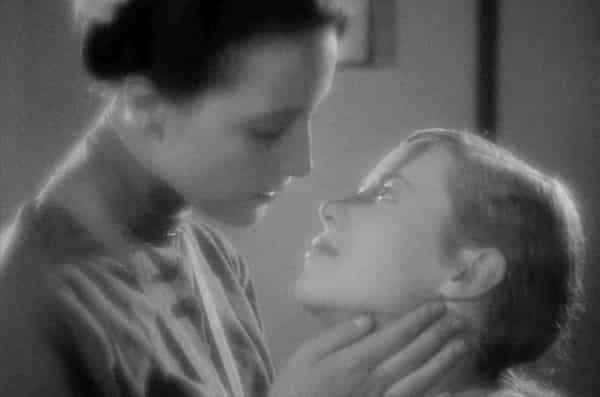
The feature film Mädchen in Uniform (Girls in Uniform) from 1931 is often cited in modern sources as a film through which a lesbian reading can be inferred (per Wikipedia). This characterization suggests a relatively open and somewhat unsettled contemporary reception of lesbian themes. I am not aware of any contemporary film reviews that highlighted the lesbian subtext, though I do not exclude the possibility. Vorwärts, however, contains roughly 40 mentions of the film from November 28, 1931, to February 14, 1933—mostly unremarkable cinema ads. In none of the pieces, not even the film’s in‑depth review from November 28, 1931, is there any hint that the lesbian subtext in the film’s source material was recognized; instead, the more conspicuous central theme remains: a critique of authoritarian, militarized education. Today, the 1931 Mädchen in Uniform— and the 1958 remake with Lilli Palmer and Romy Schneider—hold a cult status among lesbian audiences.
The Homosexual Scene in Berlin
From time to time Vorwärts reported on Berlin’s homosexual scene and its many bars and eating establishments. Yet the magazine’s aim was never to curate a guidebook for patrons or to assist gay individuals. Its purpose was to warn about this scene, especially regarding the “temptation” of minors and male prostitution.
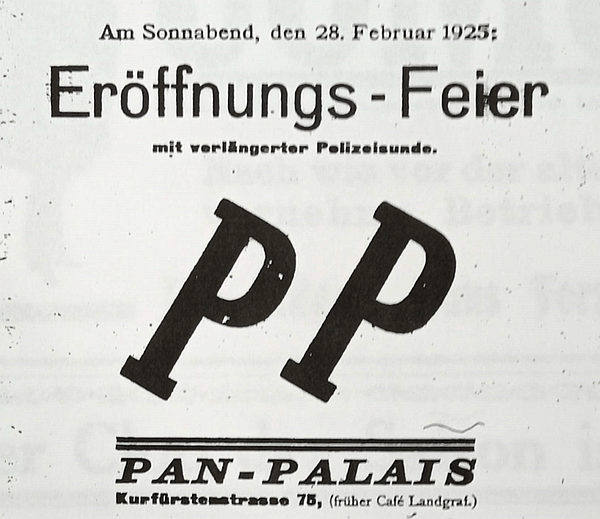
A piece on “the open activity of homosexuals” in “about 150 Berlin establishments” mentions the “seduction” of boys between 12 and 14, but also underscores that only the “seducers” should be punished, not the seduced (March 2, 1922). Depending on how thoroughly raids on homosexual venues were reported, the articles provide important hints about Berlin’s former scene. A raid in a homosexual venue on Flottwellstraße is not easily verifiable (November 4, 1922). By contrast, a raid on the August Klause in Auguststraße is described with sensational detail, calling it a “den of vice of the worst kind” where “wild orgies” took place (January 3, 1923). Unlike that event, the raid on the Landgrafen-Kasino, formerly Pan-Palais, and its subsequent closure (March 17, 1925) is corroborated by other sources, and I have written about it on TheColu.mn, along with coverage by many other newspapers. Berlin’s homosexual venues are mentioned in Vorwärts without naming names, also in the context of prostitution (September 24, 1929). For the Eldorado, the famous venue, I could only locate one piece from the Nazi era (New Vorwärts, November 4, 1934).
Similarly critical were reports about other gay gathering spots like Berlin’s Friedrichstraße with its “sparks” who gave it the moniker “Street of Lost Hopes” (October 26, 1930). A separate item mentions cruising in the Tiergarten (August 2, 1928). In the Weimar Republic there were already gays who publicly resisted social wrongs. Homosexuals raised their voices because they would not tolerate the negative portrayal of homosexuality in a theater piece at the Berlin Municipal Opera (June 28, 1927). A few years later, members of the homosexual organization Bund für Menschenrecht even clashed with police in the south of Berlin (Rauchfangswerder) (July 8, 1930). These articles offered little if any chance for gays to identify with themselves in the press but might have helped them feel less alone.
The queer community needs a strong journalistic voice—oriented toward today’s needs. Contribute to TheColu.mn to help sustain its work.
Critical Coverage from the Middle of the 1930s
In the Kaiser era, Vorwärts had actively covered consensual homosexual acts that were criminalized under § 175 and blackmail arising from homosexuality; one article listed seven cases of blackmail (January 6, 1905). In the Weimar Republic, critical pieces challenging the criminalization of consensual homosexual acts and cases of blackmail became the exception (June 19, 1925; March 17, 1927).
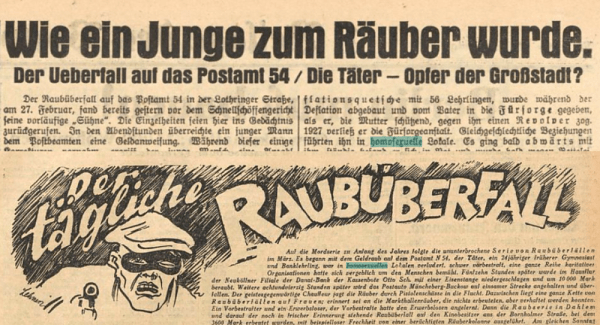
Parallel to the shifting reporting on § 175, Vorwärts’ coverage of gay men—who increasingly became criminalized—also evolved from the mid‑1930s. Examples include a young thief, Willi Perlewitz, “lollygagging in homosexual venues” (July 20, 1930); robber Willi B. leading a “checkered life in homosexual venues” (July 22, 1930); a boy who became a robber because “same-sex relationships led him into homosexual venues” (March 7, 1931); and another offender described as “corrupted by homosexual venues” (March 22, 1931). These four examples, drawn from a few months, connected homosexual venues with crime, thereby delegitimizing the community’s space. A later example in a Vorwärts article about the murder of Johannes Bessert linked the suspect to “associations with young men,” effectively turning a gay victim story into a gay offender narrative—an early instance of victim blaming (December 4, 1932).
What seems to have changed around 1930 is that the counterweight to the § 175 repeal—the call for enlightened public discussion—largely vanished, leaving crime reporting and raids as the dominant note in coverage of the gay scene, intensified by the Röhm affair’s sensational coverage. The Röhm case, to which the SPD press played a major role in exposing, already began at the close of the Weimar Republic. I will treat this case as a closed topic in the fourth installment of this series on the Nazi era.
Conclusion
Magnus Hirschfeld maintained not only a strong rapport with SPD politician August Bebel but also with Vorwärts’ editorial staff, who were highly engaged in pushing for the repeal of § 175 RStGB through 1930/1931. It is worth recognizing that Hirschfeld’s close links helped Garner a favorable press stance toward the endeavors of the homosexual movement over decades—though, upon closer inspection, this benefited Hirschfeld and the WhK, while other strands of the broader movement—Adolf Brand with his Gemeinschaft der Eigenen and Friedrich Radszuweit with his numerous homosexual journals and the Bund für Menschenrecht—were either left out or distorted in Vorwärts’ portrayal.
Moreover, Vorwärts’ and the SPD’s activism seemed to focus largely on repealing § 175 and stayed within that legal, and thus somewhat theoretical, framework. True equality demands more than simply avoiding prison. The magazines, bars, and clubs—so essential to gay life for meeting peers—were treated with disdain by Vorwärts, which condemned the press and the social venues as a whole. Raids on gay bars, with resulting arrests and social ruin, were covered but not questioned. It seems inconsistent to advocate for societal improvement for homosexuals while simultaneously casting their own social infrastructure as deviant. The magazines, bars, and clubs were crucial spaces for homosexuals to meet like-minded people.
A newspaper’s political line is revealed not only by its commentary but also by its topic choices. The criminal offenses linking homosexuality evolved over time in Vorwärts. In the Kaiser era, homosexuals were depicted as victims, with coverage centering on § 175 and blackmail. In the Weimar Republic, the emphasis shifted toward “seduction,” abuse of power, and sexual abuse of minors, which in media narratives gradually reframed the earlier victims as offenders.
What would it have been like to read Vorwärts a century ago? Initially, one might have celebrated the openness and longed for the repeal of § 175. Yet over time, one would have encountered a fragmented, distorted portrait of the gay scene. As a bar patron, one might have felt demeaned and perhaps, by 1930, canceled the subscription.