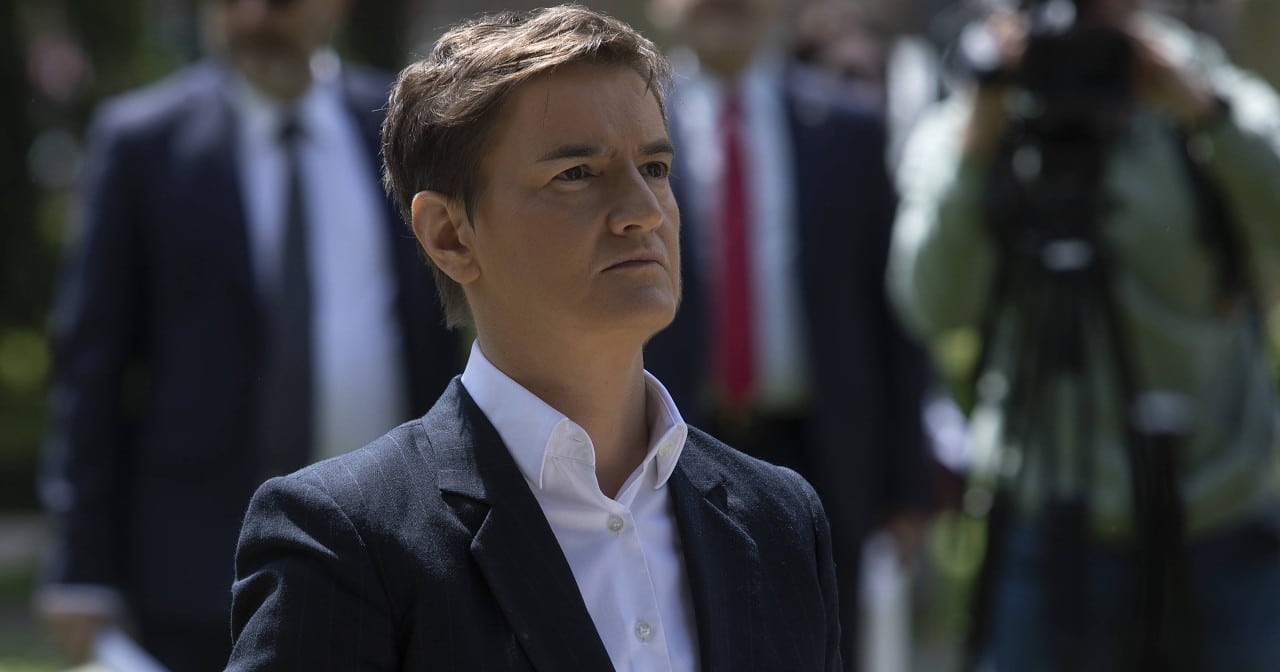
In Belgrade, a political maneuver with high symbolic significance is unfolding: the conservative-nationalist Aleksandar Vučić has resigned as head of state to run as the top candidate for the office of prime minister in the early parliamentary elections. Under the Serbian constitution, the parliamentary president assumes the duties of the head of state on an interim basis. The 51-year-old Ana Brnabić thus moves to the pinnacle of state leadership — the first openly gay person to hold the position.
The interim presidency is a familiar face in Serbian politics: she was first appointed prime minister by Vučić in 2017, an event that was seen as sensational at the time. In a country traditionally patriarchal and shaped by the Serbian Orthodox Church, an openly lesbian woman led the government. She held the post until early 2024, before taking on the role of parliamentary speaker.
Brnabić, who studied economics and marketing in the United States and the United Kingdom, initially presented herself as an independent, Western-oriented technocrat. For the international stage and Western partners, she was viewed as Belgrade’s modern face. Privately, she lives openly with her partner Milica Đurđić, a radiologist. In 2019 the couple welcomed a son.
Brnabić showed little interest in LGBTQ rights
Yet the hope of many queer activists eight years ago that Brnabić’s visibility would herald a turning point in Serbia’s equality policy gave way to disillusionment: despite years of promises, Serbia has to date neither a registered civil union nor adoption rights for same-sex couples. Legally, Brnabić is not recognized as the official mother of her own son.
In 2019 Brnabić also joined the right-nationalist governing party SNS. Critics accused her of being a poster child for pinkwashing — presenting a liberal facade to the outside while she internally supported and defended Vučić’s increasingly authoritarian policies without restraint.
At EuroPride 2022 in Belgrade, the conflict escalated when the government, citing security concerns and right-wing pressure, attempted to ban the march (TheColu.mn reported). “She has done nothing for the community, absolutely nothing thus far,” Isidora Duric of the Belgrade Pride organizing team said in a TheColu.mn interview three years ago (TheColu.mn reported).
Parliamentary election on October 25
The current transfer to the presidential palace is viewed as part of a targeted power maneuver. After the collapse of a station overpass in the city of Novi Sad in November 2024, protests against the government erupted. Vučić now hopes to secure a mandate with the early-called parliamentary election on October 25. The 56-year-old is accused of structural corruption and cronyism, and there is criticism of his authoritarian governing style and the suppression of press freedom.
Despite substantial protests, Vučić’s chances of victory are considered strong, particularly because the bulk of national TV channels and tabloid media are firmly under government influence. Vučić dominates coverage there, while the opposition is largely marginalized or smeared.
During the handover of the presidency, Ana Brnabić emotionally paid tribute to her predecessor and stressed that Serbia would “never again have a president like him.” She noted that Vučić would from that day on embark on a “new, determined fight to safeguard and preserve Serbia.” She wished him full success. Vučić had previously served as Serbia’s prime minister from 2014 to 2017.
Until a regular head of state is elected, Brnabić will lead the state’s affairs in a caretaker capacity. After the parliamentary elections, the regular presidential election is expected to take place by the end of the year. According to political scientists, it seems unlikely that the SNS would run Brnabić in the presidential race, given the reservations about a lesbian politician within the party’s rural base.