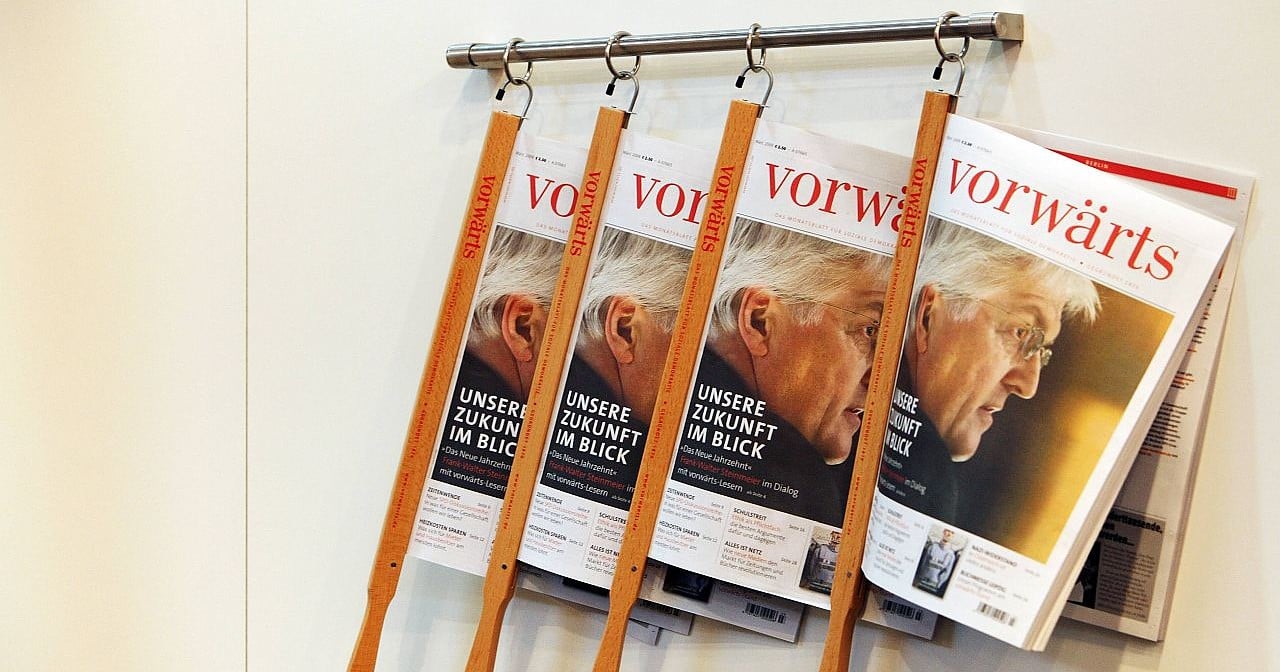
From the SPD newspaper “Vorwärts” all issues from 1876 to 1940 are digitized. On the occasion of the paper’s anniversary, I searched the digitized issues for articles about homosexuality using various terms such as “Homosexuality” and “third gender,” found more than 1,000 articles, analyzed their content, placed references to my homepage, and linked them. Below I attempt to summarize the results of the research in four installments. I evaluated the “Vorwärts” (1876-1933), which at times appeared as “Sozialdemokrat” (1879-1890), and the exile continuation as “Neuer Vorwärts” (1933-1940). Thus the newspaper lived through three eras of German history in this period and, with the articles contained here, also documented the SPD’s positions on homosexuality. A research beyond 1940 would have blown up the workload for this article series.
Primarily, what follows is concerned with how the editorial team of “Vorwärts” reported on homosexuality, what focal points they emphasized, and how they commented on the underlying backgrounds. Where necessary for understanding, I will also explain the context of articles that aren’t always self-explanatory, but usually can only be understood in the context of their time.
If, in the following, I look back on the first 65 years of coverage of homosexuality in “Vorwärts,” the impression must not arise that I base my view of the history of homosexuals solely on this source. Evaluating a single newspaper would be fundamentally flawed. “Vorwärts” is representative of a social-democratic viewpoint, but of course only one voice in a broader chorus of opinions about gay men and lesbians of that era, which must be weighed against other sources. I have kept in mind that “Vorwärts” is a social-democratic newspaper for every article, not only when the homosexual activists Magnus Hirschfeld and Adolf Brand are described as “comrades” (and thus SPD members).
The first articles about homosexuality: the Bavarian King Ludwig II.
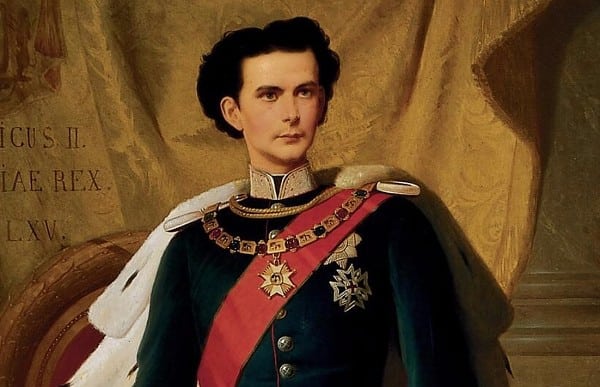
The first issue of “Vorwärts” appeared on October 1, 1876, at a time when homosexuality was largely taboo. Aside from a few general allusions to “unnatural vices” (May 30, 1877), the reporting on homosexuality begins with clearly identifiable remarks about the Bavarian King Ludwig II—and surprisingly, already during his lifetime. For the newspaper, Ludwig II was a “boy-loving” recluse (June 14, 1883) and a rapist of his riding grooms, who “yields to the most bestial vice of pederasty” (February 21, 1884). In a long article on November 3, 1888 on the front page of the newspaper, perhaps the clearest indication of the purpose behind the notes about Ludwig’s homosexuality emerges: the paper aimed to expose the immorality of the ruling class that had to be fought, a pattern that recurred in later decades.
In 1862 there had already been a homosexual scandal around the Social-Democratic politician Johann Baptist von Schweitzer, which triggered the first debate among Social Democrats about homosexuality (see my TheColu.mn article “The First Homosexual Scandal of the Social-Democratic Movement”). The “Vorwärts” did not address this at length at first. Only decades later was it mentioned within a spirited article against § 175 that Ferdinand Lassalle, like August Bebel one of the SPD’s founding fathers, had in those days supported Schweitzer (June 22, 1914).
Contributions on politics and homosexuality
In contrast to the Weimar Republic, many parliamentary debates during the Wilhelmine period were printed verbatim in the Reichstag. This includes not the speech by August Bebel on January 13, 1898 in which he advocated abolishing § 175 (to read in the Reichstag debates on p. 410), but the newspaper did print additional discussions from Reichstag sessions on January 19-20, 1898 and April 20, 1904. In the session of March 31, 1905 (April 1, 1905), there was also discussion about “Vorwärts” and its “Krupp on Capri” article, which drew diverse opinions. Through the Harden–Eulenburg affair, the political climate regarding homosexuals shifted, which is also reflected in the Reichstag records of November 29, 1907 (November 30, 1907), December 4, 1907 (December 5, 1907), and February 1, 1908 (February 2, 1908).
The fight against § 175 of the Reich Criminal Code
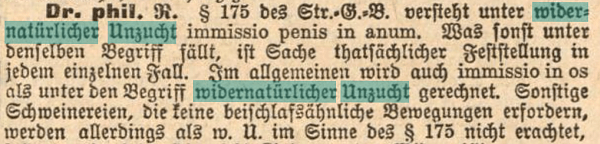
Since the founding of the Reich in 1871, § 175 of the Reich Criminal Code criminalized homosexual acts between men. The question of exactly which acts were punishable under § 175 was answered by the “Vorwärts”—relying on the Reichsgericht’s interpretation: only “immissio penis in anum” and “in os” (anal and oral sex) were punishable, while other “disgraceful acts” were not (July 25, 1893). This not only explicitly (though cryptically through the use of Latin) points to concrete sexual practices, but also to the moral condemnation of heterosexual behavior beyond criminality. It appears as a contribution in the “Mailbox of the Editorial Office,” which has the character of legal advice. The question arises whether this mailbox answer could also have been read as guidance for “those affected,” regardless of whether this was the editors’ intention or not.
From 1898 there was discussion about abolishing § 175. At least on the legal level, “Vorwärts” consistently called for abolishing § 175 up to World War I and defended this position against the conservative Berlin newspaper “Die Post” (February 19, 1905).
The Reichsjustizamt presented a preliminary draft for a new penal code at the end of 1909 that proposed extending § 175 to women. On the front page of “Vorwärts” the editorial staff stated under the headline “The draft of the new penal code” that, especially in light of blackmail, it would be problematic not to retain § 175 and to “even extend it to female homosexuality, which is so harmless to the state” (January 5, 1910; February 14, 1911; June 22, 1914).
The scandals in the German Empire
The homosexual scandals in the German Empire, led by the Harden-Eulenburg affair (1906-1909), affected politics and society and significantly shaped attitudes toward homosexuals. The reports fueled discussion about § 175—even if mostly in negative terms. The scandals were often one of the few occasions on which newspapers reported on homosexuality.
The Oscar Wilde trials (1895)
When the writer Oscar Wilde, at the height of his success in London in 1895, was discredited as a homosexual, sued for defamation and lost in April 1895. In a second trial Wilde was convicted in May 1895 of homosexual acts and sentenced to two years’ hard labor. The articles in “Vorwärts” about these trials show the taboos and moral condemnation of homosexuality: initially only “unnatural vices” are reported (April 5, 7, and 9, 1895) and moral terms such as “moral conduct” (May 1, 1895) and “sins” (June 8, 1895) are employed. There is a hint of sympathy: “How small the Wilde offense seems compared to the tortures” (July 9, 1895). This may reflect that Wilde, though part of the upper class, could be co-opted as socialist due to his political essay “The Soul of Man under Socialism” (1891). Later, the language in “Vorwärts” became clearer. Thirty years after the trial, it said Wilde went to hard labor “because he indulged in male-male love too provocatively” (April 1, 1925), subtly implying guilt by association.
The Krupp scandal (1902)
“Vorwärts” itself unleashed a broad homosexual scandal. In its article “Krupp on Capri,” Friedrich Alfred Krupp, the wealthiest industrialist in Germany, was denounced as a homosexual. The paper stood by the call for abolition of § 175, writing that perhaps this case would “provide the impetus … to finally remove that § 175 from the German Penal Code, which not only targets vice but also condemns the morally predisposed to lifelong fear” (November 15, 1902).
The article earned sharp criticism of the paper. The homosexual activist Hirschfeld came to the paper’s aid, asserting that its publication had been guided by noble motives (removal of § 175) (January 13, 1903). The insinuation of “base motives” (the denigration) was rejected by the editorial staff as slander (February 8 and February 10, 1903).
The Brand/Dasbach scandal (1904)
From December 7, 1895 onward, “Vorwärts” regularly reported on Adolf Brand, who at that time had not yet emerged as a homosexual activist but ran afoul of the state because of the distribution of a “Proletarian Manifesto”—an activity the “Vorwärts” leadership apparently viewed positively. Brand provoked society in various ways in the following years. The reporting in “Vorwärts,” which has not been widely known in homo-history research, sheds light on how Brand later became a vociferous homosexual activist. In the article “Brand against Vorwärts” (May 5, 1900), there was also reporting about Brand’s lawsuit against the “Vorwärts.” A settlement was reached out of court later. In 1904 and 1907 Brand was involved in two homosexual scandals.
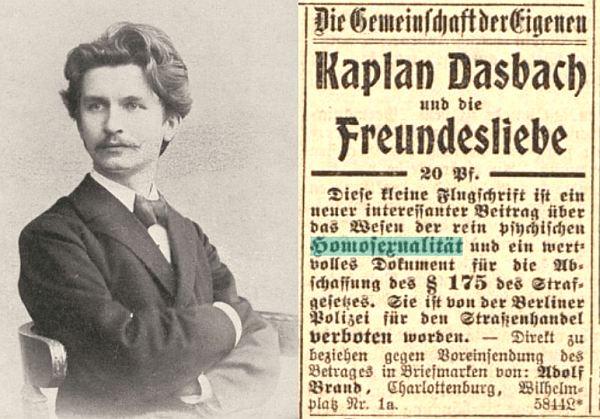
After reports about the scandal (from April 7, 1904) the editorial staff also printed a response from Chaplain Dasbach and stated that they had not yet formed their own verdict on the case (August 3, 1904). A few weeks later the paper distanced itself from Brand. Although Brand was a member of the Social Democratic electoral association, he had acted on his own. The “Vorwärts” staff accused Brand of holding the “incredibly naive view” that Social Democrats disagreed on § 175 merely because some wanted to work with the Center Party (September 11, 1904).
The Ackermann scandal (1904)
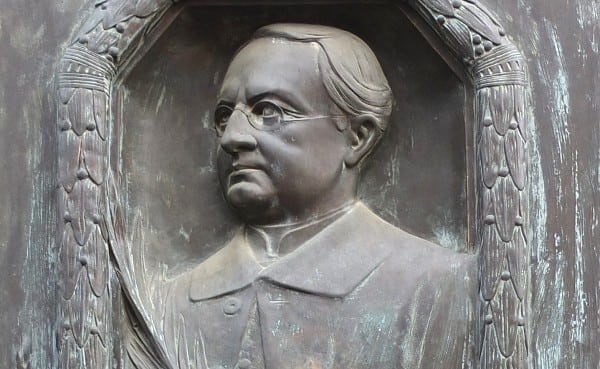
The Dresden city councilor and retired captain Dr. Paul Ackermann, hailing from a prestigious family, had met a man in a hotel on Berlin’s Friedrichstrasse and was later blackmailed by three men. “Vorwärts” initially focuses not on the blackmail but on the homosexual acts of Ackermann with three other men, and states: “It is diabolical that on such a healthy ground a worm-ridden weed is growing” (November 4, 1904). This expression signals a politicized homophobia and reveals a deep moral contradiction within the SPD, which publicly supported abolishing § 175 but sometimes cabined society’s resentments to discredit political opponents. With Ackermann’s dismissal (November 11, 1904) and his placement in a “state asylum” (February 12, 1905), the consequences of such a scandal become clear.

The Harden–Eulenburg affair (1907-1909)
The Harden–Eulenburg affair was a scandal surrounding a series of court cases about homosexuality and the libel lawsuits over these allegations from 1907 to 1909. It was sparked by texts from journalist Maximilian Harden that indirectly labeled the Kaiser’s circle as homosexual. The affair became one of the greatest scandals of the German Empire and drew worldwide attention.
Of the hundreds of articles that appeared in “Vorwärts,” I have linked only the 60 most important on my homepage under the keyword “Harden-Eulenburg Affair.” From October 1907 to July 1908 the affair was covered on the newspaper’s front page at least 16 times, which perhaps indicates its significance. Articles with headlines like “The Great Purge” (January 4, 1908) and “From the Swamp to the Heights” (April 23, 1908) clearly point to the paper’s moral condemnation. The evident contradiction between its moral denunciation and the desire to abolish § 175 is addressed with “Yes, but” sentences: “We oppose punishing homosexual love, but there is not only congenital but also acquired homosexuality, which is a product of decay” (October 24, 1907). A week later, the paper wrote: “We do not belong to those who are horrified by homosexuality. But military subordinates should be protected from such attacks.” The “sexual matters” were described by the paper as “the most effective means” for the downfall of the homosexual minority government (November 1, 1907). In terms of tone, the Vorwärts did not shy away from printing a reader’s poem about “behind-the-scenes players” (October 30, 1907), which in this context hints at anal intercourse.
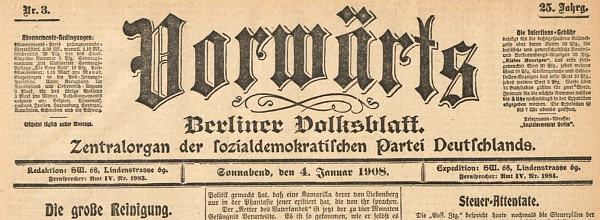
The Vorwärts’s stance on the Harden–Eulenburg affair is characterized by an ambivalent baseline: the paper used the scandal as a political weapon against the imperial elite, while also heavily feeding homophobic resentments. Although the paper called for legal exemption, in daily journalism it resorted to sharp moral condemnations. Overall, populist sensationalism dominated, aimed at severely damaging the monarchy’s reputation.
The Brand/Bülow scandal (1907)
Three years later, a similar scandal involving Adolf Brand broke out. Brand publicly accused the incumbent German Chancellor Prince Bernhard von Bülow of homosexuality in a pamphlet dated September 10, under the title “Prince Bülow and the Abolition of § 175” and alleged that Bülow had intimate relations with his private secretary Max Scheefer. “Vorwärts” reported on this (October 2, 1907) and suggested Brand would have a harder time than Maximilian Harden (November 3, 1907). This was a direct offshoot of the larger Harden–Eulenburg affair. In the detailed trial report, the differences between the WhK and the Gemeinschaft der Eigenen were emphasized. Brand was sentenced to 18 months in prison (November 7, 1907, pages 9-11). In a longer commentary, the Vorwärts welcomed the judgment and noted with satisfaction that the supposed homosexual “camarilla” was now definitively eliminated (November 8, 1907). In relation to Brand, however, the editorial staff appeared divided. Brand at that time had moved closer to the SPD politically and provided good material to fight the Center Party and the ruling class, but used methods viewed as improper in the political arena. Later, the Vorwärts seems to have moved to pointing to the scandals Brand provoked without publicly allying with him politically.
The murder of Otto Klähn (1913)
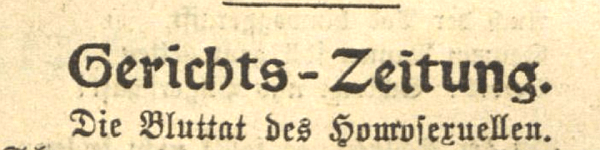
In 1913, 13-year-old student Otto Klähn was sexually abused by Joseph Ritter, murdered, and his body dismembered. The Vorwärts reported on the case as the act of a homosexual from the start. In the first article, the paper pointed to a suspicious man with a note about a “sexual crime” (May 13, 1913). A day later it described the event in detail under the headline “The Blood Act of the Homosexual” (May 14, 1913). The headline is criticized not for the reference to the “blood act” but for naming a “homosexual,” because in a comparable murder case the newspaper would not have referred to a heterosexual murderer. After only ten days and two days of trial, Klähn was sentenced to five years in prison, which the Vorwärts reported (September 23-24, 1913) without commentary.
The Redl (1913) scandal
Colonel Alfred Redl, head of Austrian counterintelligence, was blackmailed for his homosexuality and betrayed secrets to Russia. When he was exposed in 1913, he shot himself. The Vorwärts wrote: “It would be wise not to trust this tale of sexual degeneration too much. It could also be a complete invention, contrived as a deceitful excuse.” The headline chosen by the editors, “The Panama of Austrian Militarism” (June 1, 1913), plays on the French Panama scandal of the 1890s as a symbol of systemic corruption and cover-up. The Vorwärts did not shield Redl from defamation but simply wanted to prevent the mention of his homosexuality from being used as a shield. A few days later, the paper wrote of “homosexual relationships” (June 6, 1913), on which there is no doubt. I will return to the persistent media processing since the Weimar Republic in a later installment.
Reporting on Homosexuals
The homosexual movement
The early homosexual movement consisted, on the one hand, of Magnus Hirschfeld, who together with others founded the Scientific-Humanitarian Committee (WhK) and thus the world’s first advocacy organization for homosexuals. The WhK published the “Yearbook of Sexual Intermediates” from 1898 onward. On the other hand, it included Adolf Brand, who since 1896 published the journal “Der Eigene,” which by 1898 can be regarded as the world’s first homosexual journal.
Additionally, the flamboyant aristocrat Günther Count von der Schulenburg—who supported Hirschfeld and was disinherited for homosexuality—belongs to the movement at the margins. The Vorwärts criticized the psychiatrist’s assessment that led to Schulenburg’s guardianship, using the headline “High Degeneration” for this article (November 26, 1913). See Schulenburg in “Anders als die Andern,” 1906, pp. 99-106.
The convictions under § 175
For the homosexual movement, the erasure of § 175 was one of its most important goals. Because of linguistic taboos, homosexuals were often referred to simply as “175ers” in the Vorwärts. This is evident in the choice of headlines in the Vorwärts, such as “The Sub-government of § 175” (October 24, 1907) or “§ 175 in the Barracks” (December 14, 1907). In this way, § 175—along with § 218 on abortion—became one of the best-known penal-code designations.
Most often, the Vorwärts reported court proceedings under § 175 in concise blurbs, which typically ended in convicting the accused, such as the musician Franz Legula (July 16, 1896); a Berlin tavern keeper on Müllerstrasse (June 29, 1900); Major Graf Nikolaus Pückler (October 6, 1904); merchant Karl Moscholl and Gustav Haupt (August 20, 1905); an AWOL officer (December 19, 1907); and the “female impersonator” and waiter Karl Röseler (July 4, 1913). It also reveals reservations about prostitution (November 1, 1904) and “seduction” (December 20, 1908).
In some cases the paper also reported on blackmail victims based on homosexuality, such as Benedict Friedländer (December 16, 1905; see January 19, 1904; September 20, 1905; and May 18, 1913). The clearest positions of the Vorwärts against § 175 appear in reports on blackmail, as in the Redl case. In the context of blackmail, the editorial staff emphasized, alongside the call to abolish § 175, that those who acquired a homosexual inclination and thus do not belong to those “truly predisposed” should not expect special indulgence. A further commentary reads, at least consistently: “That blackmail cases tend to target wealthy people … cannot lead us to refrain from fighting the injustice … of § 175” (July 6, 1910).
It is not inherently problematic for the Vorwärts to document cases in which gay men themselves were perpetrators of crimes against children or those under their care. The few reports on the deeds of Richard Bartsch (September 30, 1908), Oscar Behrens (November 12, 1910), Jung, the instructor (April 8, 1911), and K. Braun (June 25, 1914) are not overwhelmingly weighty. The dates suggest that these reports appeared because social attitudes toward homosexuality had deteriorated since the Harden–Eulenburg affair.
The homosexual scene
Where could homosexuals meet and how did they organize themselves? Despite the homosexual movement, reports about the German Empire’s homosexual scene are rare. The Vorwärts’s pieces on the scene appearing from 1907 onward also reflect the impact of the Harden–Eulenburg affair. Reports described a trio of criminals, male acquaintances in the Tiergarten or Friedrichstrasse, and a cruising scene in Behrenstrasse (August 28, 1907). There were also reports of a Magdeburg trial against 17 homosexuals, a circle of friends, and documents like love letters (December 3, 1910). In a raid on a small homosexual venue in Berlin’s Kochstrasse, 100 men were arrested (December 10, 1912). The article “The Glue Trap for Lascivious Men” emphasized that in Berlin’s Friedrichstrasse Robert Musil’s novel The Confusions of Young Törless began to be marketed in earnest only after it was advertised in connection with homosexuality (November 18, 1913).
This negative reportage about the scene is comparable to international coverage: in Belgrade a homosexual club was discovered, arrests followed, and two more clubs were said to exist (January 12, 1908). In a “notoriously disreputable restaurant” in Paris, 28 homosexuals were arrested, 16 of whom went to prison (May 1, 1908). In a public bath in Budapest, 24 men and boys were arrested during an “orgy,” and a formal organization of homosexuals is said to have existed (November 24, 1909). Even in Chicago there was said to be a “club” (August 5, 1911). All Vorwärts pieces about the scene are demeaning, often criminalizing, and point to what many people imagine under a homosexual milieu.
Homosexual fiction
Thomas Mann remains a major author and literary luminary to this day. His homoerotic novella Death in Venice (1912) was received largely positively after its publication, and this is reflected in Vorwärts as well. In a thorough review, the piece notes Goethe’s “Explanation of pedophilic inclinations” and Winckelmann’s analysis, in which aesthetic admiration turns into sensuous passion (April 25, 1913). More than a decade later, the review notes that the novella explores the “dark corners of the artist’s psychology” (June 6, 1925). Somewhat awkwardly, it is stated that “the fruitless love is destroyed by the specter of homosexual Eros” (June 9, 1927).
Under the pseudonym Sagitta, the writer John Henry Mackay wrote Die Bücher der namenlosen Liebe (1906). When his pamphlet Sagitta: Hört! Only a Moment led to legal disputes, the Vorwärts reported on it without comment (December 10, 1908; December 11, 1908). About the Danish writer Herman Bang the Vorwärts wrote a year after his death: “He succumbed to his (homosexual) predisposition” (February 28, 1913). In the review of Gustav Naumann’s Vom Lärm auf dunklen Gassen (1907), the teacher is described as a “homosexual” who allegedly engaged in sexual relations with students (March 7, 1907). Many Vorwärts pieces on fiction do not reveal the editors’ views.
Homosexual non-fiction
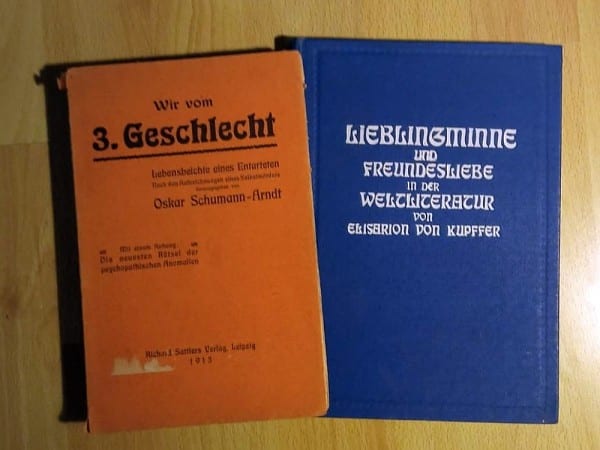
It is noticeable that almost only in a particular time window did Vorwärts point to sexual science and educational writings about homosexuality (some with advertisements), such as Caspar Wirz’s Der Uranier vor Kirche und Schrift (July 14, 1905), Ferdinand Karsch-Haack’s Forschungen über gleichgeschlechtliche Liebe (February 3, 1906), Oscar Schumann-Arndt Wir vom dritten Geschlecht (November 12, 1907), Hermann Michaelis’s § 175. Die Homosexualität in Sitte und Recht (December 1, 1907), and M. Braunschweig’s Das dritte Geschlecht (March 16, 1910). The Vorwärts’s stance on the opinions within these works is clear only in one case: when Elisar von Kupffer’s homosexual anthology Lieblingminne und Freundesliebe (1900) was confiscated three years after its appearance, the paper spoke of “moralistic guardianship” (October 24, 1903).
In Vorwärts there were also references to non-fiction works that depicted homosexuality in a negative light, such as Karl Heinrich Ritter von Lang’s Zur Homosexualität der Jesuiten (November 26, 1908), who had been drawing attention to alleged homosexual transgressions within the Jesuit order since the 1890s. In general, however, emancipatory literature tended to predominate during this period.
Lectures on homosexuality
Magnus Hirschfeld gave countless emancipatory lectures on homosexuality. Unlike in the Weimar Republic, in the German Empire there were also many lectures by other speakers announced. In some cases the speakers were not named (March 4, 1900) or are now unknown, such as the naturist R. Geist (March 12, 1901), the naturopath Mr. Grundmann (April 3, 1902), and G. Wagner (December 4, 1902). The fact that these lectures were held in the context of natural healing associations and thus within the Lebensreform movement suggests a certain openness.
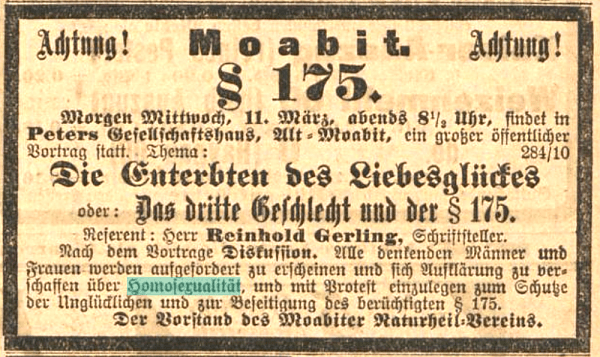
Several lectures by homosexual activists were given on the Krupp scandal. These included a talk by Reinhold Gerling on “The Outcasts of the Joyful Love or the Third Sex and § 175” (March 11, 1903) and two talks by Adolf Brand and Edwin Bab about the “Krupp Case! (… ) Homosexuality and Morality. The Betrayed of the Joyful Love and § 175” on April 15 (April 12, 1903) and April 24 (April 23, 1903).
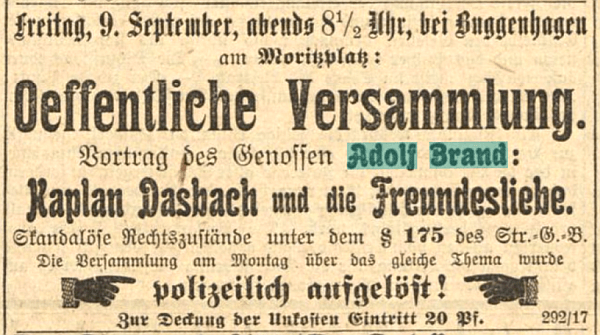
Adolf Brand also gave several lectures on “Kaplan Dasbach and the Friendship” amid the homosexually charged scandal around the cleric Dasbach. The lecture on September 5, 1904, with 700 attendees, was broken up by the police, which the Vorwärts criticized (September 6, 1904). Two further lectures on the same topic on September 9, 1904 (September 9, 1904) and September 19, 1904 (September 18, 1904) were accompanied by advertisements in the Vorwärts. Interestingly, Brand is referred to here as a “Comrade,” indicating membership in the SPD—an affiliation in homosexual historiography not previously documented. On March 27, 1905 Brand planned to give another Dasbach lecture, cautiously announced as “§ 175, the Center, and the Parliaments.” The police threatened with dispersal and, when Brand named homosexuals, dispersed the meeting with a threat of firearms. The Vorwärts indirectly criticized the police’s behavior (March 28, 1905).
Reporting on “Transvestites”
“Transvestites”—a term used at the time both as a label and self-designation—were frequently criminalized in the Vorwärts, such as Berlin waiter Karl Röseler, who was repeatedly arrested in women’s clothing, had four prior convictions under § 175, and was imprisoned for “unnatural fornication” (October 14, 1893; January 31, 1899; July 4, 1913). The 28-year-old Heinrich Müller was said to have stolen women’s clothing “for lust” and was said to have “moved in homosexual circles” (March 14, 1911). In such cases the Vorwärts never argued against § 175’s injustice or legitimized cross-dressing.
When Magnus Hirschfeld was involved as an expert, the Vorwärts’s tone changed. The accused now had someone to defend them, such as Julius Eichbaum from Berlin-Lichterfelde, who was described in press articles, including the Vorwärts, as a “false gigolo” (October 4, 1910; April 1, 1911). With Hirschfeld’s testimony, individuals like Josef Meissauer were able to obtain permission to wear women’s clothing (October 5, 1911). A man arrested in women’s clothing said he was going to consult Hirschfeld (August 23, 1912).
There is a certain openness in Vorwärts’s review of N. O. Body’s book, Baer’s Vom eines Mannes Mädchenjahren. The book tells the life of a person who was born intersex, raised as a girl, and later corrected their gender entry. N. O. Bodys’s autobiography was reviewed by Vorwärts in comparison with Verene Junkers Liebe, a novel about a lesbian relationship that advocates for acceptance of homosexuality (June 19, 1907).
Lesbians remain underrepresented
That Vorwärts mostly reported on male homosexuality had legal, but also social and economic reasons. While gay men were criminalized and thus made visible in public discourse, lesbians remained legally invisible and more hidden in private life. In political discussions such as the Reichstag session of November 29, 1907, lesbians were usually only mentioned in passing (November 30, 1907). The extension of § 175 to women was rejected.
Only in one article is the existence of a lesbian scene hinted at. Under the heading “The Homosexual Club—New Women’s Community,” Vorwärts referred to a Die Glocke article that claimed the club’s members were lesbians. The Die Glocke editor was sued by five members of the club for insult; the defendant was acquitted because the claims were “largely true.” The Vorwärts did not reproduce the editor’s comment (April 22, 1909). A note on lesbians in art and culture is also minimal; the reviewer of August Strindberg’s play Kameraden noted that the actress Frl. Somary provided “a finely honed study” of the homosexual intriguer Abel in the Bohemian figure (the character Abel is described as an emancipated woman with a “masculine mind”) (November 20, 1912). Calling emancipated women “masculine” can be read as a contemporary cipher for breaking gender roles and, by extension, for homosexuality.
The First World War (1914-1918)
During the First World War, from July 1914 to November 1918, the homosexual movement paused. The public display of military “masculinity” left little space for activism by men who might be assigned more feminine characteristics to demand their rights (see Marita Keilson-Lauritz, The History of One’s Own History, 1997, pp. 53-54, 114-117). This is clearly reflected in Vorwärts: the newspaper carried only occasional references to Magnus Hirschfeld’s talks, such as “Military Psychology” or “On the Nature of Human Personality,” but not even hints at homosexuality in the context of court cases or other criminal matters.
The queer community needs a strong journalistic voice — now more than ever! Contribute to support TheColu.mn’s work.
Conclusion
The SPD has a long and varied history — including August Bebel, the founder of the SPD. In my TheColu.mn article “How August Bebel Hit Out at the Gay ‘Puppeteers,’” I highlighted Bebel’s dual nature. Magnus Hirschfeld and August Bebel had met in 1890, and I think it possible that Bebel, due to this personal contact, added passages about homosexuality to his book Die Frau und der Sozialismus (The Woman and Socialism, 1879) in its 1891 editions and signed the petition to abolish § 175. A few years after the homosexual movement formed in Berlin in 1897, the Vorwärts’s reporting on homosexuality was positively influenced, though there are clear differences in how the two comrades and homosexual activists Magnus Hirschfeld and Adolf Brand were treated.
Politically, the Vorwärts’s campaign against § 175 in the German Empire was fundamentally persuasive. However, there was a distinction between “innate” and “acquired” homosexuality, and the Vorwärts repeatedly emphasized that it morally supported only the former group. Because the paper consistently campaigned for abolishing § 175, readers could reasonably expect emancipatory reporting; this was not always fulfilled when the paper merely disparaged the homosexual scene. In my book Anders als die Andern (Online here) I reached the conclusion, after analyzing Rhineland newspapers, that the period from 1902 to 1907 in the German Empire was more open and freer than the later Weimar Republic. The Vorwärts articles support this view, reporting on emancipatory literature.
Overall, the many articles do not form a cohesive single portrait, which is partially due to the era’s changing mood and the variety of sections in which the pieces appeared. The selection of legal cases reported by the Vorwärts changed over time. In the Wilhelmine era the emphasis was on convictions under § 175 and blackmail, making gay men appear as victims. In the Weimar Republic the share of articles criminalizing homosexuals rose. The publication Späte Aufarbeitung. LSBTTIQ-Lebenswelten im deutschen Südwesten (2018, S. 50) summarizes the SPD’s stance as reflected in the Vorwärts: “The ambivalence of Social Democracy between a readiness for emancipation and instrumental homophobia remained a constant in the 20th century.”