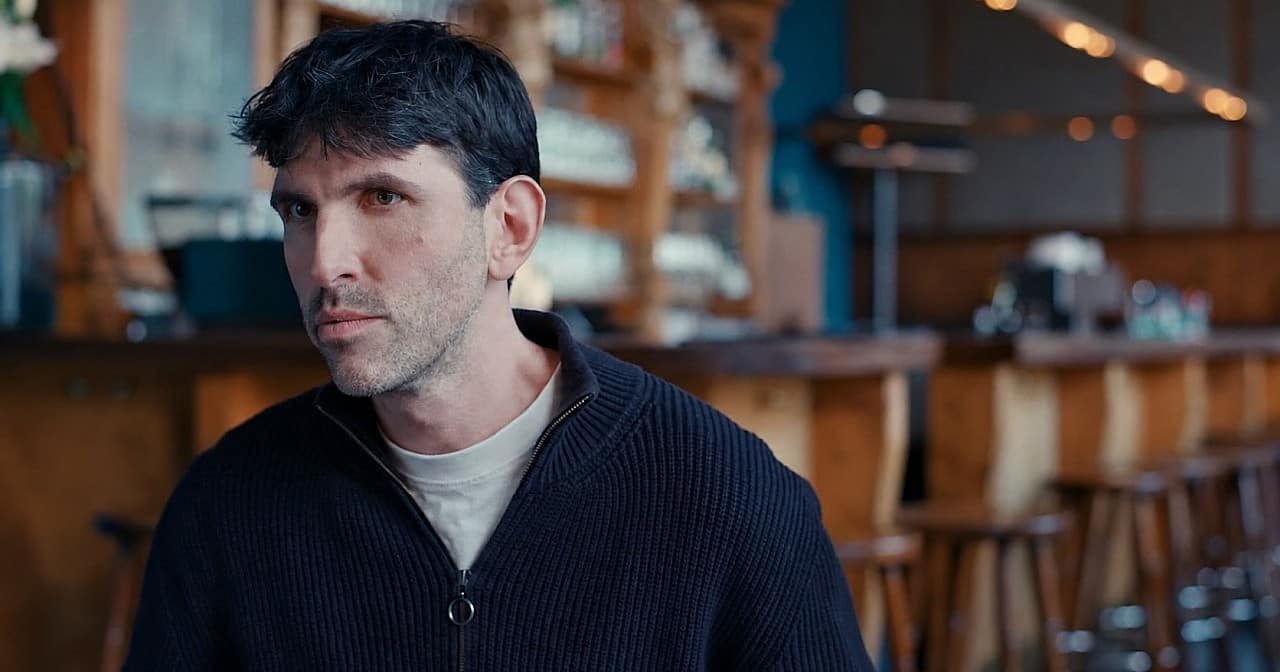
For his feature debut Knochen und Namen (Bones and Names), Fabian Stumm won the 2023 Heiner Carow Prize from the DEFA Foundation, and a year later at the Munich Film Festival he was honored with the Förderpreis Neues Deutsches Kino and the FIPRESCI Prize from the International Federation of Film Critics for Sad Jokes. This Saturday, his third feature—The Ideas—will celebrate its world premiere at the Zurich Film Festival. The drama-comedy unfolds in six episodes about people in moments of transition. As usual, the 1981-born director and writer also takes a role. Jonas Dassler is back in the mix as well. We spoke with Fabian Stumm about the new theatrical project.
Mr. Stumm, striking titles seem to be a small trademark of your films. What’s the story behind this title?
In one scene, the character played by Romina Küper justifies her endless stream of ideas by saying, “I just have a lot of ideas, and if you have ideas you’ve got to put them into the world, otherwise it’s indecent.” I liked that attitude, and I thought it was a fitting title for an episodic film that is told in a fragmentary way.
Jonas Dassler is another small signature element this time. He plays the Coq-au-vin chef who flares up. Will this become a film-family of sorts?
I hope so. You meet on a familiar footing and then, from there, we search together for new facets and temperatures. Jonas is a colleague who brings so much warmth and playfulness; I was glad we crossed paths again for the next film.
A third star is Angela Winkler. How do you attract big names with a small budget?
Angela has been a major actress for me since my youth. We’ve crossed paths a few times, and I invited her to the premiere of Sad Jokes. After that, it was clear we absolutely wanted to work together. Primarily, everyone involved looks for a good script and an interesting role—we believe that’s the foundation, regardless of budgets or paydays.
German cinema thrives on funding. You consistently forgo the warm subsidy windfall. What’s the rationale for this model?
Time. I have other projects in development that follow the traditional subsidy path, and that requires patience. But I’m at my best when I’m writing and making things, and I’ve built a stable network of people who feel the same way. We made this film as a friendship-and-family project with the resources available to us. If I were a painter, I wouldn’t wait for someone to give me a canvas and brushes. I’d find a way to paint anyway. I don’t want to give up that freedom and immediacy right now.
Is there the expectation that a queer director should primarily tackle queer topics? After all, only one story in The Ideas is queer…
I’m not feeling that pressure at all. I want the freedom to tell the things that occupy me. As a gay man, I’m telling from my perspective anyway—the gender balance is secondary to me. I’m interested in people, relationships, and the dynamics between them, which can take many forms. I think queer visibility is incredibly important. But visibility also means that queer artists aren’t bound to telling only queer stories.
Would an episodic film align better with TikTok viewing habits than a traditional feature?
I’ve never used TikTok, so I can’t judge. It’s true that bite-sized storytelling can be easier or faster to consume. In my film, however, the form is intentionally cinematic and not designed to grab attention as quickly as possible. On the contrary, the individual stories take time for their characters. What drew me to the episodic structure is that you can open up a panorama in a relatively short span and meet people in very different life situations, then move on.
What do you think of the label “Woody Allen meets Bergman meets Loriot”?
I generally try to steer clear of labels. But if people whose work I admire are mentioned in connection with my film, I won’t complain.
How important is humor?
Very important. Humor can be a powerful force, especially when dealing with challenging topics. It creates a space to speak honestly about fears, hurts, and insecurities. Besides, I love making an audience laugh. There’s something profoundly connective about it, and in these times I think it matters more than ever.
How autobiographical is this piece?
When I was writing, it felt like pure fiction. Yet on average I realized how much of me shows up in these episodes. That’s just how I approach material. I seem to sample everything that has happened to me or to people in my life. It happens almost automatically.
“I asked ChatGPT whether a relationship is good,” one line goes. Did you consult AI for the film as well?
No—I find that a creepy idea.
What’s the deal with the acknowledgments to Taylor Swift and to Doris Dörrie?
Taylor Swift’s music has been the soundtrack of my life for years—and I mean that without irony. She’s one of the great storytellers, and her output continually inspires me. In one way or another she appears in all my films. It’s a little running gag some notices and others don’t. Doris Dörrie and I met last year, and there was an immediate sense of belonging. She’s an incredibly generous colleague, and some of her thoughts and advice accompanied me during the development of the film. I wanted to thank her for that.
What’s your advice for moviegoers when the film hits theaters in January 2027?
I think The Ideas actually offers something for a wide range of tastes. While shooting, I pictured it as a painter’s palette, with each character standing for a different color. Maybe you’ll recognize yourself or the person sitting beside you. And afterward, I hope there’s something you’ll want to talk about with others.
On the soundtrack, there’s Aquarium from The Carnival of the Animals. The melody traditionally plays in Cannes before every film. Is that a hint about where the film is headed?
I’ve never been to Cannes, and I didn’t choose the music with that in mind. Let’s put it this way: if I’m invited, I’ll gladly come. Merci beaucoup!