In Heidenau near Dresden, no Stolpersteine will be laid anymore to commemorate victims of the National Socialist era. A motion in the city council, led by the AfD and CDU, passed by a majority, according to the city administration and a news agency. The vote tallied 13 yes, 6 no, and one abstention.
In a cross‑party draft resolution alongside the “Oberelbe Alliance for More Democracy,” representatives from both parties urged that Stolpersteine be rejected in the future “in the public street and sidewalk area.”
Many citizens, relatives, and grassroots initiatives felt that this form of remembrance for Nazi victims was not appropriate, the motion stated. Instead, memorial ceremonies should preferably take place at the North Cemetery of the city, so that direct access to the memorial elements is excluded.
Administration spoke out against the proposal
The administration had recommended rejecting the proposal. “Precisely the presence in public space enables broad perception and the direct engagement with history,” they wrote in an assessment of the measure.
In Heidenau, in the Saxon Switzerland-Eastern Ore Mountains district, there are Stolpersteine at two sites—among them one remembering the former mayor Paul Gröger. Last year, the Alternative Cultural and Educational Center Saxon Switzerland, based in the neighboring town of Pirna, had asked for the laying of additional Stolpersteine.
Christoph Heubner, Executive Vice President of the International Auschwitz Committee, said in the statement: “This is a transparent and shabby attempt to push Heidenau’s Nazi victims out of the city again and to dispose of them where memorials, in the opinion of the AfD, already belong: at the cemetery.” The idea that CDU lawmakers would lend their support to such petty acts is scandalous.
Stolpersteine remind in many countries
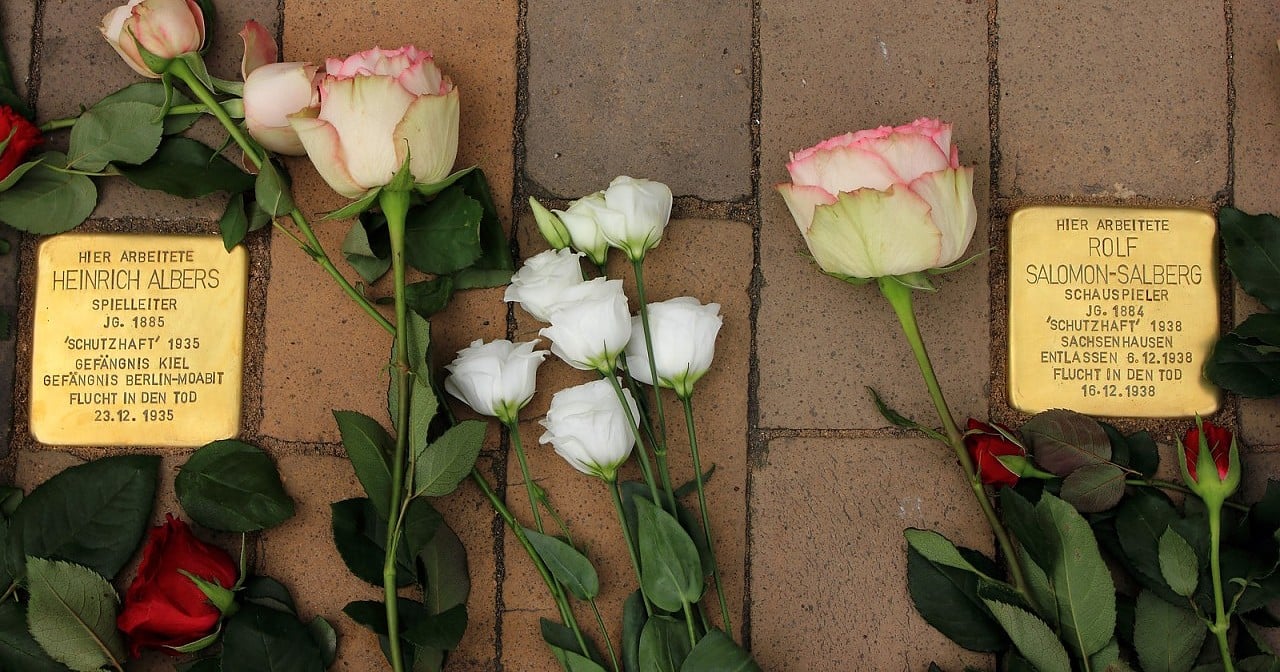
The Stolpersteine, launched in 1992 by artist Gunter Demnig, remind people across Germany and now in many European countries of the victims of the Nazi era — including queer individuals. Tens of thousands of gay men were convicted under Paragraph 175, thousands were deported to concentration camps, and many did not survive. In several cities, in recent years, Stolpersteine have been installed specifically for this victim group, which had long been left out of official commemorative culture.
The small stones, typically funded by donations, are laid at the last known residence or place of work of Nazi victims — their names and life dates are inscribed on a brass plate on the top of the stone.
Memorial signs instead of Stolpersteine in Munich
In Munich, Stolpersteine are not laid on municipal property following a city council decision. They are found primarily on private property—and also on sites belonging to the Free State of Bavaria. Instead, memorial signs featuring photographs and brief biographical details are placed in front of the homes where people once lived, drawing attention to the fates of those who were torn from their daily lives by the Nazis.
Charlotte Knobloch, president of the Israelitische Kultusgemeinde München und Oberbayern, had strongly rejected the Stolpersteine. As a child she witnessed the Nazi terror in Munich. “Before my mind’s eye I see the people who were trampled on the ground and forced into transports, as heavy leather and steel-capped boots stepped on them,” she described. (dpa)