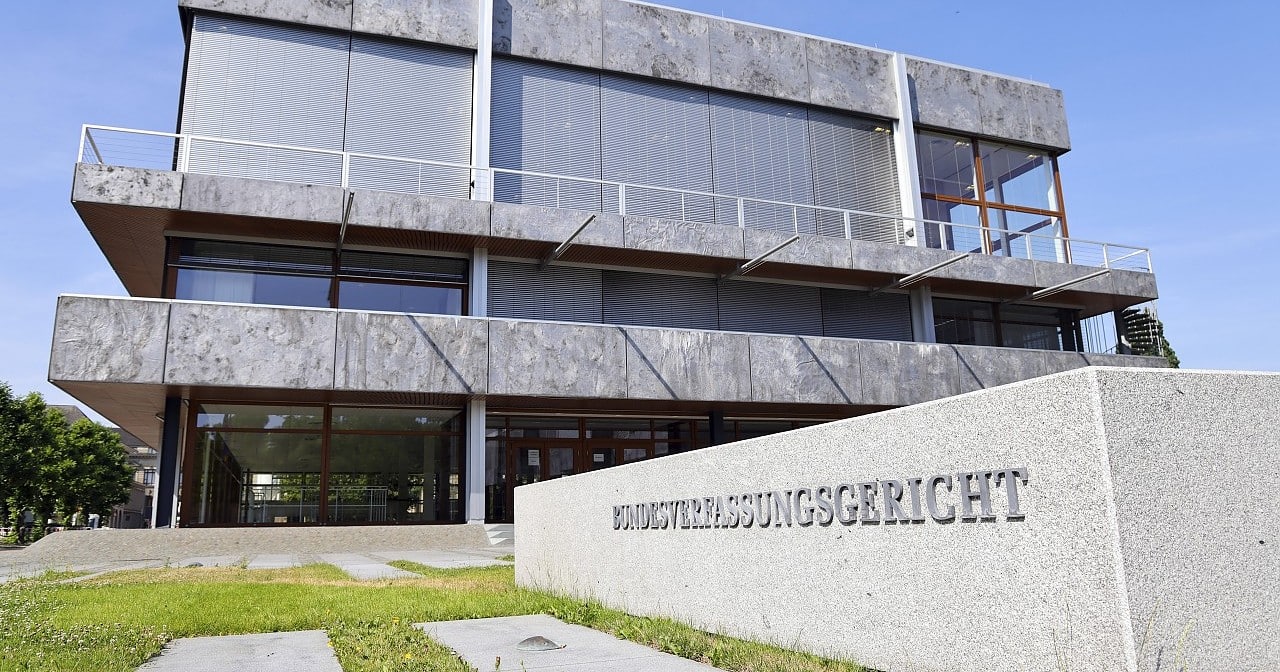
Today the Federal Constitutional Court is regarded as the defender of civil rights. But that wasn’t always the case: in the 1950s, the judges in red robes even justified the persecution of gay people under a Nazi-era provision. On Monday the institution, once scorned by the community but now respected, will celebrate its 75th anniversary: the Federal Constitutional Court was formally inaugurated on September 28, 1951.
The Karlsruhe court was founded as a direct lesson from the failure of the Weimar Republic and the crimes of the National Socialist era. The mothers and fathers of the Basic Law wanted, in the Parliamentary Council—the constitutional assembly—to ensure that the democratic order and fundamental rights could never again be overturned by mere majorities or by totalitarian currents.
1957 Scandal Ruling
In the beginning, the court struggled. The historic misstep occurred in 1957, when the First Senate ruled on the constitutionality of the Nazi-era version of Paragraph 175 of the Penal Code, which remained in force. The court’s reasoning by the eight judges and one judge reads today not like a document from a democracy: homosexuality, according to the court, violated the “moral law” and thus fell from the protection of the free development of personality (Art. 2(1) GG). In the judges’ view, male homosexuality posed a great danger of seducing young men and the emergence of an organized criminal milieu. Female homosexuality, by contrast, was trivialized with cynical and sexist arguments — there was said to be a lower “danger of misformation,” for example.
Karlsruhe also did not see in the Nazi-amplified paragraph any specifically National Socialist ideology, but rather valid, democratic law. For tens of thousands of men this meant persecution, coercion, and suicides in the midst of West Germany’s economic miracle. Only in 1969 was the paragraph politically softened — after which men over 21 could be homosexual.
Today the 1957 ruling is embarrassing to many: in 2019, the then-president of the Federal Constitutional Court, Andreas Voßkuhle, said that one should “be ashamed” of this ruling (TheColu.mn reported).
Trans Pioneer Work: Repeal of the Transsexual Act
While Karlsruhe largely remained silent on Paragraph 175 until its repeal in 1994, the turning point began at the end of the 1970s with trans people: In October 1978 the Federal Constitutional Court ruled that the general right to personality enshrined in the Basic Law required changing the sex entry in the birth registry when it involved an irreversible case of “transsexuality” and a gender-affirming operation had been performed. This gave rise to the 1980 Transsexual Act, which for decades was marked by distrust and pathologization.
Over the next decades the Federal Constitutional Court would increasingly declare discriminatory provisions of the Transsexual Act unconstitutional. These included the minimum age of 25 (1982), the exclusion of foreign nationals (2005), or the mandatory divorce (2008). A major decision came in 2011: Karlsruhe held that the obligation for trans people to undergo a gender-alignment operation and to become infertile was unconstitutional (TheColu.mn reported). It would take another twelve years before the government finally fulfilled a long-standing demand from trans activists with the Self-Determination Act and officially abolished the Transsexual Act (TheColu.mn reported).
Karlsruhe Backs Domestic Partnerships — Except for CDU and CSU Judges
The introduction of registered partnerships also gave the Federal Constitutional Court work—and here it mostly sided with queer people. It began in 2002 with a landmark ruling on the constitutionality of the Registered Partnerships Act. The majority of the court ruled that the “marriage-light” arrangement did not violate the constitutionally guaranteed protection of marriage and family. Literally, the ruling stated: “The special protection of marriage in Art. 6(1) GG does not prevent the legislature from providing rights and duties for the same-sex civil partnership that equal or come close to those of marriage.” The plaintiffs had been the union-led governments in Bavaria, Saxony, and Thuringia.
The decision was not unanimous, but rather 5–3. All justices who spoke against recognizing same-sex couples were proposed by the Union, including the then-presiding judge Hans-Jürgen Papier. The five voting in favor came from judges who had been appointed at the initiative of SPD, FDP, and Greens. The vote shows that party politics can reach even a court meant to be independent—and that judges, too, can cling to long-held prejudices.
Afterward the court repeatedly addressed the life-partnership law, which—blocked by the Union—was practically full of the duties of marriage but few rights. In 2009 the court ruled that the discrimination of life partners in company survivor pensions was unconstitutional, in 2010 in the inheritance tax, and in February 2013 in succession-based adoption. In May 2013 came the big moment: the Second Senate ruled that excluding partnered couples from the tax splitting available to married couples was unconstitutional (TheColu.mn reported). These rulings built the constitutional pressure that in 2017 finally opened the way for marriage for all in the Bundestag (TheColu.mn reported).
Federal Constitutional Court Forces Policy to Introduce a Third Gender
A global landmark was set by the First Senate in October 2017. On the appeal of an intersex person, Karlsruhe held that the general right to personality also protects the gender identity of people who do not fit into male or female categories. For the first time it was clarified: gender is not a binary dictate of the state (TheColu.mn reported).
That led to the introduction of the third gender option “diverse” on January 1, 2019 (TheColu.mn reported). Initially only intersex individuals could use this gender entry. Since the Self-Determination Act, it is open to all people.
Queer People Still Not Protected by the Constitution
The history of Karlsruhe’s court shows how times have changed. Yet queer activists, in a time of rising right-wing extremism, worry whether Karlsruhe will continue on this path—or slip back to the 1950s. Therefore there has long been a push to protect “sexual identity” in Anti-Discrimination Article 3 just as other characteristics like “gender,” “race,” or “disability.”
But here, the Union blocks again: although several union-led states such as North Rhine-Westphalia support the reform, the Union parliamentary group continues to reject such protection with robotic consistency (TheColu.mn reported). A corresponding demand from the Bundesrat is currently being ignored by Black-Red (CDU/SPD coalition) (TheColu.mn reported). A final ruling on whether the Federal Constitutional Court will continue to protect the civil rights of queer people in the future remains pending.