
A journey into the unknown: In Fatherland, Nobel Prize in Literature laureate Thomas Mann returns to Germany for the first time since World War II, accompanied by his daughter Erika. What awaits him in the country he no longer knows, from which he fled?
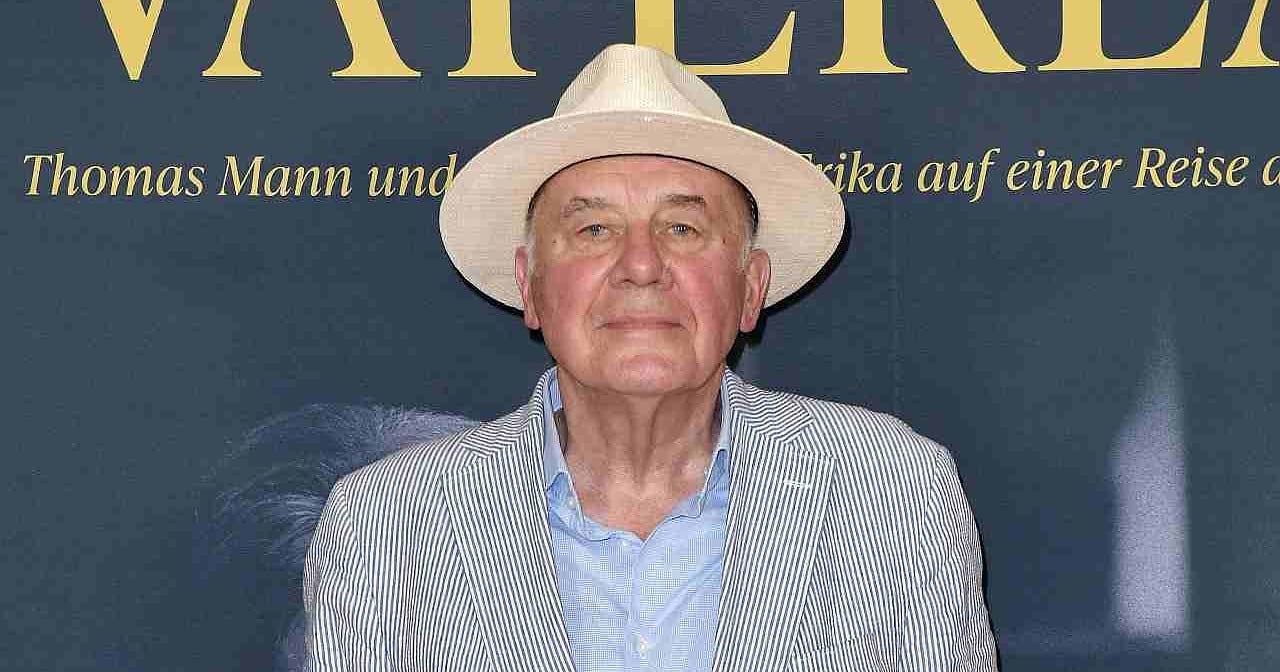
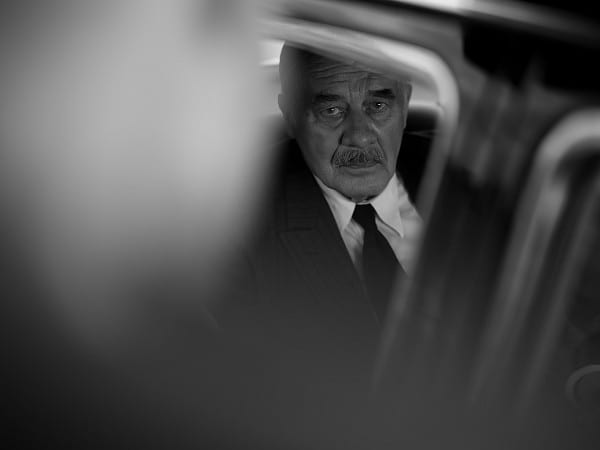
In director Paweł Pawlikowski’s film, Hanns Zischler, then 79, portrays the writer. A sensational performance, for he endows Thomas Mann with a diligent resolve, while, at the same time, an unexpected warmth glimmers through — especially toward his daughter Erika, played by Sandra Hüller.
In the lobby of a Cologne hotel, Hanns Zischler talks about Fatherland, but also about the state of German reunification — and the question whether there are today intellectuals with the kind of influence Mann once wielded.
Last year we celebrated the Thomas Mann Year, marking what would have been the writer’s 150th birthday. Dozens of books about him appeared, many becoming bestsellers. The film “Fatherland” is also drawing enormous attention. How do you explain this lasting fascination with Thomas Mann?
There are several reasons: His work as a writer goes very deep. It deals with the haunting — the lure of life, the pull of sexuality, and the dilemma one can find oneself in, wanting to yield yet bound by a constraint. He seems to have a keen sense of that tension.
The other reason is his family story: this family circus provides such rich material that people keep trying to connect it back to his work, though often with many mistakes, I think. With so many prolific children like Klaus, Erika, and Golo, privacy has frequently sparked speculation, and she was open to it. That, of course, is a perennial topic.
You know Mann’s work well. Did you learn anything new or surprising about the figure of Thomas Mann during your preparation for “Fatherland”?
No! Absolutely not, and I don’t want to. When I portray Thomas Mann, it’s utterly irrelevant what I know about him. Engaging with Thomas Mann can be stimulating; it can be a درس in sarcasm and sentimentality. But as an actor, I must follow the directions of the director in their particular dramaturgical emphasis. Pawlikowski told me: “Forget everything you know about him.” Because the situation he wants requires tasks for an actor, not for an intellectual.
And did you listen to director Paweł Pawlikowski? Did you forget everything?
Yes, of course. Because the moment I act, I’m occupied with my performance. My knowledge doesn’t help me; it could even distract me.
Paweł Pawlikowski often says he works very closely with the cinematographer. He makes the pictures. Was he equally precise in his instructions to you as an actor?
Yes, he has a clear idea of what he wants corrected. You’re placed into an exactly prepared scene — the lighting, the framing, the camera, and so on. And within that constraint I move, and then he says: moment, perhaps a touch more restraint or a touch more hesitation. These are small things that accumulate. It was therefore a very inspiring collaboration, because it was a continuous refinement.
You are one of the best-known German actors; you’ve worked with Wenders, Handke, Godard, Spielberg. Sandra Hüller is celebrated as an extraordinary talent worldwide. Pawlikowski is an Oscar winner. Who has the greater respect for whom? Or do you forget all that?
That has absolutely no bearing. A person’s fame is utterly incidental. Naturally you respect the other’s work. It’s more about agreeing on a particular language and mode of expression and carrying it from one shoot to the next. The director has very precise choreography for how people in the background should move. And then a scene succeeds as if people were moving there quite naturally.
The film is described as a masterwork, winning Cannes’ Best Director prize. At what moment did you sense it would be a good film?
From the start! When someone tackles such a topic in this compressed form, I knew it could work. It may sound presumptuous, but I was convinced from the outset of the gravity that Pawlikowski seeks to convey.
With the name Thomas Mann, there’s a lot riding on it. Was it easier for Pawlikowski to make a film about him because he has a certain distance?
Yes, I think so. I don’t believe Thomas Mann is particularly close to him. But what interests him is the burden on a writer who returns from exile expecting a welcome, and who also carries family trauma. Yet the country he returns to rejects him, while an inflated propagandistic one surrounds him.
There are some changes in the screenplay: Klaus Mann did not commit suicide during this trip, but a few months prior. He was not accompanied by his daughter Erika, but by his wife Katja. These changes emphasize the queerness in the family dynamics. Does this give the Thomas Mann character a chance to confront his homosexuality and the dynamics within his family?
His homosexual inclinations were an open secret. Thomas Mann, through his stories, is able to keep these longings alive in his characters. In his private life, it becomes complicated. There is in the film a small scene where he exchanges a cigar with a Soviet soldier. It’s a flicker of love from an aging man, and that’s exactly the kind of nuanced emphasis Pawlikowski allows, which gives the moment its impact. It’s not shown in an over-the-top way; you see how this old man is drawn to these young soldiers.
Direct link | Official trailer for the film
|
Only with his son Klaus Mann, who led a very different life, did he never really come to terms. That’s how the film begins…
Yes, and that is also very important. As a dramaturgical opening, it’s essential and harrowing. This rejection by the son, who says: I’d rather plunge into the abyss than get any closer to the old man again.
That is also brilliantly performed by August Diehl, in the scene itself, a kind of lying-down posture — nothing is accidental. He refuses to rise again; he doesn’t want to. Klaus lets himself live excesses that the father would not approve of, and that he himself also does not approve. On the other hand, Thomas Mann writes an elegy to his son a year after Klaus’s death in the memories Erika published. A love-hate relationship that developed between them, and in which the son did not have it easy, to put it mildly.
And the father as well.
The father as well, but the father masks it better. Mann’s life-egoism is relentless. He includes grief, but he says: I will endure this.
Paweł Pawlikowski calls the film “documentary fiction.” Which predominated for you in your performance: the documentary or the fictional?
For me, the fiction predominates, simply because I am part of the fiction. I move within it. The documentary is produced by the technical choices — black-and-white, the old 4:3 film format. He offers that which we most readily accept as documentary.
But visually you did approach Thomas Mann, with the mustache, for example.
Yes, of course — I approach the exterior in a certain way, but the truly documentary aspect comes from the settings he traverses: the Frankfurt city hall, this ruined city, old hotel rooms.
The queer community needs a strong journalistic voice — especially now! Make your contribution to support TheColu.mn’s work.
In the film, Thomas Mann travels between the Federal Republic and the GDR, between two systems. Just now, ahead of elections in Saxony-Anhalt, Mecklenburg-Western Pomerania, and Berlin, there’s a renewed debate about the rifts between East and West. Are you surprised that we’re still arguing about this?
I’m not surprised; I’m appalled — appalled that what we call reunification hasn’t actually been achieved. I should point out, however, that in Germany no country has ever been reunited with another. Only one city, one country, was reunified: Berlin. All the other states remained as they were. One would have needed an immediate territorial reform, the almost-forgotten Five-State concept.
I find the East-West division to be absurd in its extremity. I have tried, with my means — through protests and representation — to resist it. It is ghastly what is happening — it is homophobic, racist, deeply xenophobic, and we must continually push back against it. We will see what means we have to prevent it from spiraling further.
One who raised his voice was Thomas Mann with his radio addresses. Do you miss today’s similarly engaged intellectual voices that can reach so many people?
One must not forget that Mann’s voice came to the ether from America. That means he acted as an outsider, as someone who had become a foreigner. At the same time he says: “I am Germany.” He spoke into Germany, into this armored and crusty, Hitler-believing Germany. One shouldn’t pretend that all those were victims. Mann saw that very clearly. But it’s also naïve to think today that any intellectual voice can so powerfully restore balance. I don’t think that’s possible.
Fatherland. Biopic. Poland, Germany, Italy, France 2026. Director: Paweł Pawlikowski. Cast: Hanns Zischler, Sandra Hüller, August Diehl, Devid Striesow, Joachim Meyerhoff, Fritzi Haberlandt, Milan Peschel. Runtime: 82 minutes. Language: German original. MPAA: G. Distributor: Neue Visionen. Theatrical release: September 3, 2026


