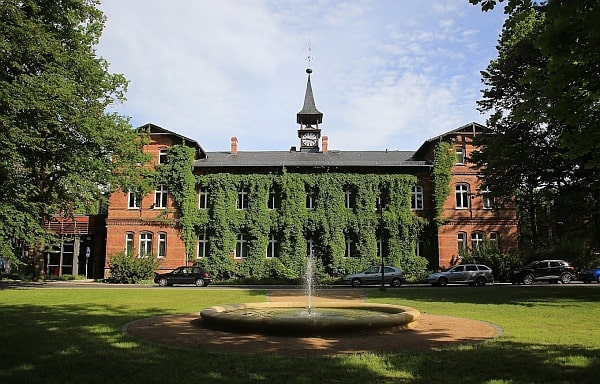
Regarding his life, Ernst Burchard (1876-1920) provided a few details in his dissertation “Some Cases of Transient Glycosuria” (1900, p. 20). Among other things, it states that since October 1899 he had been an assistant physician at the Landes-Heil- und Pflegeanstalt Uchtspringe near Stendal. He remained there until March 1902. (Today this facility is called “Fachklinikum Uchtspringe.” There is an archive there, but according to a staff member, unfortunately no records about Burchard survive.)
After March 1902 he settled in Berlin as a practicing physician and neurologist, where he became acquainted with the early homosexual movement centered around Magnus Hirschfeld, who in 1897 had founded the Scientific-Humanitarian Committee (WhK) as the world’s first organization advocating for homosexual rights. From then on, Burchard was active in this movement and even published contributions in the WhK’s Yearbook for Sexual Intermediaries (Jahrbuch für sexuelle Zwischenstufen, JfsZ). In January 1920 he died at the age of only 43. A solid general overview of his life and work can be found in the biographical lexicon by Volkmar Sigusch and Günter Grau, “Encyclopedia of Sexual Science” (2009, pp. 98-99).
If one puts aside a few statements, I have a great deal of respect for the life work of this activist, who contributed a great deal to the emancipation of homosexuals primarily as a physician, but also as a writer. In most of his roughly two dozen published books and essays, his views were remarkably modern, going beyond the simple assertion that homosexuality is neither pathological nor in need of treatment. I will now focus on Burchard’s life and influence within the queer context. I would like to thank the Centrum Schwule Geschichte in Cologne for enabling research in his holdings.
For Hirschfeld, Burchard was gay
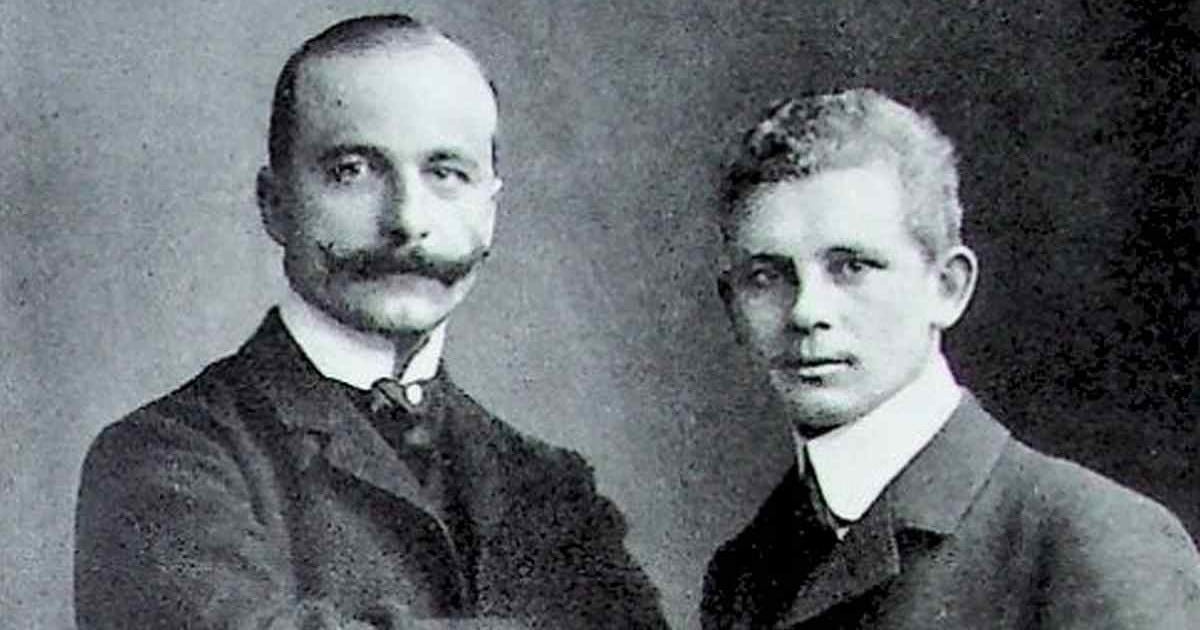
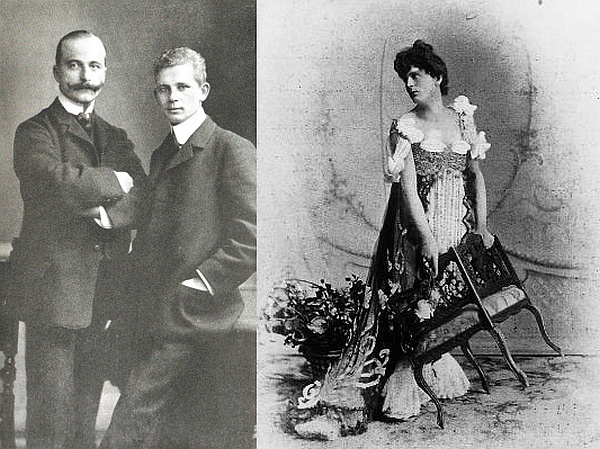
There is a photograph showing Burchard together with his (unknown) life partner. Some historians cite as a source for this photo the revised edition of Magnus Hirschfeld’s book “The Third Sex” (1904; revised edition 1991, p. 37). My concern is not to imply that this image was published by Hirschfeld in 1904; the original 1904 edition contains no photographs. The point is to use this photo as evidence of Burchard’s homosexuality.
The image was first printed in Hirschfeld’s “Gender Science” (Geslechtskunde) (Volume IV, 1930, p. 631) in a chapter about homosexual couples (pp. 597-657). The caption here reads simply “Dr. E. B. with a friend.” The initials can be resolved because other photographs in the homosexual magazine “Der Eigene” (1919/1920, No. 12, p. 5) and in Hirschfeld’s “Hirschfeld Scrapbook” (a collection from Hirschfeld’s estate at the Kinsey Institute in Bloomington, USA) show the same person and clearly identify Burchard. Hirschfeld’s reprint in “Genteskunde” thus allows two conclusions. First: Hirschfeld unmistakably signaled that he knew Burchard as a homosexual. Second: because of the abbreviation, he did not out Burchard directly—even ten years after his death. (Although a posthumous outing would not have violated the WhK’s moral code.) Even though the photo appeared posthumously, the fact that a prominent homosexual activist had a photo with his life partner is noteworthy, given the criminalization of male homosexuality at the time.
Burchard’s friends
Apart from his (unknown) life partner, there is additional information about Burchard’s circle of friends. For Hirschfeld, Burchard was primarily a colleague, who also referred to him as a friend (JfsZ, 1918, p. 209).
Hirschfeld also provided information about two other friends. One was the musician Richard Meienreis, who was also a distant relative of Burchard. The other was the medical doctor Arthur Leppmann, who was 22 years his senior and who described Burchard as his “paternal friend (… ) always ready to stand by him” (Hirschfeld: “From Then to Now”, 1986, p. 19, 61-62). Unlike Hirschfeld, however, Leppmann never published jointly with Burchard, although their medical interests in Berlin did overlap.
Regarding Burchard’s circle of friends (JfsZ, 1911/1912, pp. 246-249) was the jurist, translator, and homosexual activist Hermann Freiherr von Teschenberg (1866-1911). Teschenberg supplied JfsZ with a photograph of himself dressed in women’s clothing (JfsZ, 1902, pp. 176/177), which, by his own statement, revealed his “true nature.” The friendship with Teschenberg can thus also be viewed in the context of Burchard’s contributions to “Transvestites.”
His independent publications (Selected)
I did not have access to Burchard’s tract “Extortionist Prostitution” (1905, 24 pages) for direct analysis, but I can at least point to the positive review in the JfsZ (1905, pp. 686-687): “The provocative pamphlet aptly highlights as the main cause of the prevalence of male prostitution the coercive pressure created by society and prejudice against homosexuals (…).”
Burchard’s most extensive publication is his “Lexicon of the Entire Sexual Life” (1917), in which terms such as “Homosexuality” (pp. 77-79), “Pseudo-Homosexuality” (pp. 155-156), “Transvestitism” (pp. 174-177), and “Intermediates” (pp. 187) are explained in a way accessible to broad segments of the population. I share the assessment of Georg Bornemann (“Multifaceted and Almost Forgotten. On the sexual scientist Ernst Burchard 1876-1920,” in: “Bulletins of the Magnus Hirschfeld Society,” 2022, No. 68, pp. 8-12) that the Lexicon is an “impressive time capsule” because it makes clear the efforts “of his era to break with the backward norms of the Wilhelmine age. Moreover, it is the first attempt to provide non-dogmatic sexual education in a pocketbook format for all layers of society.”
His non-independent publications (Selected)
Five years after Oscar Wilde’s death, Burchard remembered the famous writer with his article “In Remembrance of Oscar Wilde” (in: “Kampf,” 1905, No. 24, pp. 686-687), in which Wilde’s condemnation for homosexuality was described as a murder based on “prejudice and ignorance.” “Oscar Wilde was a (…)-born homosexual person with all the qualities and flaws that (… ) reveal the nature to us psychosexually.” The WhK could not save Wilde, but he hoped that not too many more victims would follow.
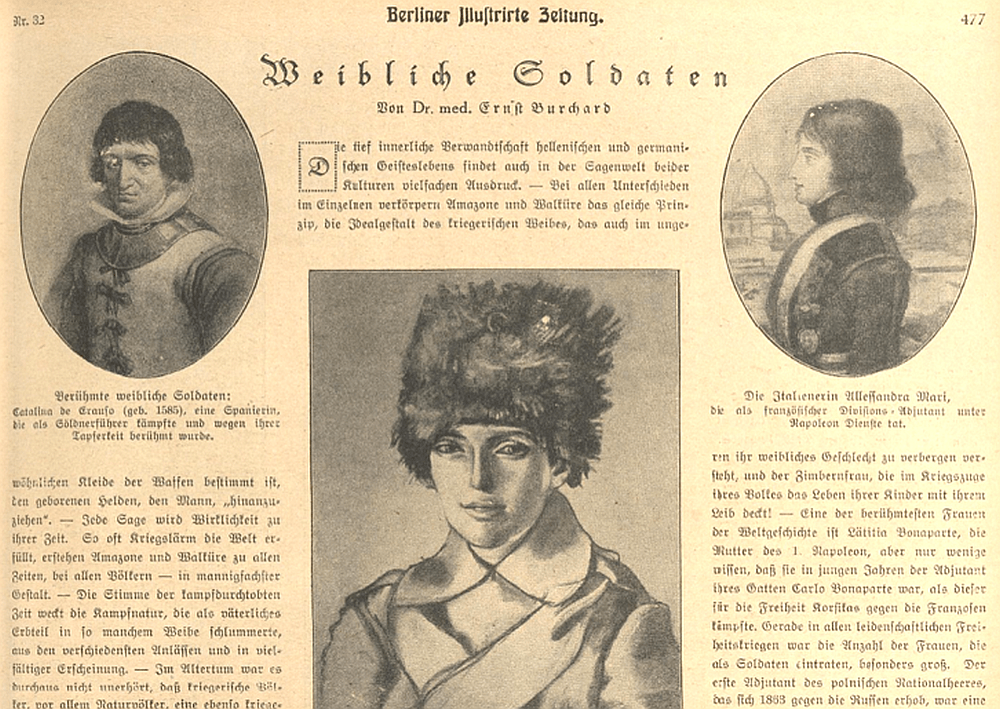
In Burchard’s later journal contributions, two articles deal with World War I. In “Sexual Questions in Wartime” in the “Journal for the Science of Sexology” (1914/1915, January 1915, pp. 373-380) and in “Female Soldiers” in the “Berliner Illustrierte Zeitung” (August 6, 1916, pp. 477-479), he examined the fitness for service of “transvestites” and of women. Here, too, I think Georg Bornemann’s assessment (see above) is apt: in the first article, Burchard sometimes follows the transphobic rhetoric of his era, but his “theses read at times as if drawn from current standard works of gender studies.” The second article presents a more progressive approach: “The reason war is generally regarded as a male domain lies in social circumstances rather than gender itself.” Regarding the second piece, it should be noted that for a sexologist it was not common to publish in non-scientific newspapers. Many scholars disliked even illustrations; this article contains 13 in total.
His involvement in the GdE with Adolf Brand
To the early homosexual movement in Germany belonged, alongside the WhK, the “Gemeinschaft der Eigenen” (GdE) founded by homosexual activist Adolf Brand, who had been publishing the literary journal “Der Eigene” since 1896, which by 1898 was the world’s first homosexual magazine. In this publication, Ernst Burchard had two poems printed: “Happy Voyage” and “Confession” (1903, issue 3, pp. 157-158, not online). Burchard thus belonged to the physicians of his era who ventured “beyond borders” into poetry. Among doctors connected to the homosexual movement or to the sexual reform movement are Magnus Hirschfeld, Edwin Bab, Arthur Kronfeld, Arnold Aletrino, and Friedrich Wolf (Marita Keilson-Lauritz: “The History of Our Own History,” 1997, p. 156).
In the “Yearbook for Sexual Intermediates” (1904, pp. 596-598) a note in a collective review stated that this issue of “Der Eigene” contained poems of varying quality. Burchard’s poems were mentioned (p. 596) but not evaluated positively; the reviewer likely regarded them as less good. Apart from contributions to Burchard’s death (see below), no further details are available about his connection with this part of the homosexual movement.
His involvement with Magnus Hirschfeld’s WhK
There is more to say about Burchard’s engagement with the WhK and Magnus Hirschfeld. Some sources suggest that Ernst Burchard publicly surfaced for the WhK only toward the end of 1902: as one of three signatories (alongside Hirschfeld and Georg Merzbach) stating for the WhK, in the context of the Krupp scandal, that homosexuality is “as honorable” as heterosexuality. This is a statement not taken for granted at the time, first appearing in “Welt am Montag” (December 1, 1902) and later reprinted by “numerous” newspapers (see JfsZ, 1903, p. 1319). This is corroborated by three online newspapers: “General-Anzeiger für Dortmund und die Provinz Westfalen” (December 1, 1902), “Volkswacht” (December 3, 1902, SPD newspaper in Bielefeld), and “Arbeiter-Zeitung” (December 4, 1902, SPD newspaper in Dortmund) and is readable in full text.
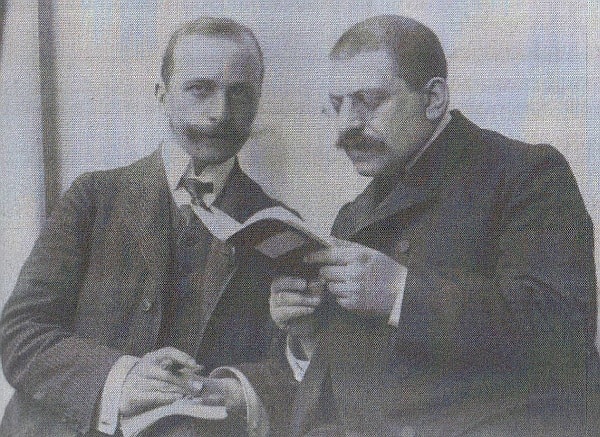
Burchard’s signature on this statement cannot be reconciled with Hirschfeld’s claim that he met Burchard only in 1904 (JfsZ, 1919, p. 125). From the “Monthly Reports of the WhK” (March 1907, April 1907 and December 1908) and research by the Magnus-Hirschfeld Society, it appears that Burchard served, between March 1907 and December 1908, as an executive member (Chairman) of the WhK.
His attachment to the homosexual movement is also evidenced by his annual donations to the WhK. The amounts in 1903, 1904 (JfsZ, 1905, p. 1069) and 1905 (JfsZ, 1906, p. 925)—each 36 marks—correspond to a modern value of roughly 250 to 300 euros each.
Burchard’s contributions to the “Yearbooks for Sexual Intermediates”
Among the many contributions to the “Yearbook for Sexual Intermediates” by and about Burchard, I would first like to focus on two of his own pieces. One is his article “Age of Consent Questions” (JfsZ, 1910/1911, pp. 362-365). In discussing the age of consent for sexual relations, he aligned with WhK publications, noting that there is no “temptation” to homosexuality and praising the benefits of ancient “pedagogical eros.” He advocates for a protective age up to 14 years. (In connection with Burchard’s reports on cases of “infantilism,” I will return to the topic of pedophilia.)
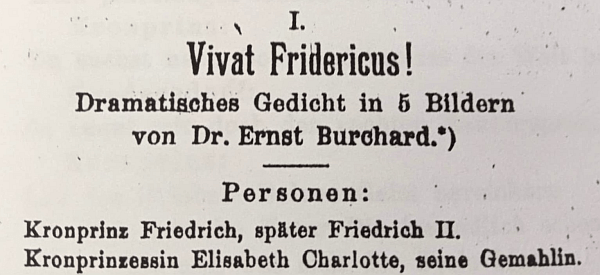
The other is “Vivat Fridericus! A Dramatic Poem in 5 Scenes” (JfsZ, 1920, pp. 3-35), which printed posthumously as a tribute to the late author and which is the longest literary text ever published in the Yearbook. The drama concerns the relationship between the Prussian king Frederick II and his heterosexual chamberlain Michael Gabriel Fredersdorf. The confession of the chamberlain’s heterosexuality creates problems that in reality mirror the confession of homosexuality. Manfred Herzer (“Ernst Burchard: Vivat Fridericus! A Dramatic Poem in 5 Scenes,” in: “Bulletins of the Magnus-Hirschfeld Society,” 1991, No. 16, p. 20) was apparently disappointed because the reversal here does not demonstrate that Frederick’s homosexuality was condemned. According to Marita Keilson-Lauritz (“The History of Our Own History,” 1997, pp. 165, 356-357), the text must here “serve as a substitute for the missing scientific engagement with the Prussian king.” The text itself self-referentially points to the dilemma that constitutes it: poetry and music are the means of telling the unspeakable. For Wolf Borchers in his dissertation “Male Homosexuality in Weimar Republic Drama,” 2001, pp. 182-186, 582), the text sits “firmly in the tradition of a sentimental act of renunciation.” With the yearbook printing, it is argued that the work celebrates “reactionary thinking” and reproduces the glorification of the Prussian monarchy without critique. There are no known performances of Burchard’s drama.
Joint essays by Burchard and Hirschfeld
There are at least six joint and now online-accessible publications by Ernst Burchard and Magnus Hirschfeld, issued in various scholarly journals between 1911 and 1914, usually containing joint expert opinions. They show that the researchers’ and authors’ interests overlapped concerning “sexual intermediates,” homosexuality, and pedophilia.
They published joint expert opinions on a male-identified person with genitalia classified as female (“Sperm secretion from a female urethra,” in “Deutsche Medizinische Wochenschrift,” 1911, issue 52, pp. 2425-2428) and on a musician in women’s clothing (“A case of Transvestitism in a musical genius,” in “Neurologisches Centralblatt,” 1913, pp. 946-950).
Two additional joint contributions address the question of the causes of homosexuality. The first was a response to a pathologizing essay (“On Dr. Stier’s article ‘Aetiology of Opposite Sexual Feeling'”, in “Monatsschrift für Psychiatrie und Neurologie,” 1912, issue 6, pp. 549-555; Stier’s essay appeared in the same year, pp. 221-241). The second piece, titled “Case Contributions on the Etiology of Sexual Offenses in States of Consciousness” (in: “Monatsschrift für Kriminalpsychologie und Strafrechtsreform,” 1914, issue 7, pp. 423-434). Burchard’s and Hirschfeld’s “Two Expert Opinions on Relationships of Homosexual Women” (in “Archiv für Kriminalanthropologie und Kriminalistik,” 1912, Volume 50, pp. 49-61) are sometimes highlighted because research in sexology at that time focused predominantly on male homosexuality, making publications on lesbian life rare and exceptional.
Another essay concerned six expert opinions on people who were considered to have retained sexual or gender characteristics at a childlike level (“Sexual Infantilism,” in “Juristisch-psychiatrische Grenzfragen,” 1913, issue 5, pp. 1-46, esp. pp. 16-20) and whose “choice of sexual objects” fell on children, with the sexual acts with these children often described in “rather harmless forms of the most adequate gratification” (p. 4). This phrasing today minimises pedophilic acts. In a review of this publication (in “Jahrbücher für Psychiatrie und Neurologie,” 1915, p. 131), it was indirectly criticized that such theses would lead to all sexual delinquents being deemed legally “unaccountable” under § 51 of the StGB. The author’s concern was explicit: Hirschfeld and Burchard wanted their expert opinion to ensure that the indicted teacher Sch. and all other offenders would remain unpunished. It should be noted that these reports were probably commissioned by the defense with some expectations. It is not surprising that this essay, with the quote above, continues to be read in a context that no longer justifies such actions (see Katrin M. Kämpf: “Pedophilia. A History of the Discourse,” 2021, pp. 88 ff.).
More joint expert opinions by Burchard and Hirschfeld
In his book “The Homosexuality of Man and Woman” (1914), Magnus Hirschfeld discusses in detail several other joint expert opinions with Ernst Burchard, which were often commissioned by the defense in court or to obtain a so-called “Transvestite Permit.” Specifically, Hirschfeld names six joint reports: about Bertha B. (pp. 171-172), the artist-turned-cabinetmaker Mr. N. (pp. 234), Baron X. (pp. 918-921), the two women A. v. Z. and K. Th. (pp. 921-925), the lieutenant L. (pp. 926-927), Edith W. (pp. 929-930) and a report in the divorce case K. against R. (pp. 931-932). Only one of these individuals can be described in more detail: the 21-year-old Bertha B., apparently Bertha or Berthold Buttgereit (1891-?), whose life I have already presented in my book “Different from the Others” (2006, pp. 82-83) and here on TheColu.mn.
Burchard’s expert report in the Gretschmer case
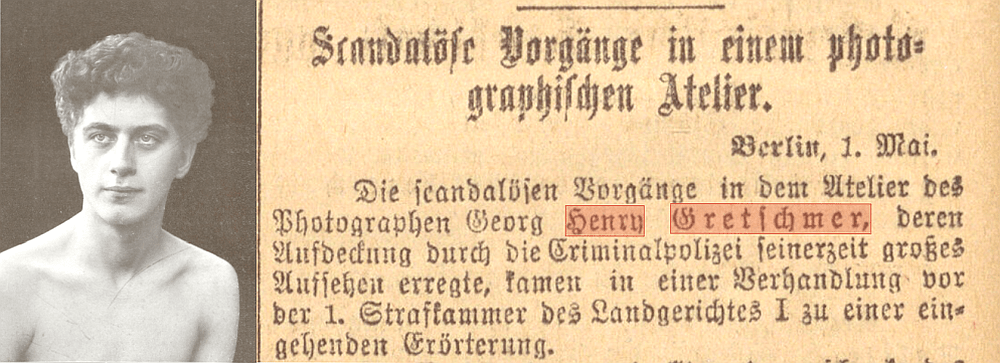
Two expert reports in better-known scandals are worth highlighting: Burchard prepared an expert opinion on photographer Georg Henry Gretschmer, who was tried in 1907 for aggravated enticement under § 175 StGB. Two entries in the WhK’s “Monthly Reports” point to a February 1907 article in the SPD newspaper “Vorwärts” (MB, March 1907, p. 52) and to an article in “Der Tag” of April 29, 1907 (MB, June 1907, p. 118). The “Vorwärts” article I found in the February 17, 1907 (p. 16) issue. The “Der Tag” article is not present in the online edition, but there is a detailed and informative piece in the “Illustrated Vienna Extra Sheet” (May 2, 1907) that uses some of the same phrasing. The “Extrablatt” article discusses Gretschmer’s membership in the homosexual organization “Gemeinschaft der Eigenen” (GdE) and his 15- or 16-year-old models Paul Gerhardt and Fritz Siering. At the end of the trial, Gretschmer received a relatively light sentence of three months in prison. The author of the “Extrablatt” article sees Burchard’s report as the reason for the mild sentence. It seems to be maintained to this day: “The relatively mild sentence was mainly due to an expert report by Dr. Ernst Burchard, who attested Gretschmer’s unaccountability (§ 51).” It remains unclear what exact acts were charged and whether, from today’s perspective, his conduct would still be prosecutable.
Two years earlier, the photographer Henry Gretschmer had a head study published in “Der Eigene” (1905, No. 2, pp. 44/45) titled “The Stranger.” The fact that the first name is listed as Henry here probably reflects the “Illustrated Vienna Extra Sheet” which notes the photographer’s full name as “Georg Henry.” It is nevertheless remarkable that this seems to be the sole documented contribution by Gretschmer in “Der Eigene,” given that as a member of the GdE and a photographer he could have supplied more photographs.
Burchard’s expert report in the Feigl case
Karl Feigl, together with his friend Kurt Münzer, attempted in 1905 to blackmail Magnus Hirschfeld and the homosexual activists Benedict Friedländer with disclosures about their alleged homosexuality. In the subsequent trial, Ernst Burchard was brought in as an expert. Burchard, who reportedly knew Feigl for some time and had occasionally observed him, expressed serious doubts about his mental health. He described the homosexually inclined young man as having a strongly feminine disposition and exhibiting traits attributed to women, such as gossiping, intrigue, and lack of judgment and critical thinking. (… ) It was considered certain that the accused was intellectually inferior. Burchard thus “requested” that the defendant be examined for mental state, and Feigl was sent to a psychiatric asylum for six weeks (Der Vorwärts, September 16, 1905). Three months later Feigl was sentenced to a year in prison for repeated blackmail in the same matter (Der Vorwärts, December 12, 1905). Hergemöller’s biographical lexicon “Mann für Mann” (2010, pp. 223-224) contains several erroneous details about this case, including that the blackmail also targeted Burchard.
Burchard’s lectures (Selected)
In a time before television and radio, lectures played a major role in disseminating new ideas. In obituaries, his “brilliant oratorical gift” was noted (“Der Eigene,” 1919/1920, No. 11, p. 6) and Hirschfeld remarked in JfsZ (1919, p. 127) that his “living word” mattered even more to him than writing books.
References to his numerous lectures can be found in the publications of the homosexual movement, such as the “Yearbooks for Sexual Intermediates.” He reportedly delivered lectures in spring 1905 on the abolition of § 175 in Stettin, Danzig, Königsberg, and Insterburg (JfsZ, 1906, p. 919). Often the WhK provided the exact title and date of lectures, such as a lecture on February 19, 1912 about “Treatment of Homosexuality” and a March 14, 1912 talk on “Burning Questions of Our Time’s Sexual Life” (JfsZ, 1911/1912, pp. 253, 254, 379). During World War I, when emancipation efforts slowed, he gave a talk on April 3, 1917 titled “Duties of Homosexuals in the Present Time” (JfsZ, 1917, p. 147). Additional references can be found in the WhK’s “Monthly Reports” (1902-1903 and 1904-1908), which the Magnus-Hirschfeld Society has posted online.
References to Burchard’s talks, which also included topics such as mental illness and nervousness, can be found in the Social Democratic periodical “Vorwärts.” The low entry fees show he aimed to educate broad strata of society. For talks dealing with homosexuality, the close connection to Magnus Hirschfeld and the WhK is evident. In the two talks on January 12 (“Vorwärts,” January 14, 1903) and April 21, 1903 (“Vorwärts,” April 23, 1903), connected to the Krupp scandal, his involvement at those events is noted, as well as his clear stance against § 175. At the WhK’s annual meeting in October 1905, he was the keynote speaker (“Vorwärts,” October 11, 1905; see also JfsZ, 1906, p. 919). In the newly founded Institute for Sexual Science in 1919, he delivered his likely last talk shortly before his death, on the topic of sexual life and its “anomalies” (“Vorwärts,” December 24, 1919).
The queer community needs a strong journalistic voice—now more than ever! Please contribute to support TheColu.mn’s work.
In January 1920 Burchard died—the scene mourned
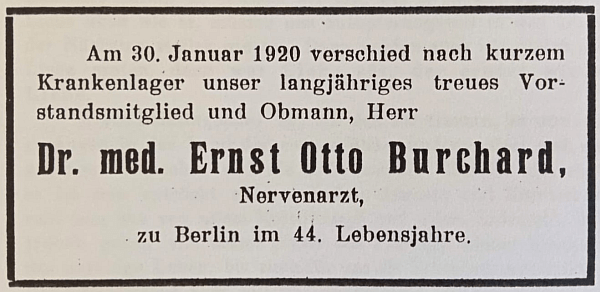
On January 30, 1920, Ernst Burchard died at the age of only 43 from complications of pneumonia. He was laid to rest on February 5, 1920 at the Berlin-Luisen Cemetery. Expressions of grief came from various corners of the movement. The homosexual magazine “Die Freundschaft” reported on his death and funeral, describing it as a “massive demonstration of sympathy” for Burchard (1920, No. 7, cf. also No. 6).
Also in “Der Eigene” there were several notices of his death. In the first obituary (“Der Eigene,” 1919/1920, No. 11, p. 6), curiously there is no reference to Burchard’s ties to the “Gemeinschaft der Eigenen,” but rather to his work with the WhK, where he fought for “the rights and freedom of homosexuals.” This is followed by the poem “Farewell,” which evidently also pertained to his death. The next issue (“Der Eigene,” 1919/1920, No. 12, p. 5) contains a photo of the deceased and the poem “At Dr. Burchard’s Coffin,” in which “Caesareon” (i.e., Max Wipperling) praises Burchard as a pioneer, “leader, friend and man.”
In the WhK’s extensive obituary, he is honored as a “cocombatant for the rights and freedom of homosexuals.” Alongside numerous biographical details, the obituary prints the memorial speech by Georg Plock from February 5 and Hirschfeld’s speech at the memorial service on May 14 (JfsZ, 1919, No. 3/4, which appeared in 1920, pp. 122-128; see also the brief report in “Vorwärts” from May 13, 1920).
Magnus Hirschfeld greatly admired the composer and WhK member Richard Meienreis. Yet none moved him as much as the setting of a Burchard poem, from which he quoted three stanzas (“From Then Till Now,” 1986, pp. 61-62). The first stanza expresses the longing for freedom, which here surely also means freedom from criminal persecution:
If I should be dead,
And they lay me to rest,
You shall bring me flowers,
In freedom blooming, just as you.