At the end of the exhibition path, you inevitably end up in the museum shop. There, Frida Kahlo waits as a ten-centimeter-tall collectible doll, her clothing and accessories designed to echo her love of nature and her “lively imagination.” Next to her stands a hand-painted Solar Frida as an immobilized painter on a shelf: if you place her in the sun, she starts to stroke her palette with a brush. For those who prefer something a bit more athletic, you can hang Kahlo’s “Self-Portrait, Dedicated to Dr. Eloesser” from 1940 on a skateboard carved from Canadian maple — though the maker recommends shielding Frida from direct sunlight in this case.
Frida’s Path to Self-(Re)Discovery
That is exactly what’s being told here: how new social groups continually discover something of themselves in this icon. One could read this premise as a critique—of Frida Kahlo’s fan base, the painter herself, or the commercialization depicted here. Yet “appropriation” is by no means presented as a reproach in this show. On the contrary: it can itself give rise to something new.
And the process begins with Kahlo herself. Frida Kahlo worked steadily at the image “Frida Kahlo”: with self-portraits and photographs, with clothes and hairstyles, with Mexican and Indigenous traditions, with female and male codes. Before the world appropriated Frida, Frida had already invented herself.
With her gaze confidently fixed on the camera, she was already experimenting with the interplay of feminine and masculine codes that would later recur in her self-portraits. However, this strategy was not unique to Kahlo—an early example is Claude Cahun’s 1928 self-portrait. The androgynous self-staging recalls Kahlo’s improvisation with gender roles. Cahun was among the figures of the “Queer Modern” whose international ties a recent Düsseldorf exhibition traced (TheColu.mn reported).
Play with Gender Codes
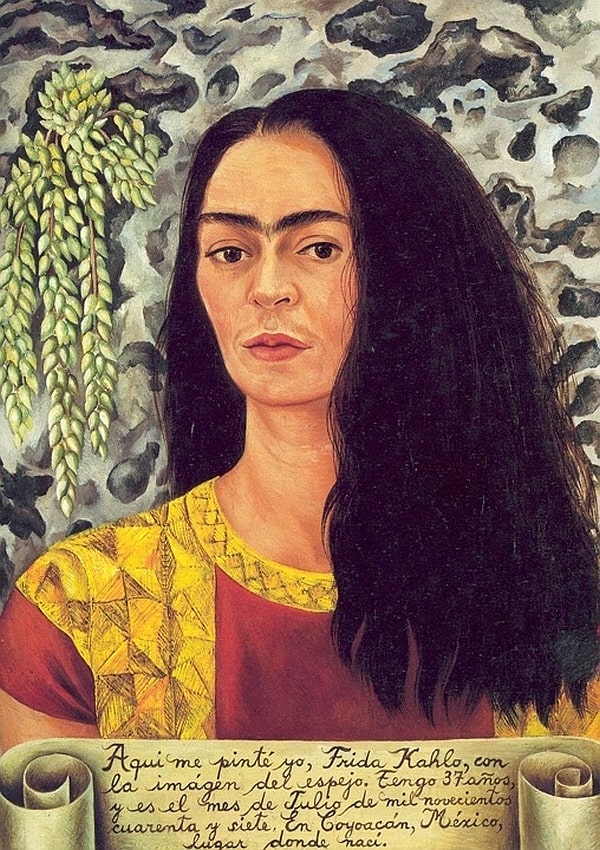
In her 1946 “Self-Portrait with Loose Hair,” Kahlo emphasizes her nearly seamlessly connected dark eyebrows as well as the fine hair above her upper lip. She does not attempt to conceal the latter; instead, she highlights it in her self-portraits. Alongside long hair and clearly feminine clothing, the hinted mustache becomes part of an appearance in which both feminine and masculine codes coexist.
Yet Kahlo’s play with gender codes was only one facet of a much broader self-creation. Equally decisive was the manner in which she presented herself as Mexican: long skirts, embroidered blouses, striking jewelry, and traditional costumes of Indigenous women from southern Mexico. Photographers captured this ever-newly imagined Frida again and again. Physical injury, illness, and pain also became part of Kahlo’s public and artistic self-image. Moreover, her sexuality resisted easy labels: alongside her turbulent marriage to Diego Rivera, she had relationships with both women and men.
From this contradictory material, later generations could fashion their own Frida. After her death in 1954, she became in the United States an emblem for the Mexican-American civil rights and cultural movement, was reinterpreted by feminists, embraced by queer art, and eventually also took on significance for the disability movement. Sometimes the Mexican woman took center stage, sometimes the autonomous woman, sometimes the wounded body, sometimes her play with gender roles and desire. Out of Kahlo’s self-invention, new Fridas emerged time and again.
“Las dos Fridas” in the Fight Against AIDS
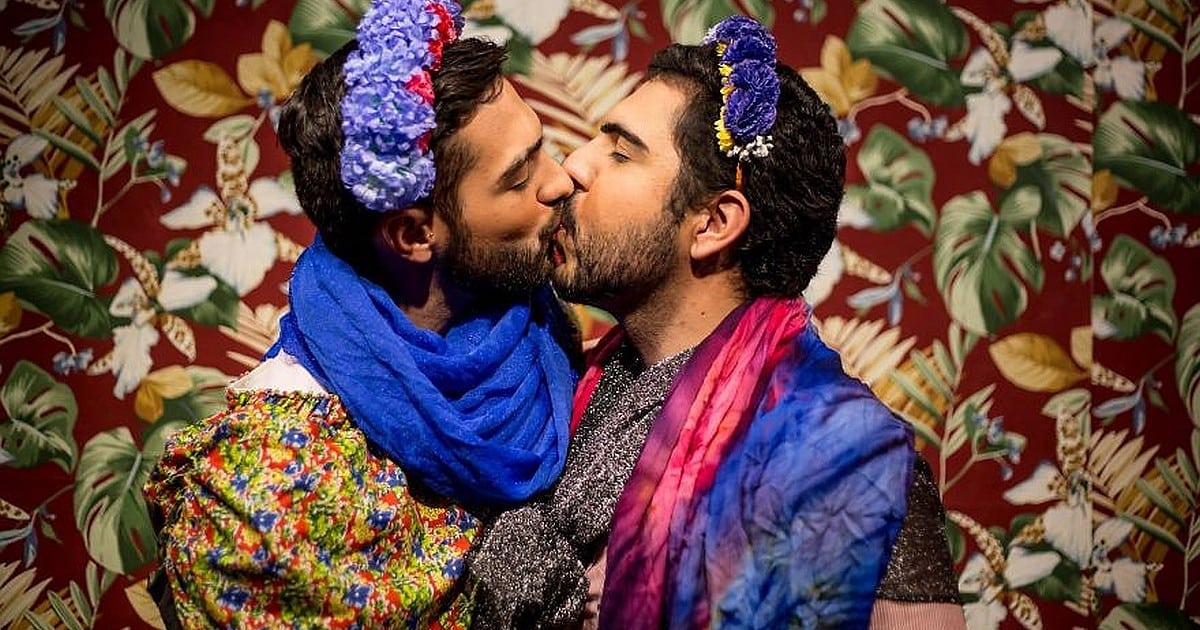
Indeed, it is the queer appropriations that demonstrate how this can mean more than mere identification. They do not simply render Kahlo a queer artist, but use her images to tell stories about bodies, eras, and experiences far from hers. The most striking example is perhaps 1989’s “Las Dos Fridas” by the Chilean artist duo Las Yeguas del Apocalipsis, whose name (in German: “The Mares of the Apocalypse”) nods to the AIDS crisis in particular.
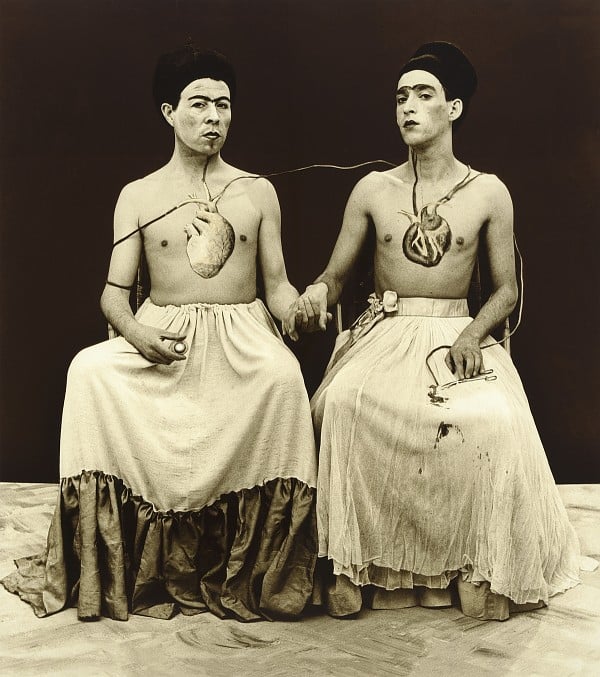
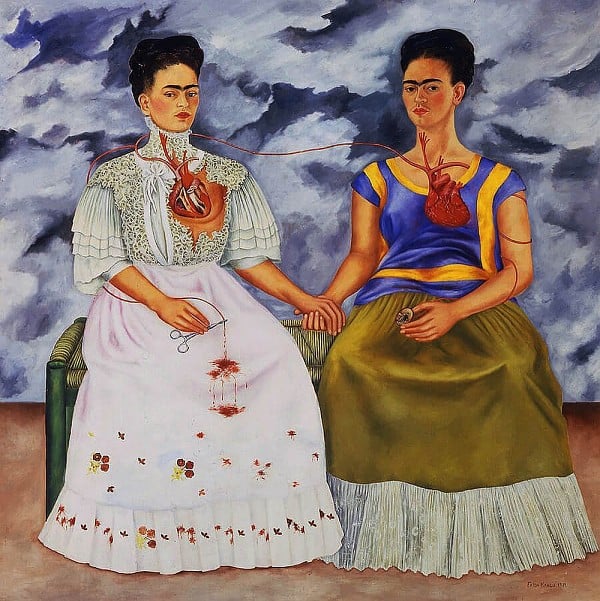
Following Kahlo’s famous double portrait “Las Dos Fridas” from 1939, Pedro Lemebel and Francisco Casas staged themselves as the dual artist. Intravenous lines connect their bodies, blood dripping onto the white clothing. Instead of the small Diego Rivera portrait that one of Kahlo’s Fridas holds, Lemebel’s version uses a condom. From the two female figures, there are thus two queer male bodies—and Kahlo’s image of a wounded, split self becomes a portrait of the AIDS crisis.
Love, bodily connectedness, and vulnerability thus acquire a new, immediately political meaning in 1989: the two artists lived at the end of the Pinochet era in a society where homosexuality faced heavy discrimination—and where the AIDS epidemic simultaneously threatened the queer community. They do not become Frida by claiming that Frida was really one of them; rather, Kahlo’s image enables them to say something about themselves. Kahlo’s work is not simply copied, but becomes material through which a later queer generation makes its own experience visible.
How broad the concept of appropriation can be is finally shown in a very practical way: even the Solar Frida in the museum shop is part of this story—a form of appropriation that, of course, invites debate.