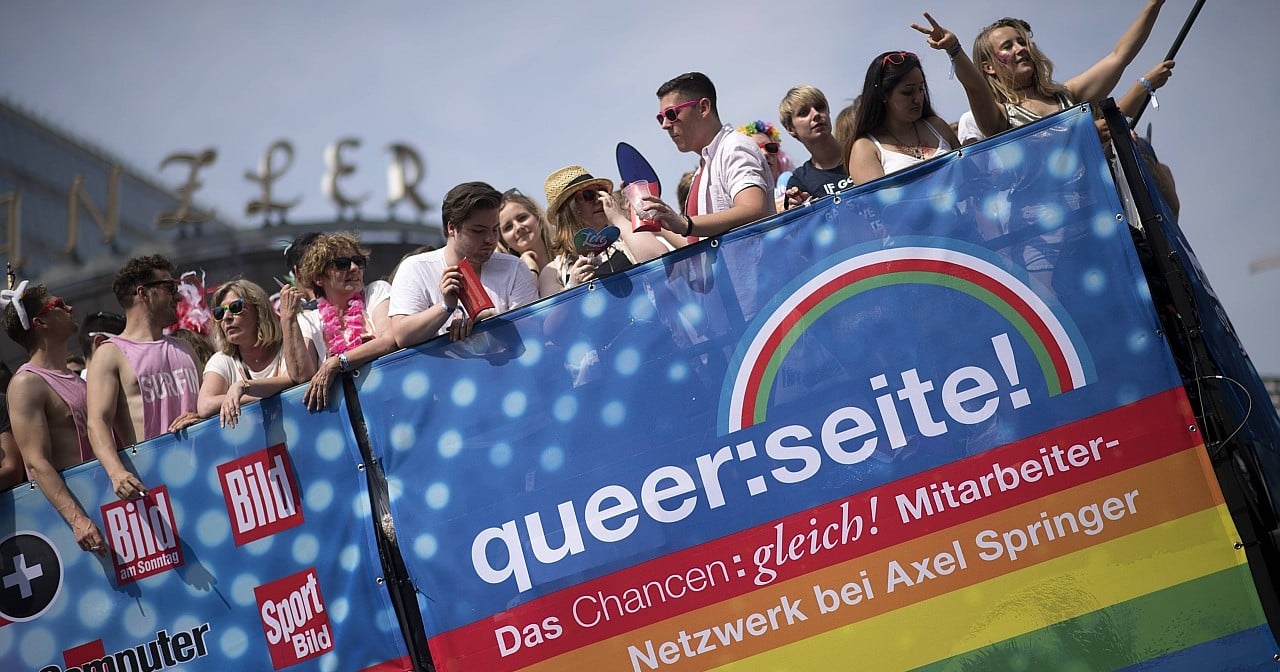
German Federal Justice Minister Stefanie Hubig is pushing to amend the Basic Law in response to the Islamist terrorist attack at Berlin’s Christopher Street Day (CSD) celebration, arguing for an explicit ban on discrimination based on sexual identity. “I support adding to Article 3, Paragraph 3 of the Basic Law a prohibition on discrimination because of sexual identity,” the SPD politician told the Rheinische Post.
The article already prohibits disadvantaging or privileging people on grounds such as ancestry, language, homeland or origin, beliefs, religion, or political views. “It is only logical to also forbid unequal treatment on the basis of sexual identity in the constitution,” Hubig stressed. She noted that more discussions within the government are needed.
Hubig must still win over the Union
There are reservations within the Union, but also encouraging signals, she emphasized, pointing to Union-led state governments. “And the Chancellor personally addressed the queer community after the CSD attack and reaffirmed that the state will stand up for their protection. An amendment to the Basic Law would give life to that pledge,” Hubig said.
During the July 25 attack in Berlin’s Tiergarten district, the 21-year-old assailant drove a van into pedestrians and then, reportedly with a machete, injured more people. A woman died, at least 31 people were injured, seven of them seriously. The Islamist was shot dead by police the day after the attack after they cornered him in a garden colony. Hubig had announced that the Federal Prosecution Service would take over the investigation as Germany’s top prosecutorial authority.
Also planned are refinements in legal questions
The justice minister is in talks with Interior Minister Alexander Dobrindt (CSU) about tightening up certain legal areas, such as information-sharing between security authorities and the judiciary. “Security agencies often have crucial information about whether a person, for example an Islamist, poses a danger. We must ensure that the criminal justice system can use these insights where necessary. This is especially important when a court decides whether a sentence should be suspended on probation,” Hubig said.
The instrument of pre-sentencing probation in juvenile criminal law — as it was used in the Abdul B. case — should be retained in general, she said, but added: “I can imagine that we need to sharpen this in some respects. It must also be clear in the law: a pre-probation should only be imposed if it is justifiable with regard to the safety interests of the community.” With this instrument, a court can first observe the development of a juvenile offender for several months — and only then decide whether the sentence will be suspended on probation.
No abolition of juvenile criminal law for extremist acts
Hubig rejected the idea of punishing extremist youths or potential danger offenders under adult criminal law and defended the application of juvenile criminal law. “The goal is to bring young offenders back onto the right track. That should remain our aim, even when dealing with young people who have radicalized. Because they are often still malleable. If you punish them under adult law across the board, that could have the wrong effect and even promote their radicalization,” Hubig warned.