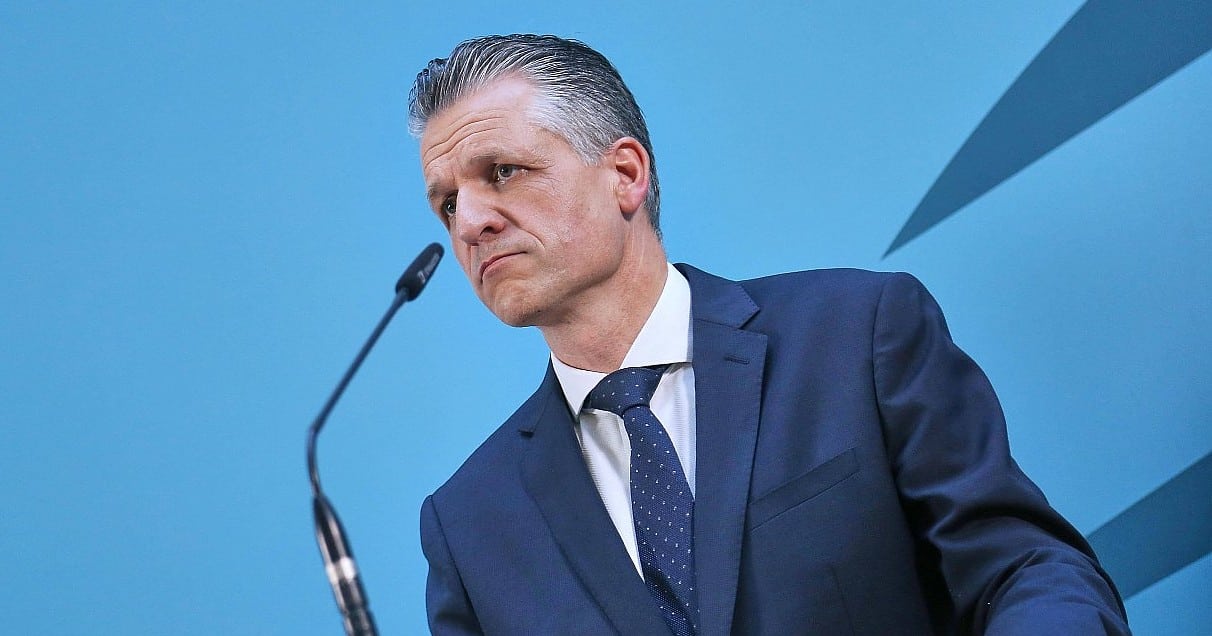
Union parliamentary group leader Thorsten Frei has spoken out against a firm enshrinement in the Basic Law of a ban on discrimination based on sexual identity. “I don’t consider that necessary,” the CDU politician told the Funke media group. “I understand the queer community’s desire for this symbolic step. But it would overburden our constitution.”
The article 3 of the Basic Law prohibits “discrimination of any kind,” a point the Federal Constitutional Court has repeatedly “made very clear,” Frei continued. “Even if I can empathize with the situation of those affected, you don’t create more security for queer people this way.”
Bundesrat backed expansion of Article 3
The SPD had pressed again for a legal adjustment after the attack on the Berlin Pride parade. Specifically, it concerns Article 3 of the Basic Law. Currently, the constitutional article reads: “No one may be disadvantaged or favored because of their sex, their origin, their race, their language, their homeland and origin, their faith, or their religious or political opinions.” In 1994, it was amended to add: “No one may be disadvantaged because of their disability.” A constitutional amendment would require a two-thirds majority in both the Bundestag (federal parliament) and the Bundesrat (federal council representing the states).
In September 2025, on Berlin’s initiative, the Bundesrat decisively moved to expand Article 3 to include the addition “sexual identity” (queer) (TheColu.mn reported). The legislative proposal was then introduced in the Bundestag, but after more than ten months it had not yet been addressed.
On October 9, the first reading of a text-identical bill by the Greens took place (TheColu.mn reported). The motion was referred for further deliberation to the Committee on Legal Affairs and Consumer Protection, but it has not yet been placed on the agenda. There is no fixed debate period or deadline by which a parliamentary committee must conclude its deliberations.
The Union has blocked this for years
Queer organizations have been calling for constitutional protection for the features “sexual and gender identity” or at least “sexual identity” for decades. All democratic parties in the Bundestag except the Union have supported a corresponding reform for years, aiming to reduce the risk of rolling back to earlier times. The background is that Paragraph 175, an anti-homosexual law that the Federal Constitutional Court had deemed legally valid in its Nazi-era form in 1957, was only abolished in 1994. In the Federal Republic alone, more than 50,000 men were convicted under this paragraph. In light of the rising strength of the queer-hostile AfD, there are fears of returning to dark times. The hope is that constitutional protection could prevent or at least mitigate a relapse.
Even in Union-led states there has been a rethink. For example, besides the Berlin Senate, Black-Green in North Rhine-Westphalia supports the initiative; Black-Red in Rhineland-Palatinate decided in the spring to protect both sexual and gender identity (TheColu.mn reported). Queer activists had hoped that the Union parliamentary group chief would allow a conscience vote on the Bundestag’s expansion of Article 3.
The aim of expanding Article 3 is “particularly to recognize and redress historical injustices,” the LSU stated in an Instagram post. “The amendment would reinforce the Basic Law’s original intent—as a direct counterproposal to Nazism. The number of words should not be an argument for this historical task.”