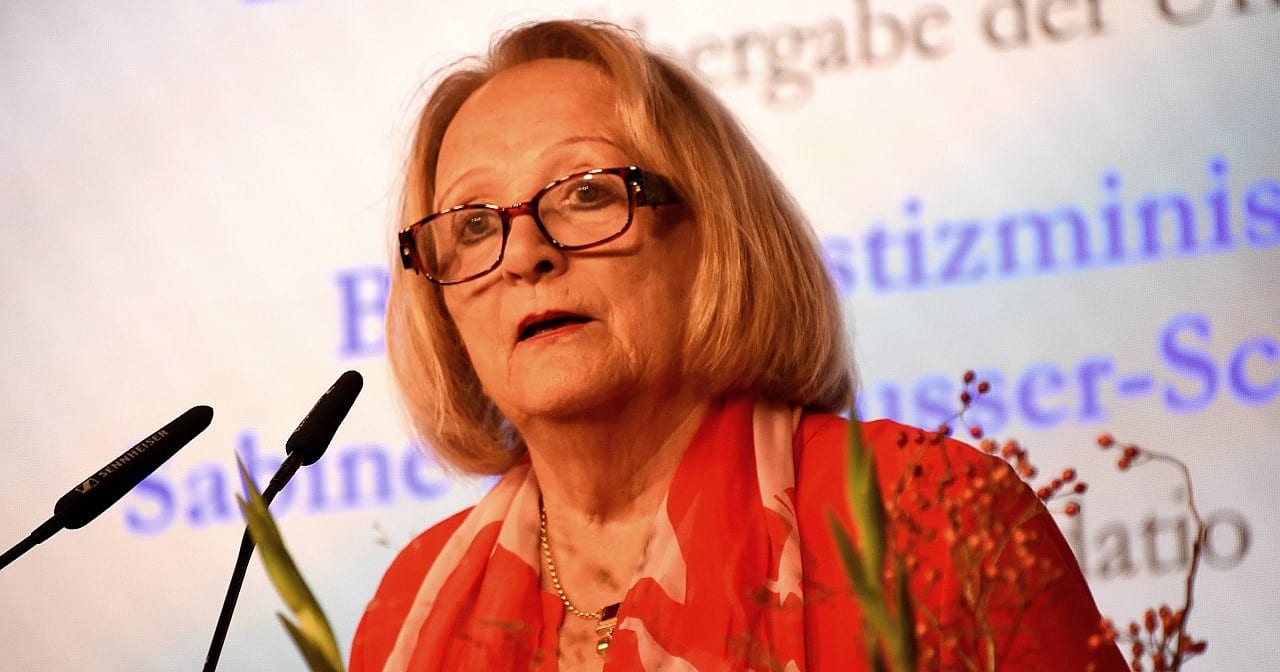
She twice stood at the helm of Germany’s Federal Ministry of Justice—but Sabine Leutheusser-Schnarrenberger (FDP) became widely known for something else: her decision to resign from the post. In 1995 she stepped down in protest against the so-called Big Surveillance, earning cross-party recognition. To this day, the jurist is regarded as one of Germany’s defining liberal politicians—and as one of the most important champions of queer rights in postwar German history. This Sunday, she turns 75.
Beyond her reputation as a outspoken defender of civil liberties, Leutheusser-Schnarrenberger has long been seen as a politician with humor and self-irony. “Humor is really important,” she said in 2017 on Bayerischer Rundfunk. This holds especially true when it comes to serious decisions—“so that you don’t think you’re the center of the universe.”
She was born on July 26, 1951, in Minden, in Westphalia. Even in her family background, politics played a role. Her father, Horst Leutheusser, worked as a lawyer and was active in CDU local politics.
From Cabaret to Politics
Even before her political career began, Leutheusser-Schnarrenberger performed on stage in Minden as part of an amateur cabaret troupe. In an interview with Deutschlandfunk in 2015, she said that cabaret had “definitely promoted” her interest in politics.
After finishing high school, she studied law in Göttingen and Bielefeld and, following her second state exam, moved to Bavaria, where she worked at the German Patent Office in Munich from 1979 to 1990. She joined the FDP in 1978, and first entered the Bundestag in 1990. Her rise from there was rapid. In 1992, Leutheusser-Schnarrenberger became the first woman to head a traditional ministry, taking over the Justice portfolio. W
Abolition of Paragraph 175
Among the most important queer-political achievements of her first term was the abolition of Paragraph 175. In the wake of legal unification after German reunification—the GDR had done away with special provisions for gay men since 1988—Leutheusser-Schnarrenberger, as Federal Minister of Justice, pushed for the complete removal of Paragraph 175. On March 10, 1994 the Bundestag passed the repeal, which took effect on June 11, 1994. Leutheusser-Schnarrenberger spoke of a historic day and described the Paragraph as a “symbol of inhumanity,” reminding of the mass deportation and murder of homosexuals in concentration camps.
She also gained nationwide recognition for her stand against the so-called Big Surveillance. The planned monitoring of residences to combat organized crime she opposed on constitutional grounds. After FDP members voted in 1995 in favor of the measure in a party base referendum, the Justice Minister announced her resignation in December 1995.
She Put Principles Above Offices
The move shaped her image as a politician who put values ahead of offices. In 2004 the Federal Constitutional Court struck down wide portions of the Big Surveillance regulation as unconstitutional, thereby upholding much of the critique she had voiced at the time.
For her, a stance meant that “politicians orient themselves around fundamental principles and values, not just in Sunday speeches, but also when it comes to important decisions,” she explained in 2017 on Bavarian Radio. In the same year, she published her partly autobiographical book “Haltung ist Stärke” (Principled Stance Is Strength).
After years in opposition, Leutheusser-Schnarrenberger returned to the federal cabinet in 2009 as Federal Minister of Justice—now in a government led by Chancellor Angela Merkel of the CDU. Protecting civil rights remained one of her central themes. She fought against the data-retention regime introduced before her tenure, which forced telecom providers to store communications data for six months. The regulations were deemed unconstitutional by the Federal Constitutional Court in 2010.
Also in 2010, the FDP politician was awarded the “Compass Needle” at Cologne’s CSD. She was described as someone who “always sought dialogue with the lesbian and gay movement and showed up at many CSDs in Germany,” according to the NRW Gay Network’s justification at the time. In 2009 Leutheusser-Schnarrenberger took on the patronage of the Stuttgart CSD, which drew sharp criticism from the CDU (TheColu.mn reported).
Establishment of the Magnus Hirschfeld Federal Foundation
In her second term, Leutheusser-Schnarrenberger also spearheaded the creation of the Magnus Hirschfeld Federal Foundation, which the government decided to establish in 2011 on the initiative of the FDP (TheColu.mn reported). Named after the Jewish sexologist and early advocate of the homosexual rights movement, the foundation is intended to counter discrimination against queer people through research and education. After leaving federal politics, Leutheusser-Schnarrenberger in 2014 launched a support circle for the Hirschfeld Foundation and became its chair (TheColu.mn reported).
Within the FDP, Leutheusser-Schnarrenberger also played a significant role. From 2000 to 2013 she led the Bavarian state association, and from 2001 to 2013 she served on the FDP’s national executive committee.
Since stepping back from active politics in 2013, she has continued to advocate for civil and human rights. She has held various roles, including serving as deputy chair of the Friedrich Naumann Foundation until March 2026 and, until 2024, as North Rhine–Westphalia’s antisemitism commissioner.
Her distinctive name has accompanied her for around five decades. In 1976 she married journalist Ernst Schnarrenberger and adopted the double surname. Her husband died in 2006 at 57 from cancer. Leutheusser-Schnarrenberger lives on Lake Starnberg in Bavaria. (mize/AFP)