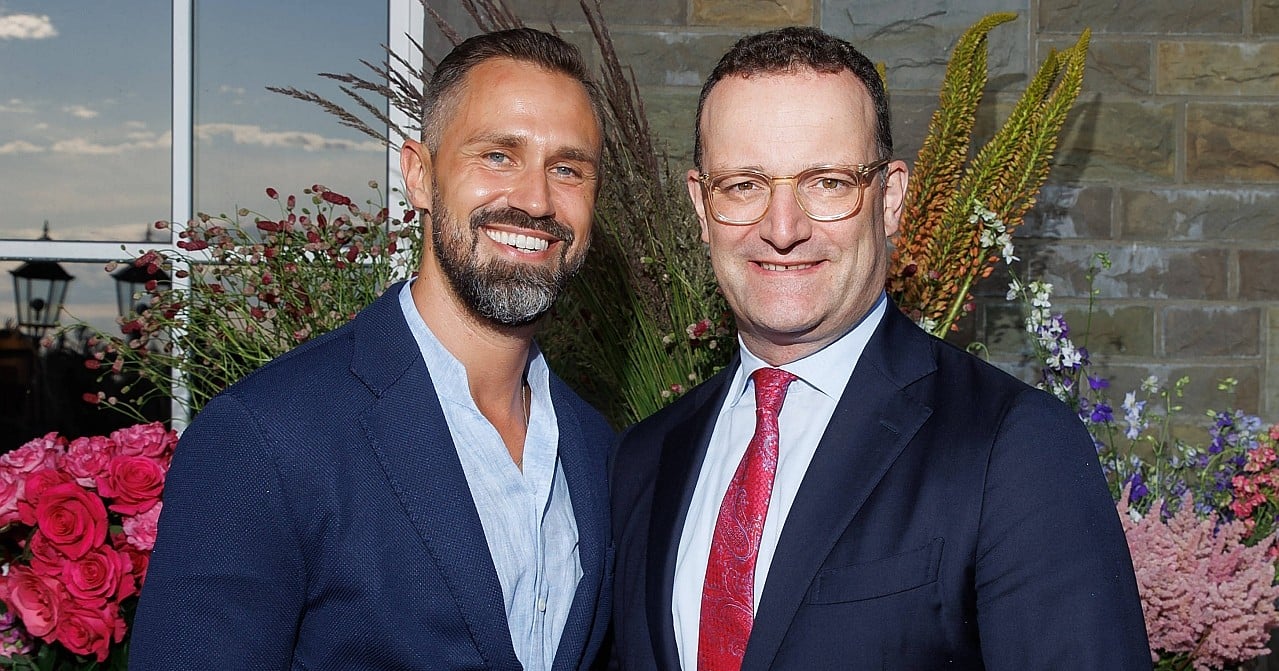
The CDU politician Jens Spahn and his husband Daniel Funke are now officially embracing a rainbow family. The 46-year-old leader of the Union faction in the Bundestag confirmed to Bild: “My husband has become a dad, and I with him. Georg is our whole happiness. This feeling is almost impossible to put into words.”
Funke has since posted a photo on Instagram showing the two men with a baby stroller. “We are family,” he wrote. The 44-year-old, who has been married to the politician since 2017, is said to be the biological father of the child carried by a surrogate in the United States.
View this post on Instagram
Instagram / daniel_f_punkt
|
“We are aware that the topic of surrogacy often carries uncertainties and also a number of prejudices,” Spahn told Bild. “But as the great Franz Beckenbauer once said: ‘God takes joy in every child.'”
Surrogate Mother “belongs to the family”
The surrogate mother is expected to continue playing a role in Georg’s life. “She now belongs to the family and will accompany Georg’s life path,” the two wrote, according to Bild, in a note informing friends and colleagues about the birth of their son.
“We are overjoyed and utterly smitten with the little guy, and we look forward to you meeting him soon,” the message continued. “Thrilled to begin life together as a family of three, with two proud dads.” Spahn and Funke are currently spending time in the United States with their son until August. Georg is the given name of Jens Spahn’s father, who passed away in 2024.
Spahn had spoken on several occasions about his desire to start a family, such as last November (as reported by TheColu.mn). In another interview in 2021 he said there were no concrete plans for a family yet. “But if there are, it should be soon—we’re not getting any younger.”
Debate over the existing surrogacy ban at home
A debate over surrogacy had already arisen in April when virologist and CDU member of the Bundestag Hendrik Streeck and his husband Paul Zubeil confirmed their parenthood. “Yes, we can confirm that we have become parents,” Streeck told Bunte at the time. According to the magazine, the child of this couple was also born in the USA (TheColu.mn reported).
In the United States, surrogacy is not governed uniformly; it varies by state. In Germany, parenthood must be legally recognized retroactively. In Germany, surrogacy is illegal; such contracts are considered immoral and therefore null. Surrogate mothers and the couple that hires them are not prosecuted in Germany, but intermediaries may be. Egg donation is also not permitted in Germany. Physicians can face criminal charges if they artificially fertilize an egg for a purpose other than enabling a pregnancy for the woman who bears the egg.
Concerns in Germany focus largely on commercialization. A commission established by the then‑ruling coalition in March 2023 concluded that legalizing egg donation would be constitutionally feasible. A so‑called altruistic surrogacy would be legally possible if limited to exceptional circumstances, such as a close relationship between would‑be parents and the surrogate mother.
But no legislative change came about, and none appears on the horizon. In a May interview, Federal Justice Minister Stefanie Hubig (SPD) was asked whether surrogacy should be opened up for gay couples in Germany. She responded that “we have not agreed on this in the coalition contract, and I do not see a majority within the federal government for it.”
In a statement adopted at the CDU party congress in February of this year, it said: “Given ethical, legal and practical concerns regarding surrogacy, the CDU Germany reaffirms its demand to continue banning surrogacy—even in altruistic models—in order to prevent abuse, exploitation and health risks.” (the article continues)