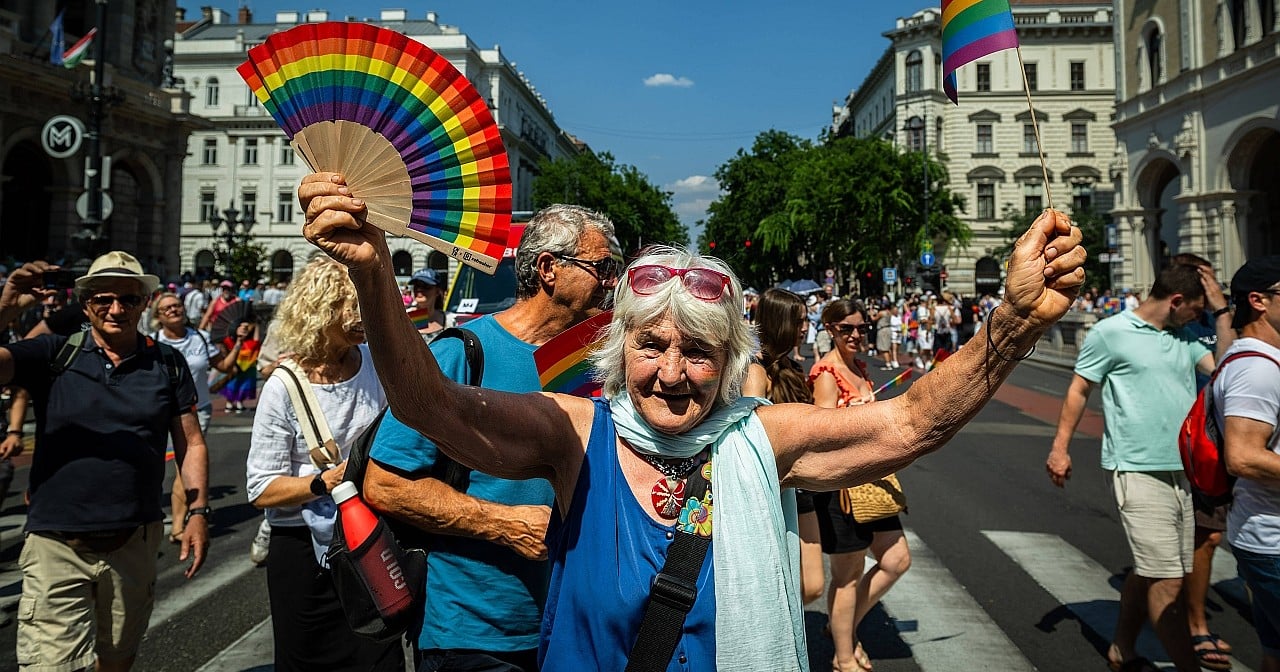
Colorful, joyful, and proud: In Budapest, tens of thousands defied the heat to take part in this year’s Pride march — the first since the ouster of right-wing nationalist prime minister Viktor Orban. Many of the participants, including a large share of young people, waved small flags or big rainbow banners on Saturday. Many expressed hope that the rights of queer people could be strengthened under the newly elected government of Peter Magyar.
According to an AFP photographer on the ground, at least 100,000 people joined the demonstration — fewer than last year, when more than 200,000 people attended despite a ban. Still, the turnout was larger than in the years leading up to 2025.
Queer visibility at 40 degrees in the shade
The event went ahead despite the intense heat, with temperatures hitting 40 degrees Celsius in the Hungarian capital. Organizers had urged especially vulnerable attendees to stay home and watch the parade online. On the edge of the parade, soldiers from the Hungarian armed forces handed out large amounts of cold water to participants.
“We’re proud of ourselves and of everyone else here, and that we’ve braved the asphalt’s around-50-degree heat to take to the streets,” said 53-year-old teacher Zsuzsanna Naszalyi.
Among the participants was 18-year-old Petra Toth, who had traveled with her girlfriend from southern Hungary. The situation for the LGBTI community, she told AFP, “improves more and more, especially because of the change in government.”
After Pride 2025, the mayor was indicted
Orban’s government had barred the Budapest demonstration last year, citing a queer-phobic law from 2021. In 2025, the law was tightened. Under Green Mayor Gergely Karácsony, an opponent of Orban, the demonstration nevertheless took place. Despite the ban, more than 200,000 people participated — significantly more than in previous years, when about 35,000 took part (TheColu.mn reported).
In January, Karácsony was indicted. In early June, prosecutors dropped the charges (TheColu.mn reported). In April, the European Court of Justice ruled that Hungary’s anti-LGBTI laws violated EU fundamental freedoms (TheColu.mn reported).
Pride participants pelted with vegetables
At Budapest Park, the capital’s largest open-air venue, a rainbow flag was flown for the entire Pride month for the first time. There were two arrests on Saturday after demonstrators were pelted with vegetables.
Yet public sentiment has “really shifted,” said 60-year-old participant Balazs Moczar-Boor. He and his partner had considered leaving Hungary if Orban had remained in office.
The direction of the new government remains unclear
Hungary’s new conservative, pro-European prime minister, Magyar, who took over from Orban in May after 16 years in office, has repeatedly spoken in favor of equality and freedom of assembly. However, he has thus far neither endorsed the Pride parade nor taken steps to repeal the anti-queer laws enacted under Orban (TheColu.mn reported).
During his campaign, Magyar avoided addressing LGBTI rights. Since his election he has stressed that his government will not tell people how to live.
“We’ve made clear that in our view everyone is free to love whom they want and to live with whomever they choose, as long as they do not break the law,” Magyar said in early June when asked about the right to marry and adoption for same-sex couples. “If there is a desire for us to discuss these socially and politically sensitive topics, we’re open to a debate about it,” he added.
Poll: 68 percent support marriage equality
Last week, several human rights organizations issued a joint statement urging the government to repeal anti-LGBTI laws. Amnesty International urged Magyar’s government to extend equal rights to same-sex couples. The organization pointed to a recent Median poll showing that 68 percent of Hungarians support both marriage equality and adoption by same-sex couples.
In Budapest, people are “ahead of their time” and accept “everyone,” said Lidia, who traveled from the north of the country and asked not to reveal her full name. But in the countryside, life looks “very different.” She hopes now that the country will “get back on the right track” and that gay people can marry and adopt children. But she added that such changes will take time. (AFP)