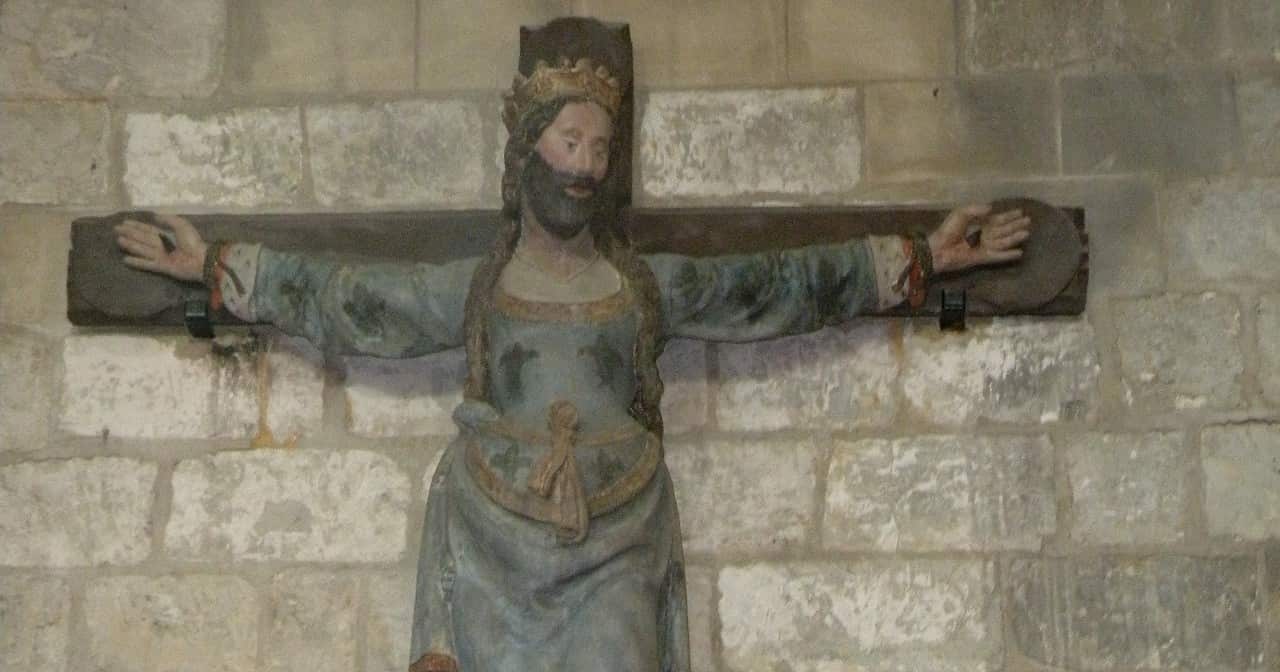
At first glance, the wooden figure wearing a crown, a flowing beard, and a cross could be mistaken for a king or a Christian saint. But on closer inspection, the delicate hands and breasts do not quite fit the beard. A sign nearby explains it: the oak-carved statue, dating from around 1480, represents Saint Wilgefortis, also called Kümmernis, a legendary figure from the Middle Ages who has recently emerged as an unofficial patron saint of the LGBTQ+ community.
“We love her, our Wilgefortis, because in this figure different sexual identities are represented, and in this way we have something to contribute to Pride Month,” says Kim Mildebrath, spokesperson for the Schnütgen Museum of Medieval Art in Cologne. The museum plans to host again on July 5 one of Europe’s largest Pride parades, drawing more than a million attendees through the city.
“Wilgefortis is currently making a real comeback,” Mildebrath notes. Some compare her to the bearded art figure and Eurovision Song Contest icon Conchita Wurst, portrayed by Austrian performer Tom Neuwirth.
According to the legend, Wilgefortis was the daughter of a pagan king in Portugal. The king wished to marry her off to a pagan prince against her will. In desperation she prayed to Jesus Christ for help, and he granted her a beard. In other words, Wilgefortis suddenly did not fit the heteronormative image. “She used that as a weapon for a self-directed life,” Mildebrath says. Yet that life did not last long, for her father crucified her on the very same day.
Queer Debates Already in the Late Middle Ages?
Wilgefortis’s feast day is July 20. Her name is thought to derive from the Latin words virgo and fortis — “strong virgin.” An alternate name, Kümmernis, alludes to the burden of sorrow many women endure through violence and abuse. “There is strong evidence that women identified with her suffering,” Mildebrath explains. The fact that Wilgefortis embodies both female and male attributes seems to have fed the fascination with her, otherwise there wouldn’t be so many depictions of her. “That shows that debates we tend to see as very contemporary were present already in the late Middle Ages,” Mildebrath adds.
Bernd Mönkebüscher is a Catholic priest from Hamm in Westphalia. He came out as gay in 2019 and later helped initiate the campaign “#OutinChurch — For a Church Without Fear,” which fights for the rights of queer workers within the church.
Mönkebüscher points to one of the Ten Commandments, which warns against making an image of God. “That, for me, also means you shouldn’t imagine God as a man.” The numerous depictions of Wilgefortis suggest that deviating genders have drawn attention long ago as well. “The beard was used as a way to repel a male suitor. But the many images showing her with a beard also prove that people found it fascinating. What repels some attracts others.”
Saint Wilgefortis: “There Has Never Been Wilgefortis”
Anselm Schubert, a professor of church history at the University of Erlangen-Nürnberg, also finds Wilgefortis an intriguing figure. “But I’m not sure she really serves as a good identification figure for the LGBTQ+ community,” he concedes. “If you look a little more closely, doubts can arise. First, there has never been a Wilgefortis; she is a pure legend.” For Catholics, she is less apt precisely because she is not a real saint. And third, she isn’t truly queer or trans — she’s simply a young woman who did not want to be forced into marriage. “The beard is not proof of transgender identity; it is a deliberate distortive device intended to deter marriage. In that sense, it’s a bit different.”
Yet, as with any work of art, everyone is free to interpret Wilgefortis as they wish. The way people view figures who have populated myths for centuries shifts with the times. “Even Christ himself has been seen as male, female, or androgynous over the last two millennia,” says Schubert, who explores this in his book Christus (m/w/d): A History of Gender.
The Heavens Are Full of Men
In ancient times the prevailing view was that men ruled, so early Christian Fathers often believed that all women would be transformed into men at the moment of their resurrection. “The heavens are full of men,” Schubert muses with a smile.
In the Middle Ages, however, Christ was sometimes worshiped as a woman. “Not because people believed he was actually a woman, but because, in that era, the idea took hold that women, as God created them, are complete in themselves. The rise of women’s religious orders brought a piety that attributed feminine virtues to Christ — love, mercy — considered quintessentially feminine at the time.”
In the 16th century, radical Protestant circles gave rise to the belief that Christ was androgynous, uniting both genders within himself — the masculine Father and the feminine Wisdom. “And since humans were created in God’s image, they were originally androgynous. Only after the Fall did the genders divide into Adam and Eve.” According to this view, after death each person would be reunited with the missing gender and become androgynous in heaven. “Even today there are churches in the United States, like the Shakers, that hold that Christ existed in both male and female form.” In that sense Wilgefortis would have had stiff competition from Jesus Himself.