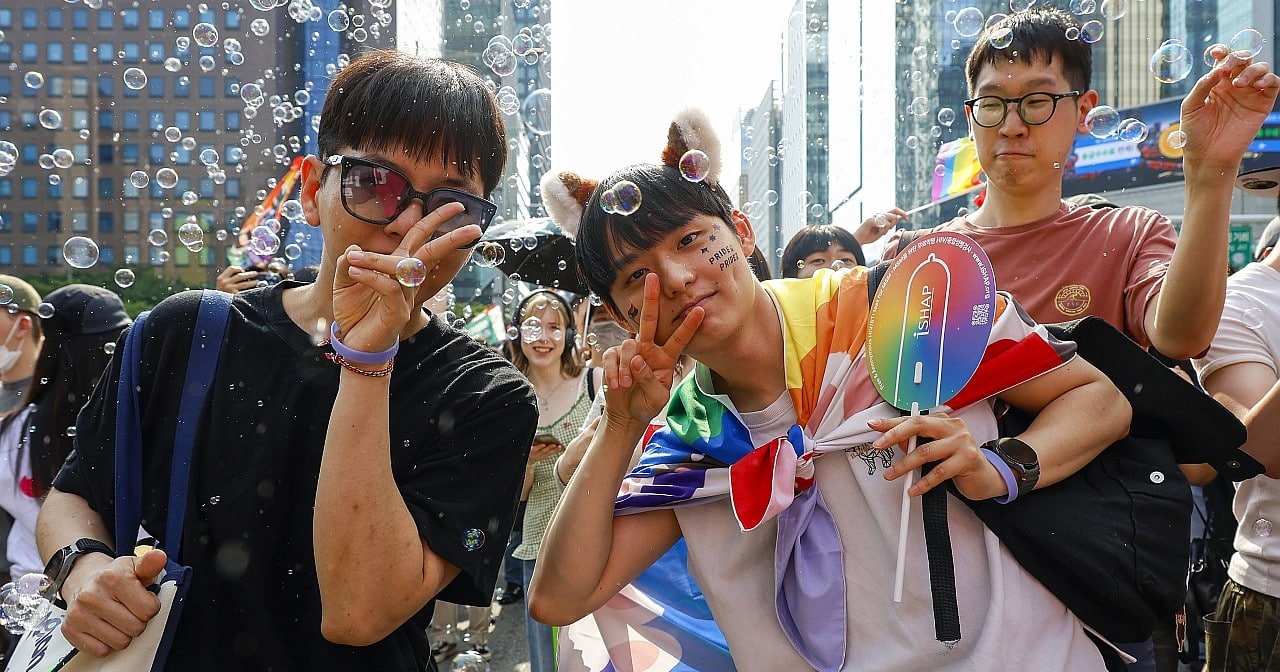
As weekday office workers rush through glass towers, on this Saturday afternoon more than 10,000 people fill Seoul’s downtown in a rainbow sea of color. At the Seoul Queer Culture Festival, they march with rainbow flags and protest banners to advocate for the rights of the LGBTQ+ community.
Since 2000, South Korea’s branch of Pride parades has taken place in the capital. The first march drew only a few dozen people; now thousands participate.
“South Korea is still very conservative,” says a student
Under the blazing noonday sun at 86 degrees, the mood is buoyant: on a stage, a group of performers dressed in drag costumes entertain the crowd, while dozens of stalls showcase the work of civil-society organizations. Free HIV tests are offered, and merchandise is sold.
“I came today because I’m gay and I wanted to experience Pride for the first time,” says a 19-year-old Korean who introduces himself by the English nickname David. “South Korea is still very conservative,” adds the university student.
During high school, his classmates were openly homophobic; only at university did he encounter a supportive environment.
Even though South Korea is widely regarded as a cultural trailblazer, socially and in LGBTQ+ discourse it remains traditional and feels very different from many EU countries.
Anti-queer groups speak of “sin” or a tool of communism
How polarized Korean society is on LGBTQ+ issues is evident even on this Saturday. Just a few hundred meters from the Pride parade, as in years past, a counter-demonstration organized by Christian groups takes place.
More than 10,000 demonstrators have gathered in front of City Hall, where they chant hymns and advocate for a “healthy Korea.” In their view, homosexuality is a sin.
Looming large in the debate is a 2020 OECD study placing South Korea, alongside Japan and Turkey, among the lowest performers in legal equality for LGBTQ+ people. And little has likely changed since then.
Discrimination legislation blocked for decades
For decades, lesbian, gay, bisexual, and transgender Koreans, as well as nonbinary and trans people, have fought for a comprehensive anti-discrimination law that would legally protect sexual and gender minorities. For roughly 20 years, a bill to that effect has been blocked in South Korea’s National Assembly.
No president has dared to push the proposal—either out of conviction or for fear of losing conservative-Christian voters’ support.
Ahn Chang Ho, head of South Korea’s national human rights commission, likewise opposes a comprehensive anti-discrimination law, arguing that it could infringe on freedom of expression.
In the past, the former judge, appointed in 2024 by the conservative ex-president Yoon Suk Yeol, has repeatedly made homophobic remarks. He once described homosexuality as a “central instrument for a communist revolution.”
German Embassy stands in solidarity with the LGBTQ+ community
Support for Korea’s queer community comes from a coalition of 20 largely European embassy representatives, who published a joint show of solidarity on Friday. “We firmly believe that strong action against discrimination will strengthen the nation’s resilience and simultaneously bolster social cohesion as well as economic development,” the statement, signed by the German embassy, reads.
Notably, the statement was not shared by the U.S. Embassy. Unlike in prior years, the United States’ diplomatic mission did not participate in the event this time.