Was Susan Sontag a queer icon? The question is more complicated than it might appear at first glance. The American writer, essayist, and intellectual pursued women, moved comfortably within queer circles, and with her Notes on Camp authored a text that remains one of the most important touchstones in queer cultural history. At the same time, she never publicly identified as lesbian or queer.
With the exhibition “Susan Sontag – Seeing and Being Seen,” the Schwules Museum dedicates a comprehensive show to one of the most influential thinkers of the 20th century. The exhibition, originally shown at the Bundeskunsthalle Bonn, was not only carried over to Berlin but expanded with new perspectives: at the center are, among other things, Sontag’s close relationship with Berlin and her influence on queer cultural history.
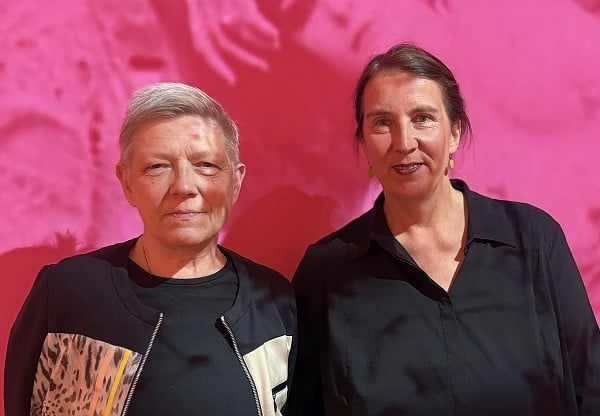
We spoke with the curators Kristina Jaspers and Birgit Bosold about Sontag’s handling of her own queerness, her essays on illness and AIDS, the contemporary relevance of “Notes on Camp” — and why a, at times, contradictory figure like Susan Sontag continues to spark debates today.
Today Susan Sontag is often read as a queer icon, even though she never publicly came out as lesbian or queer. What difficulties did this pose for you in conceiving the exhibition?
Kristina Jaspers: Susan Sontag was born in 1933 and lived through the anti-queer repression of the McCarthy era firsthand. A factor likely also was the custody dispute over her son in the late 1950s. Her ex-husband mounted a public smear campaign against her, fueled by the then-virulent belief that lesbian women were unfit as mothers. In our exhibition, some of the contemporaries we interviewed for the Berlin adaptation speak in nuanced terms about whether and why Sontag struggled with coming out, even though her queerness was an open secret.
Birgit Bosold: The Schwules Museum has shown far more monographic exhibitions about figures who did not formally come out than about those who did. Yet they remained icons of queer cultural history. To name just a few: Friedrich Murnau, Marlene Dietrich, Pier Paolo Pasolini, Rock Hudson, Michel Foucault, Johann Joachim Winckelmann, Ludwig Wittgenstein, or the Manns.
Are these cases really comparable?
Birgit Bosold: Of course there are gradations, ranging from relative openness for their times to complete concealment. But all these people did not come out in our contemporary sense. Coming out as a social practice is a post–Stonewall phenomenon. Before that, there was no normative expectation of a public confession, not least because male homosexuality was long criminalized—within West Germany, for example, until 1969. But even for many later-socialized individuals, the refrain of the gay movement in the early 1970s to “make public” one’s own gay or lesbian status did not fit, and for some it still does not fit, for various reasons.
In a piece in the Journal of Sexualities, Susan Sontag’s reluctance to come out is criticized as a “political problem” — especially against the backdrop of the 1970s gay movement. How do you view this critique?
Birgit Bosold: One could, as the culture critic and author Wayne Koestenbaum does in the wonderful documentary “Regarding Susan Sontag,” simply ask whether someone who wrote “Notes on Camp” really needs to come out. But it would have been a powerful gesture, particularly at the height of the AIDS crisis, if she had reinforced her engagement against the instrumentalization of the disease for queer-hostile resentments with a public affirmation of her own queerness. On the other hand, other queer figures of her time did not do so either. Queer.de itself has written about Andy Warhol and his “prevented coming out,” and about James Baldwin’s rejection of self-designations like gay or lesbian—and his distance from the queer community.
Kristina Jaspers: We also hear from people in the exhibition who remind us that Sontag’s stance was not simply a refusal to come out, but rather a complex negotiation shaped by her era. The AIDS crisis and the politicization of queer identity created a crucible in which personal disclosure carried very particular risks—and very real consequences. In the exhibition, we also include interviews with Sontag from German television where she speaks to these matters directly.
Many critics have argued that Sontag’s writing about illness and AIDS is too distant, abstract, or metaphorical. How do you respond to that critique, especially in light of Sontag’s own texts that argue against the metaphoricization of illness?
Birgit Bosold: This critique is often aimed at Benjamin Moser’s biography of Sontag. The book is undoubtedly impressive and, for Sontag fans, a rich trove of details. Yet I personally dislike its sometimes almost pathologizing approach to Sontag, including its framing of how she wrote about AIDS or cancer as a denial or distancing of her own body. It’s a provocative read, but not the shape we want for this show.
Kristina Jaspers: I also find Moser’s portrayal rather one-sided, and I would recommend Daniel Schreiber’s much more balanced and readable biography. Sontag argued against stigmatizing the sick in works like “Illness as Metaphor” and “AIDS and Its Metaphors.” In the exhibition there is a chapter on “Health and Illness.” There we show campaign posters for the San Francisco AIDS Foundation—photographed by Sontag’s partner Annie Leibovitz—demonstrating their active engagement in AIDS relief.
In the AIDS context, Sontag’s writing often struck contemporaries as distanced and abstract, especially when compared with authors like Paul Monette or Edmund White. How do you view that critique?
Birgit Bosold: She writes differently from the aforementioned authors, who both produced literary or autofictional AIDS texts. Sontag chooses an analytic approach. That is precisely why her writings come across as distant and abstract: she wanted to arm people with a tool to resist stigma. We also have from her estate numerous letters from those affected who felt empowered by her books.
Kristina Jaspers: Sontag was deeply connected to the gay community; many of her closest friends—whom we also feature in the show, such as Peter Hujar, Paul Thek, Robert Mapplethorpe, or Alf Bold—died of AIDS. Her personal stake spurred her to write the influential essay. The exhibition also features excerpts from German television interviews where she discusses this very issue.
“Notes on Camp” is now recognized as a central text of queer cultural history. In your view, what makes the essay so enduringly resonant for queer debates?
Kristina Jaspers: Sontag simply refuses to separate high culture from popular culture. Her willingness to treat subcultural phenomena with the same seriousness as the great minds of European intellectual history was groundbreaking. And she did not present it as a scholarly treatise or a fixed definition, but as a deliberately subjective text, which keeps it relevant to this day. Bruce LaBruce’s commentary on “Camp and Anti-Camp” shows how her ideas remain productive today.
Susan Sontag wrote extensively about photography, pose, and aestheticization. At the same time, she consciously crafted a highly aesthetic self-presentation in her younger years. How do you view this tension?
Birgit Bosold: I don’t see a tension there. What characterizes Sontag is that she engages with the tools of staging in a highly conscious way. After all, to not stage oneself would itself be a pose, a cool nonpose.
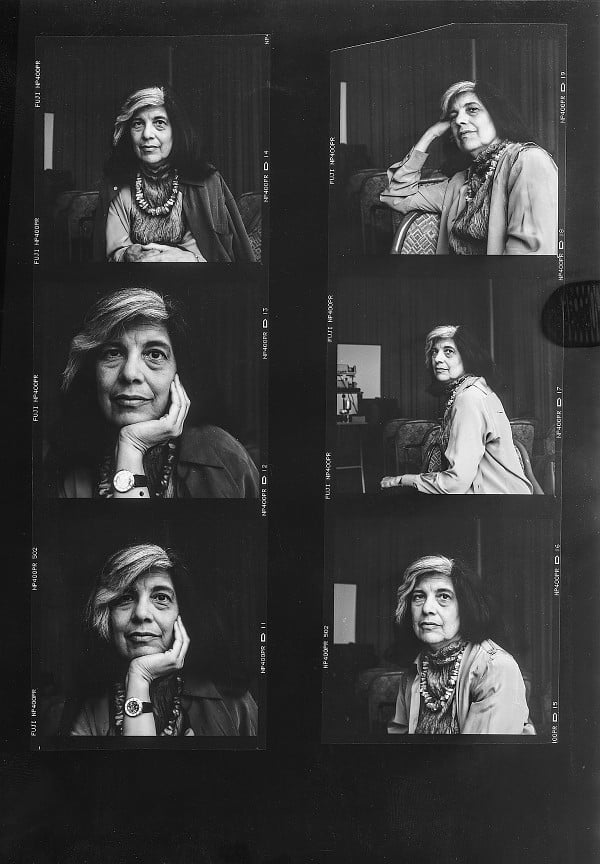
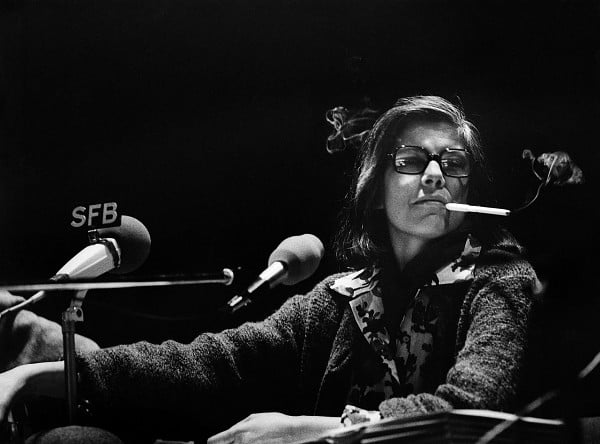
Kristina Jaspers: The exhibition is titled not by chance “Seeing and Being Seen.” We show photographs taken by Andy Warhol, Peter Hujar, or Annie Leibovitz of Sontag, but we also include images Sontag analyzes in her books “On Photography” or “Looking at the Suffering of Others.” Our interest lies precisely in how Sontag contemplates visual politics, self-presentation, representation, and visibility. As a queer Jewish woman, she brings a particular sensitivity to these topics. Sontag does not offer definitive interpretations of how we should see something; she pushes us to look closely and think about the mechanisms of seeing.
Today’s younger queer generations often demand visibility and clear stances. Do you think a figure like Sontag could still function as a queer icon under today’s conditions?
Birgit Bosold: Whether she still functions as an icon is for visitors to decide. With this show, we want to present a figure of queer cultural history whom many younger people may not know anymore. She was, however, an icon for many in the older queer generation—not only because of her writings but also because of her political courage and, of course, her appearance and demeanor—stunningly glamorous and provocatively confident—and we hope she still has something to say to younger generations.
The exhibition also sheds light on Susan Sontag’s relationship with Berlin. What new perspectives about her emerge from this?
Kristina Jaspers: It’s wonderful how many contemporary figures we found who still vividly recall Sontag in Berlin. She first visited in the 1950s with her then-partner Harriet Sohmers, in the 1970s with William S. Burroughs, and later formed friendships with Ulrike Ottinger, Carolin Emcke, or Erika and Ulrich Gregor. The German Academic Exchange Service enabled several longer stays around the time of the turning of the era, and she was a regular at Kino Arsenal. She loved Berlin. In a letter from that period, shown in the exhibition, she writes how much she enjoys Berlin’s atmosphere and how well she could work here. And she even says that Berlin could someday become like New York.
What remains of Susan Sontag today for queer cultural history?
Kristina Jaspers: Carolin Emcke puts it very well in an interview we show in the exhibition. She says: “The generation of Susan Sontag—and I think there are many, many figures like her—lived an incredibly dissident, brave life that the previous generation could hardly imagine and bequeathed to us terms and practices with which we then establish our own terms and practices. From Susan Sontag, what remains is certainly the wildness, not letting oneself be intimidated, not shrinking away when there are voices in the public sphere willing to oppose. From Susan Sontag remains the sense of responsibility for the entire world, not just for one’s own people, but for all who need solidarity, concern, empathy, or advocacy.”
The queer community needs a strong journalistic voice — especially now! Your contribution helps secure TheColu.mn’s work.
Do we today even need to defend Susan Sontag—or should queer memory culture openly narrate her contradictions and blind spots as well?
Birgit Bosold: Why should we defend her? Queer historiography has long leaned a little toward hagiography. We built “Hall of Fame” for the brave heroes of queer emancipation and/or told the stories of persecution. That is understandable. Queer historiography initially had to counter the erasure of queer experience in mainstream history and was always also an instrument of self-assertion. But this has been shifting for some time, and increasingly the aim is to tell our history and historical figures with their sometimes quite problematic complexity.