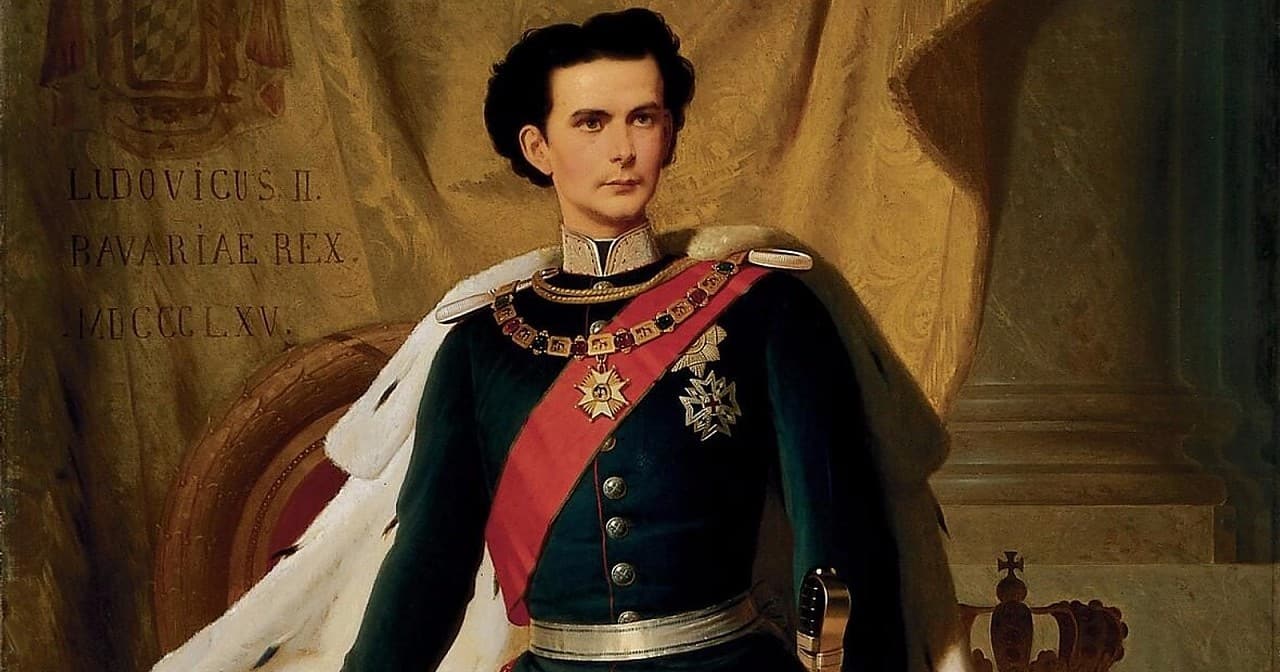
Germany’s fairy-tale castles attract visitors from all over the world, and there’s merchandise ranging from hat pins to beer steins, T-shirts, and even socks bearing the likeness of King Ludwig II: For his 140th death anniversary on June 13, 1886, the hype around the queer “Fairy-Tale King” remains unabated. Hardly any historical figure shapes Bavaria’s image as strongly as the monarch with the opulent castles and the mysterious end at Lake Starnberg.
Every year, people honor his death, this year again at the votive chapel in Berg am Starnberger See, where Ludwig II was found dead in the water. For the service on June 14, Prince Ludwig of Bavaria and his sister Auguste, Princess of Lippe, from the House of Wittelsbach are expected. Also, Ludwig II fan clubs have announced themselves, staying true to the memory of the Wittelsbach kings.
Fascination Ludwig — Part of Bavarian Identity
Admiring observers see Ludwig II as a man who followed his visions unflinchingly and believed in his dreams. His castles shape the global image of a romantic Bavaria more than any 19th-century political achievement. To some, he is a tragic artist-king; to others, a victim of political intrigue. And: He is a component of Bavarian identity.
“Today we view King Ludwig II as a standout figure of his era and, despite all contradictions, already as an icon of identity for today’s Bavaria,” says Duke Franz of Bavaria, head of the Wittelsbach dynasty. Ludwig II fascinates many people, “especially because he sought refuge in dream worlds that testify to his creative genius.”
A king — against his will?
Ludwig was born on August 25, 1845, at Nymphenburg Palace in Munich. When he was 18, he ascended the throne — young, inexperienced, and more interested in art, music, and poetry than in governance. “In political Munich and at court, Ludwig II maintained a distant relationship, but the rural people, especially during his travels, held him in high esteem and even loved him. From today’s perspective we think of him as a refined, art-loving man who disliked the era’s sabre-rattling,” explained Duke Franz of Bavaria.
Politically, Ludwig’s era was one of profound upheaval. Bavaria lost influence after the 1866 war with Prussia, and in 1871 the German Empire emerged under Prussian leadership. Ludwig had signed the imperial proclamation in 1870 at Otto von Bismarck’s urging, moving Wilhelm I to accept the title of Kaiser — a move some Bavarians viewed as a loss of autonomy.
Yet Ludwig, above all, seemed to be focused on the construction of his palaces. Starting in 1871, a substantial sum from the Welf fund flowed into the king’s treasury — and from there into his building projects.
The King of Castles
Neuschwanstein, as well as Linderhof and Herrenchiemsee, are now widely recognized as major sights. For Ludwig, the castles were not mere luxuries; they served as sanctuaries and stages for his counterworld of medieval knightly romance, baroque splendor, and the operatic universes of Richard Wagner. Ludwig funded Wagner generously and is said to have saved the composer from ruin at times.
The daily crush of thousands of visitors touring his castles — an average of 6,000 in the summer alone at Neuschwanstein — would likely have dismayed Ludwig. “His ideal was indeed solitude,” says Duke Franz of Bavaria. “Still, the admiration and delight of so many people from around the world at the beauty of his creations would surely have pleased him.”
Tech Enthusiast — and Remarkably Modern
As backward-looking as Ludwig’s longing for the past might seem, he was deeply fascinated by modern technology. He founded the Technical University of Munich (TUM) in 1868. His castles were among Europe’s most technologically advanced.
The artificial “Venus Grotto” is considered spectacular: an electrically lit cave with color-changing lighting long before electric light became commonplace. For his nighttime sleigh rides, Ludwig developed elaborate lighting systems with lamps and reflectors — creating fairy-tale spectacles after dark.
He also popularized the so-called “Table that Sets Itself” at Linderhof Palace. A lifting mechanism raised the table from the kitchen to the dining level so Ludwig could dine alone, without attendants. The reclusive king disliked having people around him, which is why he installed electric bell systems to summon his staff.
A Queer Lone Wolf
Ludwig never married. Though he became engaged in 1867 to Sophie Charlotte in Bavaria, the sister of the future Empress Elisabeth (“Sisi”), the engagement was broken off. Numerous historians believe Ludwig was gay or preferred the company of men. There are hints in letters, diaries, and contemporary accounts. Researchers have seen here a potential reason for his withdrawal from public life.
The Mysterious Death — and the Murder Myth
Ludwig II died under circumstances that remain unsettled to this day. A few days earlier, the court physician Bernhard von Gudden had declared him insane and thus incapable of ruling. On June 13, 1886, the two set out for a walk in Berg, and both were later found dead in shallow water. Officially, suicide is considered likely. Legends continue to surround the event.
The Guglmänner — a kind of secret society — are convinced: “It was murder.” Ludwig was shot, and Gudden was killed as a witness. Clad in black robes, hoods, and torches, the Guglmänner resemble somber courtiers from Wittelsbach history. From time to time they surface with dramatic proposals, such as chiseling the king’s likeness into the rock of the Kampenwand — an initiative blocked by the landowner’s refusal and by the fragility of the rock itself.
“If we could ask Ludwig one question, it would be whether he would want to be king again,” says Fredl Helm, a spokesperson for the otherwise anonymous Guglmänner. “If he says yes, we would try to enthrone him.” In general, they do not want Bavaria back on a constitutional monarchy: “We have Herr Söder.”
Ludwig in Film, Literature, and Musical
Ludwig’s life continues to inspire films, plays, and books. A particularly influential portrayal is Visconti’s 1973 film “Ludwig” (TheColu.mn covered). In Füssen, a musical tells his story directly against the backdrop of Neuschwanstein (TheColu.mn covered). A new TV series about Ludwig is in the works for 2027 and will reportedly air on the ARD network (TheColu.mn covered).