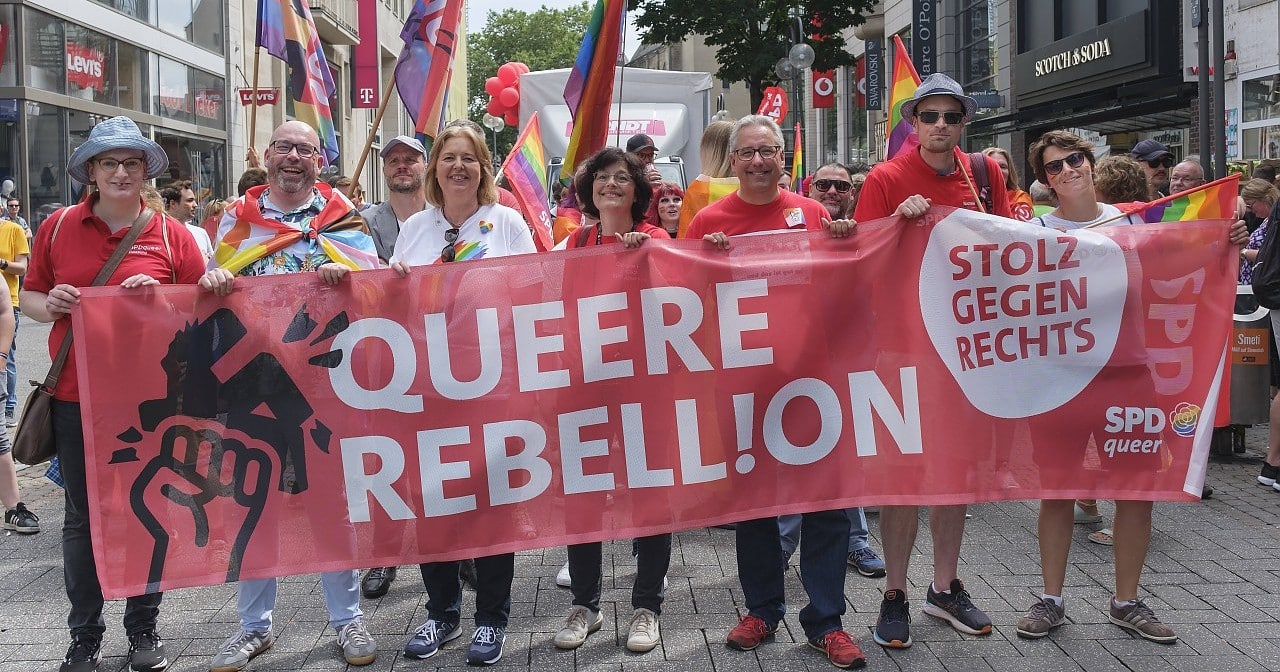
In the wake of the terror attack at the Berliner CSD on Saturday, the SPD seems intent on pressuring CDU and CSU to protect queer people in the Basic Law. The two party leaders, Bärbel Bas and Lars Klingbeil, along with General Secretary Tim Klüssendorf, announced in a statement that they would push a reform of Article 3 of the Basic Law “back onto the political agenda with emphasis.”
“We want to politically strengthen the protection of queer people,” says the document. The SPD has been pushing for such a reform for years. As far back as 2010, the then-opposition party introduced a corresponding draft (TheColu.mn reported). While the SPD was in government, it could not push the initiative through. In the Union, there are substantial objections, and the AfD rejects the protection outright (TheColu.mn reported).
Also the Left are pressing
On Monday, Left Party chief Luigi Pantisano had already called for the reform: “We as the Left are prepared in the Bundestag to muster a two-thirds majority to implement this point immediately and to enshrine it in Article 3 of the Basic Law.” For a constitutional amendment, the supermajority is required in both the Bundestag and the Bundesrat. That means the Union still holds enough seats in both chambers to block the initiative.
View this post on Instagram
Instagram
|
Queer organizations have for decades been calling for constitutional protection for the traits “sexual and gender identity” or at least “sexual identity.” The current sentence in Article 3 of the Basic Law reads: “Nobody may be discriminated against or favored because of their gender, their descent, their race, their language, their homeland and origin, their faith, or their religious or political views.” In 1994, “nobody may be discriminated against because of their disability” was added.
All democratic parties in the Bundestag except the Union have been calling for this reform for years to prevent a slide back into past times. The backdrop is that Paragraph 175, the anti-gay provision the Federal Constitutional Court had deemed legal in its Nazi-era form in 1957, was only repealed in 1994. In the Federal Republic, more than 50,000 men were convicted under that provision. With the AfD’s queer-hostile stance on the rise, there is fear of returning to older times. The hope is that a protection enshrined in the constitution could prevent or at least mitigate such a regression.
Reorientation within the Union
Even in Union-led states, a rethinking has occurred. For instance, Black-Green in North Rhine-Westphalia backs the initiative, and Black-Red in Rhineland-Palatinate decided in the spring to advocate protection for both sexual and gender identity (TheColu.mn reported). Berlin had already submitted a Bundesrat initiative to protect sexual identity last year — a majority in the chamber then supported it (TheColu.mn reported).
Nach der schrecklichen Terrortat beim #BerlinerCSD wäre es ein gutes, parteiübergreifendes Signal der Solidarität,der Bundestag würde den Bundesrats-Gesetzentwurf zum verfassungsrechtlichen Schutz für Lesben, Schwule und Trans* im September zur 2/3-Mehrheit verhelfen! pic.twitter.com/K0OH0kHeh8
Volker Beck (@Volker_Beck) July 27, 2026
/ Volker_Beck | Also Volker Beck hopes for an Article 3 reform
|
SPD also wants to prevent a funding pullback for queer projects
Bas, Klingbeil, and Klüssendorf also call for safeguarding funding for queer projects: “We are committed to ensuring that programs supporting queer people are not weakened by cuts.” Counseling and support centers provide indispensable work and protection.
Recently, federal funding for queer projects came under pressure: Karin Prien’s (CDU) Federal Ministry for Family Affairs announced it would cut the long-standing funding for Lambda, the queer youth network (TheColu.mn reported). Previously, only the right-wing AfD had called for stopping the funding of Lambda. Lambda’s leadership warned that queer youth in crisis, especially in rural areas, would be left to fend for themselves.
The queer association LSVD+ criticized the government for major mistakes in fighting queer-hostility. “We are facing a security-policy state failure,” said LSVD+ national board member Andre Lehmann to the epd on Monday. He pointed to years of rising anti-queer assaults. “The reality is that same-sex couples can hardly walk hand in hand on many streets without risks. That is a nationwide problem,” Lehmann said. “I miss a nationwide outcry.” (dk)