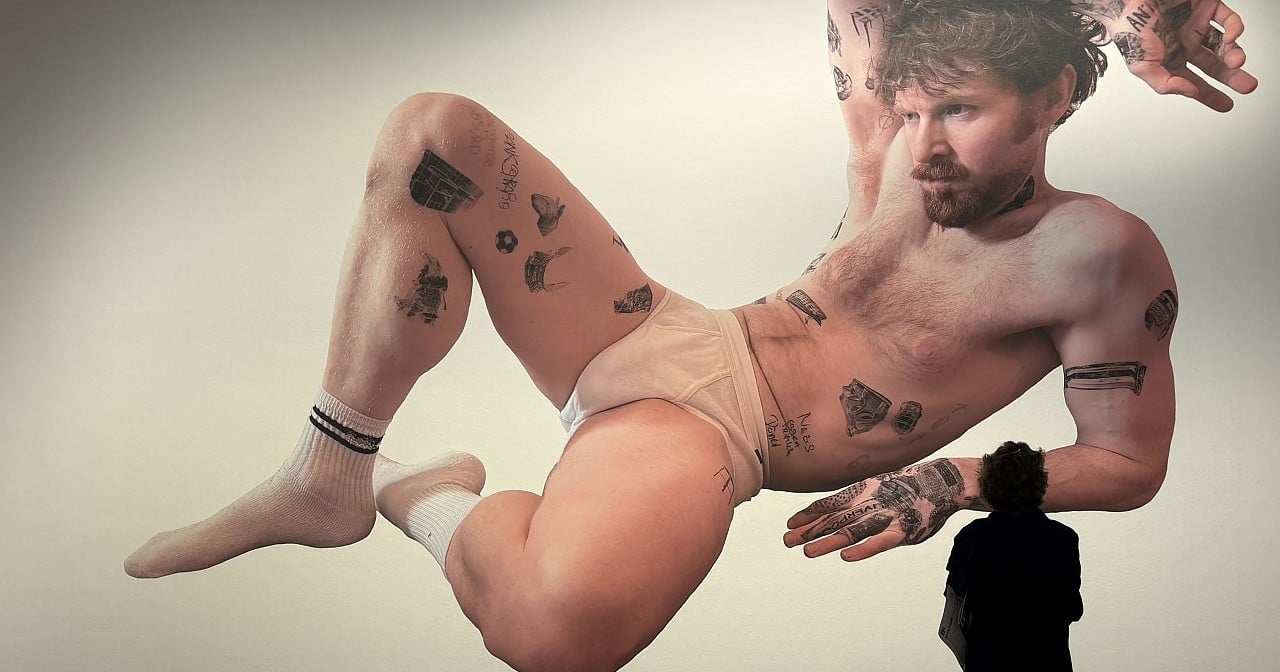
Marc Brandenburg is one of the most singular and successful figures in Berlin’s art scene, shaped by the West Berlin subculture of the 1980s. He is best known for his drawings built from photos he shoots himself or images borrowed from magazines — and for his stance. A frequently cited remark of his goes: “I think stirring confusion is an important driving force that makes people think.”
The Berlinische Galerie has mounted a retrospective titled “20th Century Debris” for the artist born in 1965. On a tour through the exhibition, we spoke with him about what it means for him to be an outsider.
In your show at the Berlinische Galerie you span a wide thematic arc: you present gay pornography, the homeless in sleeping bags, scenes from Berlin’s nightlife — but also pop icons like Michael Jackson.
Yes, oddly enough a film about him was released almost at the same time. I didn’t realize it when the exhibition was being planned. And once again Michael Jackson is omnipresent — and he remains a fascinating pop figure long after his death.
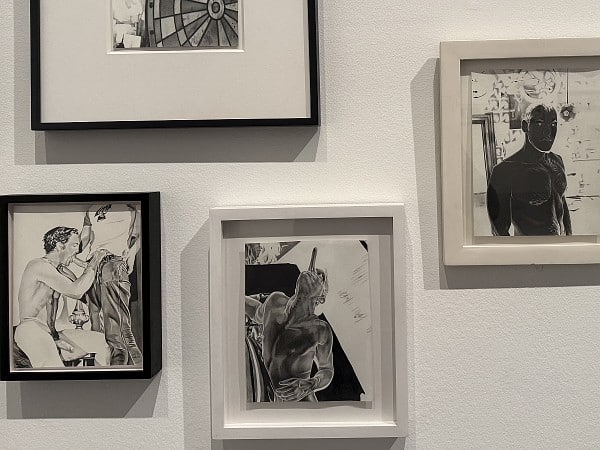
In a drawing that hangs prominently in your new show, you depict Michael Jackson as a negative — all light becomes dark, all dark becomes light. Yet his skin still appears black. Without a caption you wouldn’t really recognize him.
The photo isn’t well known and comes from the Thriller era. By that time his physical appearance had already changed so far that he could no longer be clearly identified ethnically. He wasn’t seen anymore as a Black person, but as Michael Jackson. He remains so famous that — when you hear the name Michael — your first thought is still of him.
There’s an ongoing debate about the abuse allegations…
…I think it’s total nonsense. Everything was done to condemn him — and one shouldn’t forget that during the trial he was perceived again as the Black man. Still, there was an acquittal. That’s all one needs to know. Of course Michael Jackson was a strange person — and thus an easy target. And one can question whether it was appropriate that the children stayed overnight with him. I believe that within the whole system he became too powerful — so powerful that those white children were presented as his own biological children. Without Michael Jackson, there would have been no Obama, his significance was so great.
You once spoke about belonging to a double minority as a Black gay man and always feeling like an outsider. How did that manifest?
I was in my American classroom the only child in an interracial relationship — and I was very introverted. Unbeknownst to myself, I was also gay. Kids just sense that someone is somehow different. It matters how you see the world and how the world looks back at you. But I never felt it was a problem to be an outsider. And then I had not only a white, but also a German mother — giving me a link to a completely different country.
And how did you end up moving to Germany?
My father was a Black GI and he certainly had his problems in the 1960s. At home, everything would eventually explode into violence. Those were formative experiences. I already used drawing to retreat completely into my own world. My mother finally divorced and then, in 1977, moved back to Berlin, with me and my two siblings.
At that time you were twelve. Not long after, you were already moving within West Berlin’s subculture …
My mother was an extra in the film “Schöner Gigolo, armer Gigolo” — the movie with David Bowie and Sydne Rome, shot in Berlin in 1977/78. She took me along to the shoot at Schlosshotel Gerhus. That was a pivotal experience for me. Among the background actors, I first saw the people who belonged to West Berlin’s subculture. By 1979 I was part of it too.
How should you picture that?
I started going out and realized it was more than just nightlife — it became a whole way of life. At fourteen I already had a sense of style and was usually the youngest by far. “Jungle,” “Excess,” “Metropol” — those were the clubs back then. I completely overhauled my life, secretly running away at night, showing up to school the next day with caffeine tablets, then sleeping until midnight. Then it all started again. I didn’t take orders from anyone.
And you had already met many prominent trans people at a young age…
…for me, as a fourteen-year-old, it was completely normal to hang out with Angie Stardust, Jayne County, and Zazie de Paris. Those were the people I grew up with. The best years in Berlin’s subculture were 1980 and 1981, when punk, culture, and left-wing politics all blended. It was a time of upheaval, with many creative figures. Later I also worked in clubs as a bartender and bouncer. That was my cosmos…
…which you later reflected in your work. Do those memories make you nostalgic?
I’m not sure I’d call it nostalgia. You can’t quite imagine it anymore because it was a completely different world. There was no Internet, no social media, and the scene in the city was very small. There were just a few places that glittered, and everyone came together there.
Recently I watched a documentary about West Berlin in 1980 at a cinema in Barcelona, and it made my heart leap. I could smell the coal dust, see the row of buildings with bullet holes, the dirty snow. Those were real winters back then. My companion Adrian thought I’d gone completely over the edge. He couldn’t grasp my enthusiasm, because he’s twenty years younger and doesn’t know that Berlin. Everything was gray and bleak. Yet in all that gloom there was also this amazing scene that could only have developed there. Berlin was, at that time, almost a pariah city.
A city of outsiders in which you felt a sense of belonging as an outsider?
Yes, everyone was different, and that connected people. But being different meant something different for each person; people didn’t really dwell on it.
Did you ever feel excluded in West Berlin because of your skin color?
There weren’t enough people of color for it to really be a topic. Just like in the punk scene I usually moved in, no one greeted you with open arms; it was everyone against everyone. (laughs) The only thing that mattered was that you carried something about you that marked you as an outsider.
Does belonging and being on the outside show up in your work?
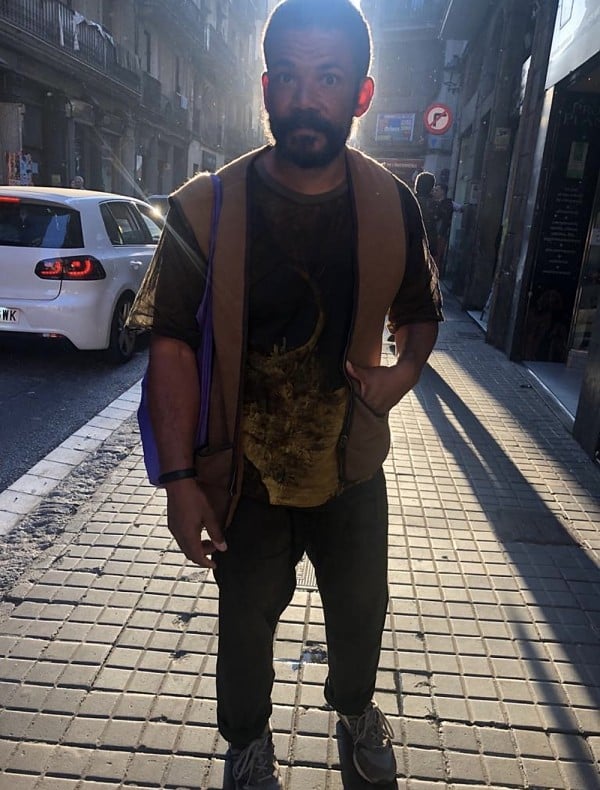
It’s just inside me; I don’t really think about it. Not even in my choice of subjects. It also applies to the masking in my images. For me, it’s normal to depict someone wearing a mask, someone clad in a hood, or turned away. It’s the same with my homeless portraits. Masking and anonymizing go hand in hand. It’s also about creating distance and showing respect.
You once said you’re fascinated by surfaces?
Homelessness, in itself, is part of a larger issue. But there’s also the side of me that simply sees the folds and creases on the sleeping bags. Those are two sides, from which I derive a motif.
To you, surface doesn’t mean the opposite of depth as in classical philosophy, but rather a kind of access through which something or someone can reveal itself?
I translate something into drawings and thereby create an access point for many who would normally walk past the homeless. I draw attention to it, as a kind of conversation starter. I even push this further in my tattoo stickers. There will certainly be people who think I don’t treat it with enough seriousness. But for me, it’s a way to point people toward something.
Is it okay if we talk a bit about your artist name?
I think it’s fine for it to stay unclear whether that’s even a stage name. (laughs)
Your surname surely confuses many people when they meet you. Is that intentional?
People who hear my name naturally assume it’s a white person. It’s a way to nestle into people’s minds; the name doesn’t get forgotten easily. But I’ve been using the name since 1983, long before the fall of the wall. Back then, no one spoke of Mark Brandenburg yet. Essentially, it comes from a time when everyone gave themselves ironic names.
What does the state of Brandenburg mean to you? Is it a no-go area?
One of my best friends lived there, and I visited him once every eight or nine years. He used to say you have to talk to people there. But he’s also easy to listen to; he’s a white old man himself. He has since moved back to Berlin because it got too brown for him. I don’t want to be there; I don’t want that endlessly whining AfD-Nazi energy around me.
The queer community needs a strong journalistic voice — especially now. Support TheColu.mn’s work with your contribution.
What goes through your mind when you see the many Pride parades in Brandenburg’s smaller towns, which have since been launched? Fifteen years ago you described Pride as “carnival.”
That’s something entirely different. I was always an outsider in the gay scene too. Back then it felt a bit too chaotic, too playful, and too square. What happened at Pride events in the late 80s and early 90s was no longer political at all, just a champagne party. Even the sexuality shown didn’t seem provocative anymore, but silly. I felt there was no substance left, only partying. I prefer a more militant approach.
Like the demonstrations in Brandenburg now?
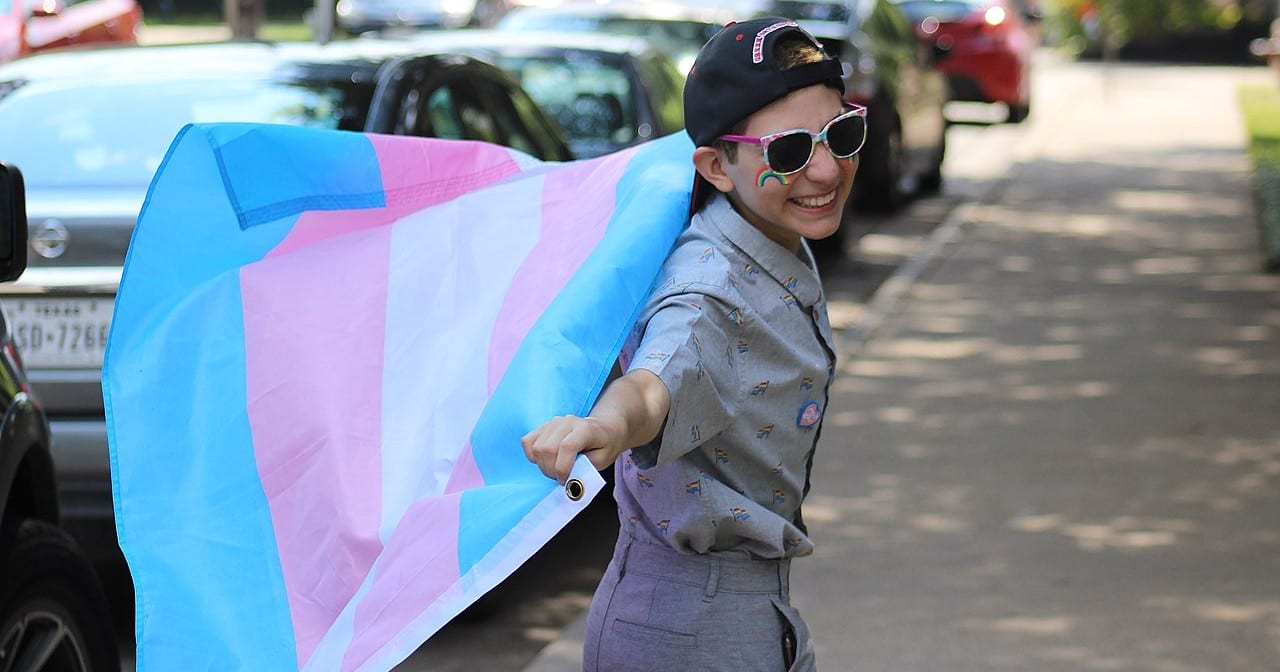
Yes, absolutely. Even if you were now to celebrate a cheerful, colorful Pride, in enemy territory it would have a completely different impact. I would stand up for it, I would always hold the flag high.
Since the early 2000s you’ve been highly successful. Your images hang in the New York Museum of Modern Art, the art magazine Monopol put you on its cover, and your work is shown at international art fairs — not to mention the retrospective now generously presented here at the Berlinische Galerie. Has success changed you?
I don’t think so. In fact, I’m also an outsider in the art scene. When Wolfsburg staged the 1999 “German Open” exhibition introducing the 1990s artist generation, I was one of only two autodidacts who didn’t pursue the traditional academic path. And I’m not strategic at all — I need my freedom. There’s a great documentary about Peter Berlin in which he says he’s constantly waiting to get out of the dinner party vibe and go cruising. I can relate to that; that’s how I operate too.