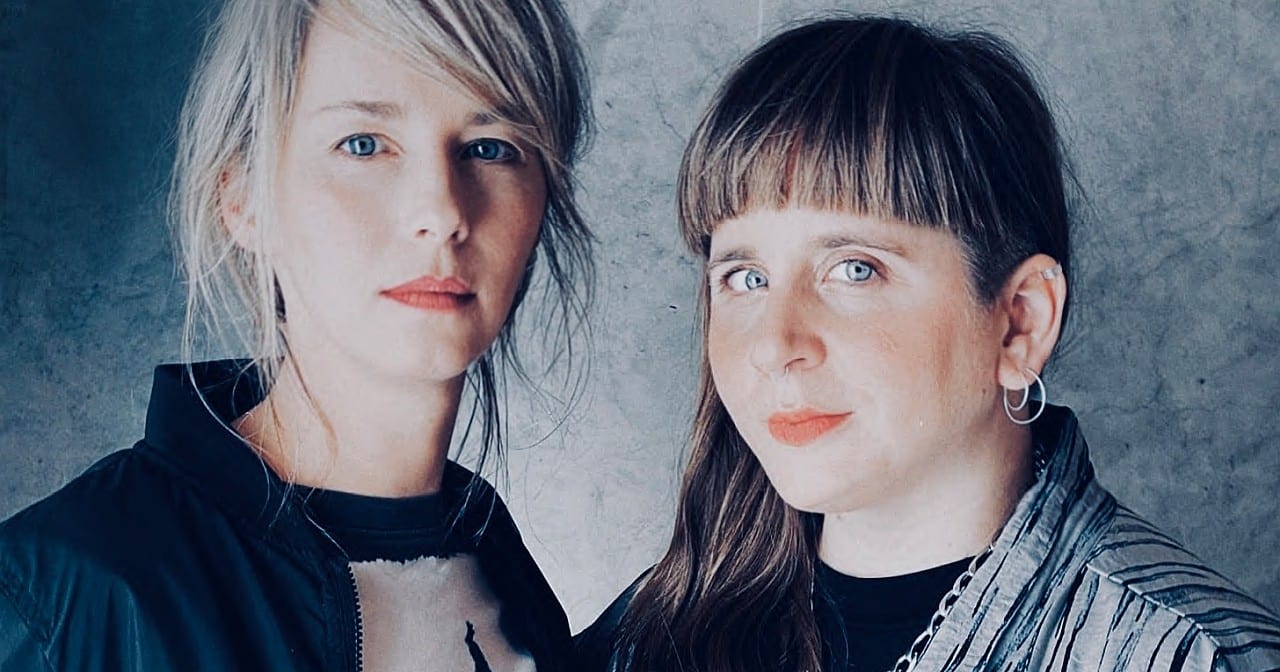
In a moment when political and societal crises are increasingly tangible, the longing for transformation, for a different way of being, could hardly be stronger. “Sirens Call” by Miri Ian Gossing and Lina Sieckmann invites us into the world of the merfolk subculture, where people stage themselves as sea-dwellers in performative ways in search of belonging, identity, and new forms of existence. Oscillating between documentary and fiction, the film Una the Mermaid and Moth sends viewers on a surreal road trip through a politically fractured America.
In conversation with the two directors, Miri Ian Gossing and Lina Sieckmann, we pursue these questions: What role does fluidity play as a queer concept? And how can cinema help reveal new forms of identity and community?
I felt while watching “Sirens Call” that the film is a kind of trans “Nomadland.” Were there cinematic inspirations or queer films that influenced you? Or did you develop a completely autonomous narrative?
Miri: I’d say that as filmmakers we’re not starting from a blank slate. Our influences come from a wide range of sources—from filmmakers and theorists to everyday life, music videos, and pop culture. In particular, the work of friends and artists in our circle left a strong imprint. At the Cologne University of Media, we were mentored by queer video artists who deeply inspired us.
Lina: But it’s also true that “Sirens Call” took shape over six years. It was always a highly process-driven project. We did not begin with a fixed idea of how it should look. Of course, we carry a distinctive artistic handwriting from our prior short films. Yet we started without a finished concept and deliberately embraced open experimentation. Still, there are numerous quotes from works that influenced us.
Miri: Experimental cinema and the New Queer Cinema were especially formative for us. A central theme in “Sirens Call” was engaging with mermaid mythologies—whether Disney’s or Hans Christian Andersen’s. Our aim was to create a new form of siren—one that emancipates itself from the classic male-centered narrative: the aim isn’t to win a man’s love or to surrender one’s own voice. Instead, the film foregrounds new forms of being, a connection to the environment, nature, and technology. Our mermaid seeks community, survival in a crisis-ridden world—and she seeks her chosen family, her chosen relatives.
The film delves deeply into fluidity. How did the idea of linking fluidity as a queer concept with the merfolk subculture come about, and how did you shape a film that is entirely queer?
Miri: The queer aspect of the “mermaid” has always been part of film history—whether in Jack Smith’s Normal Love (1963) or Cher as “Mermaid” (Richard Benjamin, 1990) from a camp perspective. For the people we worked with, the queer and trans perspectives came in so organically. A large portion of our cast identifies as nonbinary and trans; for many, their “Mersona” carries a deep symbolic meaning. Our film can also be read as an expression of a trans existence that transcends species boundaries.
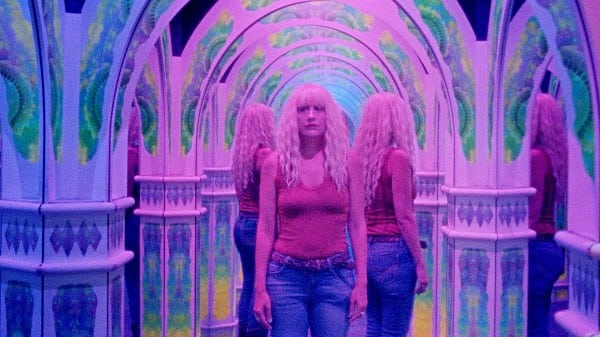
“Sirens Call” opens up a nonbinary space, an in-between. To what extent does this trans potential show up in the film’s storytelling?
Lina: The film traverses different genres—it starts as science fiction, evolves into a road movie, adopts documentary forms, and ends almost in melodrama. For us, it was important to treat it as open-ended experimentation. The opening lab scene symbolizes this open process in which identities, affiliations, and connections are continually renegotiated, with content and form intertwining.
Miri: We were especially interested in breaking genre boundaries. Many queer-themed films still work within traditional narrative structures. We wanted the fluidity of the merfolk world to be reflected on a formal level as well. “Sirens Call” probes the edges between fiction and documentary, toys with hybrid storytelling forms, and withholds the conventional arc of a hero’s journey.
The film centers on the search for belonging and rootlessness—two core experiences for many queer people. As the story unfolds, a steady pursuit emerges. What conclusion did you reach?
Miri: Our aim wasn’t to provide a ready-made answer but to pose questions. Everyone comes with a unique biography and experience. We wanted to invite viewers to engage with perspectives rooted in posthumanism and a “trans being in the world.” The lead character moves through different stages—she begins within a capitalist system where even breath is commodified, then meets Moth, a transgender teen. This encounter brings an authentic connection to the film for the first time. Later, the protagonist finds her chosen family among activists in Portland and discovers her own voice. Yet rather than delivering a conventional “happy ending,” we wanted to show that the search for one’s place, identity, and belonging never fully ends.
Lina: Exactly. We didn’t want to smooth things out or provide a classic ending. The struggle for connection remains a throughline to the end, even after Una meets the other merfolk. We don’t treat identity as something fixed; we’re drawn to the idea of constant becoming—a process that never truly ends. For us, Una embodies a queer temporality that challenges conventional biographical norms.
Direct link | Trailer for the film
|
What was the idea behind letting two distinct trans temporalities—Una as an ancient figure and Moth as a contemporary genderqueer person—collide?
Miri: What was particularly compelling was that Moth herself was transitioning during the production. “Sirens Call” is a hybrid film that blends fiction and documentary. When Una and Moth—who in real life are mother and child—meet as strangers in a new life phase, it’s as if they’re getting to know each other anew. This setup is touching; it can be read as a portrait of a cross-generational trans experience, but also as a bridge between transspecies and transgender identities.
Water plays a central role in the film. Where does the impulse to swim—both metaphorically and literally—come from?
Lina: That’s a question we’d actually ask our protagonists. You can’t easily generalize it. For us, the liquid milieu as a state of matter and medium held a powerful symbolic and physical pull.
Miri: For me personally, water carries enormous meaning. It can buoy you regardless of body or gender, while demanding surrender and trust. As a queer person with a trauma background, existing in water was a crucial learning and healing experience—drifting with the waves. In “Sirens Call” this is echoed in the creative process: we deliberately surrendered to the film’s flow rather than imposing rigid concepts. At the same time, water represents more than just fluidity—it’s in a state of perpetual change, stores memory, is essential to life, and threads through our existence.
How does the body intersect with the Mermaid subculture’s themes?
Lina: The body is a platform for multiple discourses. In our society, we’re often defined by our bodies. In mermaid subculture, there are opportunities to actively shape the body—a kind of “Looking Back.” The film’s protagonists extend their bodies through prosthetics or performances, resisting traditional labels.
Miri: Exactly. “Sirens Call” also engages with themes of illness, disability, immunity, and bodily modification. Many of our protagonists grapple with these issues—whether through personal experiences with illness or through a deliberate expansion of the body. What I found especially exciting is the idea that the body can be a space not only of constraint but of possibility and expansion through prosthetics.
The queer community deserves a strong journalistic voice — especially now! Do your part to support TheColu.mn’s work.
What political implications does “Sirens Call” project outward?
Miri: The film doesn’t hand out ready-made answers; it raises questions that can be negotiated collectively. What motivates me is the resilience of queer communities like ours—our sea creatures—even under political oppression. They forge new forms of community and solidarity. “Sirens Call” invites viewers to reflect on belonging, transformation, and radical empathy.
Your film breaks with traditional storytelling structures and Hollywood narratives. How did dismantling these conventions factor into your approach to queer representation?
Miri: There are countless films you may like that fit those conventions. But how many people actually have a true hero’s journey in their lives? (laughs) It’s the American Dream—who really gets to have a “happy ending”?
Lina: And when we talk about queer narratives, the goal is to discover alternative ways of telling stories. It’s not only about what is told, but also about how it is told. A story can be as radically queer as you want—and if you force it into a conventional dramatic arc, it remains trapped in a binary, heteronormative structure.
Miri: That’s why with “Sirens Call” we aimed to craft something that feels more organic, more like waves than a single peak—and we refused to treat the male orgasm as the driving climax. (laughs) We were also inspired by Kishotenketsu, a narrative approach common in East Asian cinema. Rather than a linear conflict resolution, it unfolds perspectives gradually, with twists that don’t resolve in a traditional sense. Things can stand side by side rather than in opposition. That approach feels much closer to queer experiences for us.
Sirens Call. Hybrid documentary. Germany, Netherlands 2025. Directors: Miri Ian Gossing, Lina Sieckmann. Cast: Gina Rønning as Una the Mermaid, Moth Rønning-Bötel. Runtime: 121 minutes. Language: English original with German subtitles. Rating: 12+. Distributor: missingFILMs. Theatrical release: April 30, 2026