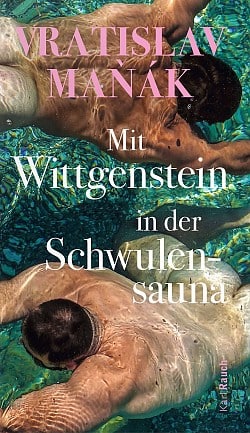
One should not judge a book by its cover. But just in case we dare: the essay collection “With Wittgenstein in the Gay Sauna” (Amazon affiliate link) not only carries the spring’s, by far, most beautiful title. It also features what is arguably the season’s most enticing cover.
Two naked men swim side by side. The Greek photographer Michalis Goumas captured them for his intoxicatingly beautiful series “Summer Renaissance” — shot from a bird’s-eye view, so their faces are not visible. Tanned bodies, sun-kissed buttocks that caught less sun, muscles, dark hair. The sunbeams glitter in the water and on the skin.
Gay, not queer culture
But it’s not only the cover that impresses. The content of the essay collection is also worth exploring. Czech journalist and writer Vratislav Maňák engages with gay culture places and practices.
Yes, it explicitly concerns the culture of the gay community, the author writes in his preface. He is aware that it may feel “a little old-fashioned” to write about “gay identity in all the diversity of its manifestations.” Yet precisely because the queer world is not one-dimensional, he does not want to borrow someone else’s voice for even a moment.
From opera to the queer club in Berlin
Gay men like to party, they love the opera, they enjoy casual sex in saunas or cruising in parks—these are, of course, stereotypes. Yet anyone who goes through the world with open eyes will realize they have a grain of truth.
And that is exactly what Vratislav Maňák, born in 1988, does. He observes, analyzes, interprets. His essays are each anchored in a Central European city. Each place is tied to a gay cultural practice: encounters in a Budapest bath, the Bratislava Pride Parade, gay saunas in Vienna, an opera visit in Brno, cruising in Prague, and Berlin’s queer club culture.
Feature reports as cinema in the mind
Vratislav Maňák knows how to describe the places not only precisely but with devotion. How he portrays the bustling activity of Budapest’s Rudas bath or the hedonistic, sexy atmosphere of Berlin’s KitKat Club truly makes you feel part of the events, without actually being there. He masters the form of reportage as cinema in the mind.
Yet this is far more than vivid descriptions: the places serve as starting points for thinking about and philosophizing the developments within gay culture — in the truest sense of the word.
How much should a Pride parade provoke?
Each piece is simultaneously a cultural and social analysis, drawing on influential traditions of thought: with the ideas of queer theorist Eve Kosofsky Sedgwick on male intimacy, he explains why Budapest’s Rudas Bath is such a special place.
He taps the ideas of Frantz Fanon, the pioneer of decolonization, and journalist Manuela Kay to criticize the Bratislava Pride as too tame and harmless. One does not want to provoke the hostile parts of society; instead of excess, there is a “humble bourgeois defilé.” “The will to consensus,” which characterizes the Bratislava Pride — and not only there — is “also an assault on integrity.” For who can a gay man be if his homosexuality is to play no role at all?
The complex thinker Wittgenstein in a salacious place
With philosophers Michel Foucault, Roland Barthes, and the titular Ludwig Wittgenstein, Vratislav Maňák explores the Kaiserbründl, Vienna’s best-known “men’s sauna,” which back in the days of the dual monarchy was still called Centralbad. “I allow myself a fantasy,” Maňák writes, “I imagine Ludwig Wittgenstein walking into the Centralbad.”
Using this thought experiment as the title, of course, is provocative — and therefore exceptionally well chosen. To bring one of the most important philosophers of the last century, a complex and elusive thinker who also lived his own homosexuality largely in secret, to a salacious and sexually charged place opens a field of tension.
The queer community needs a strong journalistic voice — especially now! Make your contribution to support the work of TheColu.mn.
Maňák challenges Wittgenstein
Yet it is far from mere provocation: Vratislav Maňák manages to derive meaningful insights from it. This concerns not only Wittgenstein’s perhaps best-known maxim, that one must remain silent about that which one cannot speak of — for although speaking about the visit to the Kaiserbad is difficult for Maňák, he dares to do so. He also disagrees with the philosopher’s view of the body: Wittgenstein argued that we do not need to reflect on our bodies. But visiting a gay sauna can contradict that, because there one can “unite the subject with his physique in unprecedented intensity and in a qualitatively new way.”
Those are conclusions that are not easily put into words, and their full meanings unfold only when reading the entire work. Maňák’s thoughts are indeed complex, but there is joy in following them. That owes much to translator Lena Dorn, who has managed to render even the most intricate sentences in a way that remains comprehensible.
Ambitious and entertaining at the same time
Here and there one may disagree with Maňák’s analyses, yet in many places one finds oneself nodding in agreement: the interpretations are sound and insightful, and one might simply not have given such careful thought to these issues before. With the form of the analytical-literary reportage essay, Vratislav Maňák has created a whole new, promising genre.
The book’s great achievement, which goes beyond the individual illuminating essays: the volume makes clear that contemporary gay everyday culture, the gay enthusiasm for opera, or the desire for anonymous sex are topics worth thinking about. And that one can write about them in a way that is demanding, sharply pointed, and at the same time entertaining and humorous.
Vratislav Maňák: With Wittgenstein in the Gay Sauna. Sociological Considerations. Translated from Czech by Lena Dorn. 192 pages. Karl Rauch Verlag. Düsseldorf 2026. Hardcover: 26 € (ISBN 978-3-7920-0243-8)